


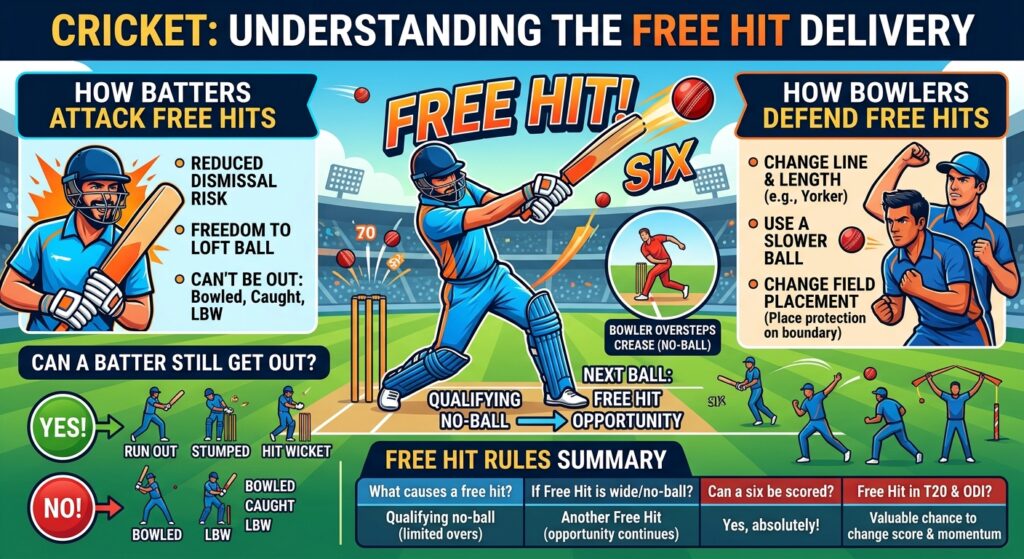
A free hit in cricket is one of the most exciting moments in limited-overs cricket. When a batter gets a free hit, the next delivery gives them a valuable chance to attack the bowler without worrying about some of the most common forms of dismissal.
You will often hear commentators say, “This is a free hit,� just before the bowler starts the next delivery. The fielding captain usually changes the field, while the batter looks for a boundary. In T20 and ODI cricket, free hits can have a major impact because one delivery can quickly change the score and momentum of an innings.
But what exactly is a free hit? Why is it awarded? Can the batter still get out? Does a free hit count as a legal delivery? This guide explains the free hit cricket rules in simple language for beginners.
What Is a Free Hit in Cricket?
A free hit is a delivery on which the batter has protection from certain types of dismissal after a qualifying no-ball.
Under the applicable limited-overs playing conditions, when a bowler delivers a no-ball that triggers the free-hit provision, the following delivery is a free hit.
The idea is straightforward: the bowler has already committed an illegal delivery, so the batter receives an extra opportunity to attack on the next ball.
For example:
- Ball 1: Bowler delivers a no-ball.
- Ball 2: Free hit.
- Ball 2 must be delivered again as a legal delivery unless another no-ball or wide occurs.
The exact circumstances that trigger a free hit depend on the playing conditions of the competition.
Why Is a Free Hit Given?
The free-hit rule is designed to give the batting side an advantage after certain no-balls.
A no-ball is an illegal delivery, and the batting team receives an additional run. The ball also does not count as one of the six legal deliveries in the over.
In limited-overs cricket, the following delivery can become a free hit.
This creates an interesting contest because the batter knows that some common dismissals are temporarily unavailable, while the bowler has to find a way to prevent the batter from taking advantage.
When Does a Free Hit Happen?
The most common situation is when the bowler delivers a no-ball that qualifies for a free hit under the relevant playing conditions.
For example, imagine a bowler oversteps the crease while delivering the ball.
The batting team receives the applicable penalty run, and the next delivery becomes a free hit.
The scoreboard may show something like:
Score: 76/3
No-ball: +1
Next ball: Free hit
The batter now has an excellent opportunity to increase the score.
Is Every No-Ball Followed by a Free Hit?
This is an important point for beginners.
You should not assume that every no-ball in every form of cricket automatically produces a free hit. The free-hit provision is part of the playing conditions used in certain limited-overs competitions.
Therefore, the exact rule can depend on the competition and its regulations.
In modern international ODI and T20 cricket, qualifying no-balls are followed by a free hit.
Can a Batter Get Out on a Free Hit?
Yes, a batter can still be dismissed on a free hit.
The free-hit rule does not make the batter completely immune from dismissal.
What changes is that certain methods of dismissal are not available from the free-hit delivery.
For example, a batter cannot normally be dismissed:
- Bowled
- Caught
- LBW
from the free-hit delivery.
However, other dismissals can still occur in appropriate circumstances.
Run Out
A batter can be run out during a free hit.
Suppose the batter attempts to hit the ball and starts running. A fielder collects the ball and breaks the wicket before the batter reaches the crease.
The batter can be given out run out.
Stumped
A stumping can also be possible if the relevant conditions are met and the batter leaves the crease while the wicketkeeper legally breaks the wicket.
Hit Wicket
Depending on the circumstances, a batter can also be dismissed hit wicket.
So, calling it a “free hit� does not mean the batter is allowed to do anything without consequences.
What Happens If the Free Hit Is a Wide?
A free hit remains a free-hit opportunity until a legal delivery is completed, subject to the applicable playing conditions.
If the bowler delivers a wide during a free hit, the batting team receives the wide penalty and the next delivery remains a free hit.
For example:
No-ball → Free hit
If the free-hit ball is wide:
Wide → Free hit again
The bowler therefore has to deliver a legal ball before the free-hit opportunity is completed.
What If the Free Hit Is Another No-Ball?
This situation can be particularly frustrating for the bowling team.
Suppose:
Delivery 1: No-ball
Delivery 2: Free hit, but another no-ball
The batting team receives the no-ball penalty, and the next delivery is again a free hit.
So the sequence can continue if the bowler keeps delivering qualifying no-balls.
This is one reason bowlers need to maintain control when bowling a free-hit delivery.
Does a Free Hit Count as a Ball in the Over?
A free hit itself does not have a special status regarding whether it counts as a legal delivery.
If the free-hit delivery is legal, it counts as one of the six legal balls in the over.
If it is a wide or no-ball, it does not count as a legal delivery.
For example:
| Delivery | Result | Counts as Legal Ball? |
|---|---|---|
| 1 | No-ball | No |
| 2 | Free hit, legal delivery | Yes |
| 3 | Normal legal delivery | Yes |
| 4 | Wide | No |
| 5 | Free hit, legal delivery | Yes |
This distinction is important when following the scorecard.
Can a Batter Score Six on a Free Hit?
Absolutely.
A six on a free hit is completely legal if the delivery itself is legal and the ball is hit over the boundary without bouncing inside the field.
In fact, batters often become more aggressive during free hits because they know they cannot normally be dismissed by being caught, bowled, or LBW.
A free hit can therefore produce:
The batter still has to execute the shot correctly.
Why Do Batters Attack Free Hits?
The biggest reason is reduced dismissal risk.
Imagine a batter is facing a normal delivery. A powerful shot could result in a catch.
During a free hit, a catch does not normally result in the batter being dismissed because caught is one of the protected methods.
That gives the batter more freedom to attempt aggressive strokes.
Common options include:
- Lofted drives
- Pull shots
- Hook shots
- Sweeps
- Reverse sweeps
- Slog shots
- Straight hits
The exact shot depends on the bowler, field placement, pitch conditions, and batter’s strengths.
How Do Bowlers Defend Against a Free Hit?
A free hit can put pressure on the bowler, but good bowlers still have several ways to limit the damage.
Change the Line
A bowler may move the ball away from the batter or attack a different area of the pitch.
Change the Length
Instead of bowling a predictable delivery, the bowler may use a yorker, slower ball, bouncer, or another variation permitted by the laws and playing conditions.
Use a Slower Ball
A slower delivery can make it difficult for the batter to generate power.
Change the Field
The captain can move fielders according to the applicable fielding restrictions.
For example, a captain may place more protection on the boundary in areas where the batter is most likely to attack.
Free Hit and Field Changes
Free hits can create an interesting tactical battle between the captain and batter.
Before the delivery, the fielding captain may consider where the batter is likely to hit.
If the batter is known for strong leg-side hitting, the captain might place additional protection in that area, subject to the fielding restrictions.
The batter may then notice the field and change their intended shot.
This makes a free hit more than simply a chance to swing the bat. It is also a tactical contest.
Free Hit in T20 Cricket
Free hits are particularly important in T20 cricket.
A T20 innings contains only 20 overs, so teams constantly look for ways to score quickly.
A free hit can be extremely valuable because the batter can attack with less risk of a conventional dismissal.
For example, a team scoring at 9 runs per over could suddenly score 15 or 20 runs from an over containing a no-ball, free hit, and boundary.
Example
Suppose the over begins like this:
| Ball | Result | Runs |
|---|---|---|
| 1 | No-ball | 2 |
| 1 Free Hit | Six | 6 |
| 2 | Single | 1 |
| 3 | Dot ball | 0 |
| 4 | Four | 4 |
| 5 | Single | 1 |
| 6 | Two runs | 2 |
Total:
2 + 6 + 1 + 0 + 4 + 1 + 2 = 16 runs
A single no-ball followed by an attacking free hit has helped produce a very expensive over.
Free Hit in ODI Cricket
The same basic concept applies in One Day International cricket under the applicable playing conditions.
However, the strategy can differ depending on the stage of the innings.
During the early overs, a batter might take a calculated risk because fielding restrictions can create gaps.
During the final overs, a free hit can become even more dangerous because the batting team is already looking for boundaries.
A six or four from a free hit can significantly improve the team’s final total.
Free Hit Rules: Quick Summary
| Question | Answer |
|---|---|
| What causes a free hit? | A qualifying no-ball under applicable limited-overs playing conditions |
| Does a free hit count as a ball? | Yes, if the delivery is legal |
| Can the batter hit a six? | Yes |
| Can the batter be caught? | Not normally from the free-hit delivery |
| Can the batter be bowled? | Not normally |
| Can the batter be LBW? | Not normally |
| Can the batter be run out? | Yes |
| Can a free hit be a wide? | Yes |
| If the free hit is a wide, is there another free hit? | The free-hit opportunity continues under the applicable conditions |
| Can another no-ball produce another free hit? | Yes, where the free-hit provision applies |
Common Misunderstandings About Free Hits
One common misconception is that a batter cannot be dismissed at all during a free hit. That is incorrect.
Another misunderstanding is that a free hit is an extra ball added to the over. It is better to think of it as a special status attached to the next delivery, not as an additional type of delivery.
A third misconception is that free hits exist in exactly the same way in every type of cricket.The rules can differ between formats and competitions, so the relevant playing conditions should always be checked.
Final Thoughts
The free hit in cricket is one of the most exciting rules in modern limited-overs cricket. It gives the batting team an opportunity to attack after a qualifying no-ball while placing additional pressure on the bowler.
For beginners, the easiest way to remember the rule is this: a qualifying no-ball can lead to a free hit on the next delivery in limited-overs cricket.
The batter cannot normally be dismissed by being caught, bowled, or LBW from that free-hit delivery, but they are not completely safe. Run outs, stumpings, and other applicable dismissals can still occur.
Because T20 and ODI cricket are often decided by small margins, a single free hit can make a noticeable difference. A well-timed six can change the momentum instantly, while a clever slower ball or well-placed fielder can help the bowling team survive the danger.
That balance between opportunity and pressure is what makes the free hit such an important and entertaining part of modern cricket.
