


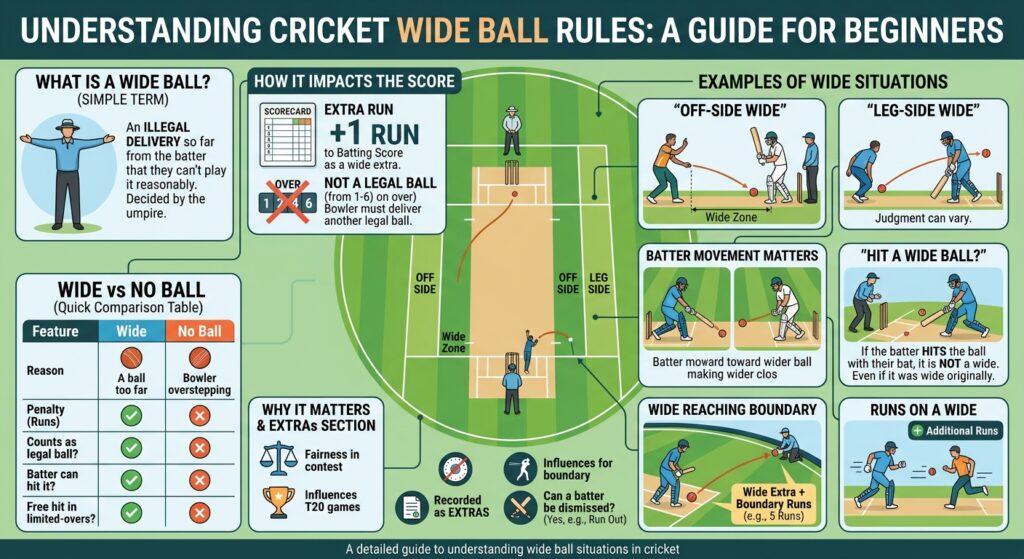
A wide ball is one of the simplest rules in cricket, yet it can sometimes cause confusion for people who are new to the game. You may hear the umpire call “wide,” see an extra run added to the scoreboard, and notice that the ball does not count as part of the over. But why is a delivery called wide, and what exactly happens after the umpire makes the call?
In cricket, a “Cricket Wide Ball Rules” is called when a bowler delivers the ball so far away from the batter that the umpire considers the batter to have had no reasonable opportunity to play it with the bat. The exact judgment depends on the laws of cricket and the playing conditions being used.
A wide is important because it gives the batting team an extra run and means the delivery does not count as one of the six legal balls in an over. The batter can also score additional runs from a wide delivery in certain situations.
Understanding wides is useful for both cricket players and spectators because wides can influence the score, the length of an over, and sometimes the result of a close match.
What Is a Wide Ball in Cricket?
A wide ball is an illegal delivery that passes the batter outside the area where the batter could reasonably be expected to play the ball with the bat.
When the umpire calls a wide, the batting team receives the applicable wide-ball penalty.
The important points are:
- A wide gives the batting side an extra.
- The delivery does not count as one of the six legal balls in the over.
- Additional runs can sometimes be scored.
- The umpire decides whether the delivery is wide.
- The judgment can depend on the batter’s position and the relevant playing conditions.
The purpose of the rule is to prevent bowlers from deliberately bowling extremely far away from the batter simply to make the ball difficult or impossible to hit.
Why Is a Wide Ball Called?
The basic idea behind the wide rule is fairness.
A bowler should challenge the batter without making the ball so far away that the batter has no reasonable chance to play it.
For example, imagine a right-handed batter standing normally at the crease. If the bowler sends a ball far outside the batter’s reach on the off side, the umpire may call it a wide.
However, the decision is not based only on a fixed distance from the stumps. The batter’s movement and position can also affect the decision.
This is one reason why two deliveries that appear similar can sometimes receive different calls.
How Many Runs Is a Wide?
Under the Laws of Cricket, a wide results in one run being added to the batting side’s score as a wide extra, unless additional runs are completed or awarded.
For example:
One wide = 1 run
But a wide can produce more than one run.
Suppose the ball is bowled wide and the batters run three additional runs. The batting team can receive the wide penalty plus the completed runs.
Similarly, if the ball goes all the way to the boundary without being touched by the bat, the resulting total can be higher than one run.
This is why bowlers must control wide deliveries carefully.
Does a Wide Count as a Ball?
No.
A wide does not count as one of the six legal deliveries in an over.
This is one of the most important things to remember.
Imagine a bowler has delivered five legal balls. On the next delivery, the ball goes wide.
The umpire calls wide.
The over still contains only five legal deliveries.
The bowler must therefore deliver another legal ball before the over can be completed.
Example
| Delivery | Result | Legal Balls Completed |
|---|---|---|
| 1 | Dot ball | 1 |
| 2 | Single | 2 |
| 3 | Wide | 2 |
| 4 | Two runs | 3 |
| 5 | Dot ball | 4 |
| 6 | Wide | 4 |
| 7 | Four | 5 |
| 8 | Single | 6 |
The bowler has delivered eight actual balls but only six legal balls.
This demonstrates why wides can make an over contain more than six deliveries.
Wide Ball vs No Ball
Wide balls and no-balls are both illegal deliveries, but they are not the same thing.
A wide is generally related to the ball being outside the batter’s reasonable reach.
A no-ball occurs when the bowler or fielding side breaches one of the relevant laws governing a legal delivery.
Both can give the batting team an extra, and neither counts as one of the six legal balls.
| Feature | Wide | No Ball |
|---|---|---|
| Basic issue | Ball too far from batter | Delivery or fielding infringement |
| Extra awarded | Usually 1 | Usually 1 |
| Counts as legal ball? | No | No |
| Can batter score additional runs? | Yes | Yes |
| Free hit in many limited-overs competitions | Usually no | Often yes, depending on rules |
The exact scoring and free-hit arrangements can depend on the competition’s playing conditions.
Can a Batter Hit a Wide?
A batter can physically hit a ball that would otherwise be considered wide.
However, if the batter makes contact with the ball using the bat, the delivery is generally not recorded as a wide simply because it originally appeared outside the batter’s reach.
This is an important distinction.
For example, a batter may move across the crease and reach a ball that would have been called wide had the batter remained in the original position.
The umpire considers the batter’s position and movement when judging the delivery.
Batter Movement and Wide Decisions
Batter movement is one of the more interesting parts of the wide rule.
A batter is not required to remain completely stationary after taking guard.
Batters can move around the crease to change the angle of the bowler’s delivery.
However, this can affect whether a ball is considered wide.
Suppose a batter moves far toward the off side before the ball is delivered. A delivery that would normally be outside the batter’s reach might now be closer to the batter.
Likewise, if the batter moves dramatically toward the leg side, a delivery on the off side may become more difficult to reach.
Umpires must therefore judge the ball in the context of the batter’s position.
Wide Ball on the Leg Side
Leg-side wides can be particularly interesting.
In many situations, a ball passing behind the batter’s body on the leg side can be called wide if it is outside the permitted area.
However, the exact judgment depends on the batter’s position, movement, and the relevant playing conditions.
A bowler cannot simply send every ball behind the batter and expect it to be legal.
The purpose of the rule is to ensure that the batter has a reasonable opportunity to play the delivery.
Wide Ball Outside Off Stump
Deliveries outside off stump are common areas for wide calls.
Fast bowlers and spin bowlers may attempt to move the ball away from the batter, but if they go too far outside the batter’s reasonable reach, the umpire can call wide.
This becomes especially important in limited-overs cricket, where bowlers often try to force batters to reach for deliveries outside off stump.
A bowler needs to find the right balance between bowling close enough to challenge the batter and wide enough to make the shot difficult.
Going too far can simply give away an extra run.
Wide Ball and the Boundary
A wide can reach the boundary without the batter touching it.
If the ball passes the batter and travels to the boundary, the batting team may receive the applicable wide penalty plus the boundary allowance under the Laws.
For example, a delivery called wide that goes directly to the boundary can result in five runs being recorded as wides in the standard situation.
This is a very expensive mistake for a bowler.
Instead of giving away one run, the bowler may effectively concede a boundary plus the wide penalty.
Can Batters Run on a Wide?
Yes.
Batters can run when the ball is called wide.
If the ball remains in play and the batters complete runs, those runs can be added to the score according to the Laws.
For example, if a wide is bowled and the batters run one additional run, the total scoring from the delivery can be two runs.
The wicketkeeper may attempt to stop the ball and prevent the batters from taking additional runs.
This is why wicketkeepers need to remain alert even after the umpire has called wide.
Wide Balls and the Wicketkeeper
The wicketkeeper plays an important role in controlling wides.
A fast delivery slightly outside the batter’s reach may travel quickly toward the boundary. If the wicketkeeper moves quickly and stops it, the batting side may receive only the wide penalty.
If the keeper fails to stop it, the batters may run additional runs.
For this reason, wicketkeepers practice their movement from side to side and work on judging the direction and speed of the ball.
A good keeper can save several runs over the course of an innings.
Why Wides Matter in T20 Cricket
Wides can be particularly damaging in T20 cricket because teams have only a limited number of deliveries to score.
A wide does two things at the same time:
- It adds an extra run.
- It gives the batting side another delivery.
That second point is extremely important.
Suppose a team is chasing 10 runs from the final over. The bowler sends down a wide.
The batting team immediately receives an extra run, and the ball must be bowled again.
The target has effectively become easier while the batting side still has the same number of legal deliveries remaining.
A single wide may not look significant, but several wides can quickly change a match.
Wides in Test Cricket
Wides matter in Test cricket too, although the tactical situation is different.
Test matches provide far more deliveries than T20 games, so a single wide usually has less immediate impact.
However, repeated wides can still frustrate a captain and give the batting team easy runs.
In a long innings, bowlers are expected to maintain discipline. Unnecessary wides can allow the opposition to score without having to play a proper cricket shot.
Wides in One-Day Cricket
In One-Day cricket, wides are also important because teams have a fixed number of overs.
Bowlers need to maintain accuracy while also trying to take wickets.
A wide costs an extra run and uses up another delivery before the required legal ball count is completed.
During the final overs, even one unnecessary wide can be costly because the batting team is usually trying to maximize every available scoring opportunity.
How Umpires Signal a Wide
The umpire has a recognizable signal for a wide.
The umpire extends both arms horizontally to the sides.
This signal tells the players and scorers that the delivery has been called wide.
In professional cricket, the decision is also communicated through the scoreboard and television graphics.
The signal needs to be clear because the scorers must record the correct type of extra.
Common Reasons Bowlers Bowl Wides
There are many reasons a bowler may deliver a wide.
1. Poor Line and Length
The bowler simply misses the intended target.
2. Excessive Movement
Swing or seam movement can take the ball farther away than expected.
3. Pressure
A bowler may try too hard to avoid giving the batter a scoring opportunity and end up bowling too wide.
4. Poor Execution at the End of an Innings
Death bowling requires exceptional accuracy. Under pressure, a bowler can easily miss the intended line.
5. Batter Movement
The batter can move across the crease, changing the effective target area.
How Bowlers Can Reduce Wides
Good bowlers work constantly on reducing unnecessary wides.
They can improve by:
- Practicing a consistent run-up
- Maintaining a repeatable release point
- Watching the batter’s movement
- Understanding the pitch
- Controlling swing and seam
- Practicing different lines
- Staying calm under pressure
Accuracy becomes especially important in limited-overs cricket because every delivery has a significant value.
How Wides Affect the Scorecard
Wides are recorded as extras rather than runs scored from the bat.
Suppose a team scores 250 runs and has 12 wides.
Those wides are included in the team’s total but are not credited to individual batters.
A scorecard might therefore show something like:
| Type of Extra | Runs |
|---|---|
| Wides | 12 |
| No-balls | 2 |
| Byes | 5 |
| Leg byes | 8 |
| Total Extras | 27 |
In this example, 27 runs came from extras.
This helps distinguish between runs scored through batting and runs conceded through errors or other extras.
Can a Batter Be Dismissed on a Wide?
A wide does not normally allow the usual batting dismissals such as bowled, caught, or LBW in the same way as a legal delivery.
However, a batter can still be dismissed in certain circumstances during a wide.
For example, a run-out can occur if the batters attempt to run and a fielder breaks the wicket before the relevant batter reaches the crease.
The exact dismissal possibilities are governed by the Laws of Cricket.
Why the Wide Rule Is Important
The wide rule keeps the contest between batter and bowler fair.
Without it, a bowler could simply send the ball far outside the batter’s reach whenever the batter looked dangerous.
That would make batting unnecessarily difficult and would reduce the importance of skillful shot-making.
The wide rule encourages bowlers to challenge batters with accurate deliveries rather than simply avoiding the bat.
Simple Example of a Wide
Imagine a bowler is trying to bowl a delivery just outside off stump.
The ball moves further away from the batter than expected.
The batter cannot reasonably reach it.
The umpire calls wide.
The batting team receives one run.
The ball does not count as one of the six legal deliveries.
The bowler must bowl another legal delivery.
If the wicketkeeper stops the ball immediately, the batting side may receive only the wide penalty.
If the ball gets past the keeper and the batters run, additional runs may be added.
If the ball reaches the boundary, the total can become much larger.
Final Thoughts
Cricket wide ball rules are designed to make the contest between bat and ball fair while also penalizing bowlers who fail to maintain control.
The basic rule is simple: when a delivery is too far away from the batter to provide a reasonable opportunity to play it, the umpire can call it a wide according to the applicable laws and playing conditions.
A wide normally gives the batting team an extra run and does not count as one of the six legal deliveries in an over. Additional runs can also be scored if the ball travels away from the wicketkeeper or reaches the boundary.
For bowlers, wides are frustrating because they provide runs without requiring the batter to play a successful shot. For batters, they are useful opportunities to increase the score and receive another delivery.
Once you understand the wide rule, many aspects of cricket scoring become easier to follow. The next time an umpire stretches both arms to signal a wide, you will know exactly what it means and why the bowler must deliver another legal ball before completing the over.
