


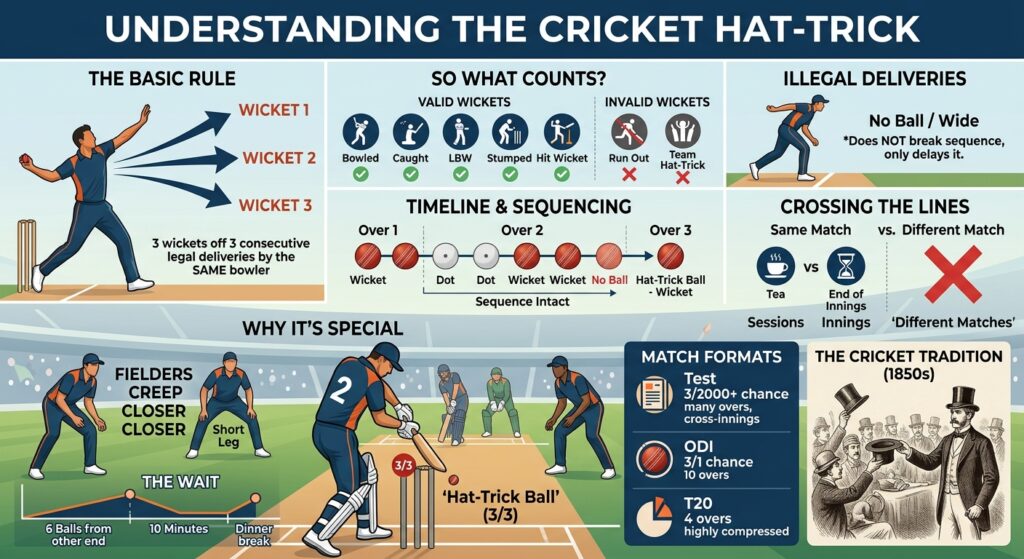
There’s a particular kind of silence that falls over a cricket ground when a bowler has just taken two wickets in two balls. You can feel it even through a TV screen — fielders creeping in a little closer, the crowd leaning forward, someone in the commentary box lowering their voice like they’re afraid to jinx it. That’s the hat-trick in cricket. And honestly, even people who’ve watched cricket for years sometimes get a little fuzzy on the actual rules once you start asking specific questions. Does it have to happen in one over? Do run-outs count? Can it happen across two different innings?
Let’s clear all that up properly.
The Basic Idea about Hat-Trick in Cricket
A hat-trick happens when one bowler dismisses three different batters using three balls in a row. Not three wickets in a spell, not three in the same over necessarily — three consecutive deliveries, bowled by that one player, with nothing else slipped in between.
That middle part trips people up constantly. A lot of fans assume the three wickets have to fall within a single over, but that’s not actually a requirement. As long as the next ball this bowler sends down is the very next one he’s involved in — even if an entire over from someone else at the other end happens in between — the sequence is still intact.
It sounds like a small technicality, but it’s actually the whole reason hat-tricks are so exciting to watch unfold in real time. A bowler can finish an over having taken two wickets, walk back to his mark knowing the crowd has done the maths, and have to wait through six balls of someone else’s over before he even gets his shot at history. That waiting period is arguably more nerve-wracking than the ball itself.
So What Actually Counts as a Wicket Here?
Only dismissals that go down as the bowler’s own. Bowled, caught, LBW, stumped, hit-wicket — all fair game. What doesn’t count is a run-out, because that dismissal isn’t credited to the bowler’s figures at all. It might happen on what would otherwise be the “hat-trick ball,” but since it’s not his wicket in the scorebook, it breaks the chain rather than completing it.
There’s a looser, unofficial idea some scorers use called a “team hat-trick” — three wickets in three balls involving different bowlers, or with a run-out mixed in. It’s a fun footnote and sometimes gets mentioned by commentators when it happens, but it isn’t a recognised individual achievement in the way a genuine hat-trick is, and it won’t show up on a bowler’s career record.
No-balls and wides throw a spanner in things too. If a bowler oversteps, that delivery simply doesn’t count toward the sequence, since it’s not a legal ball in the first place. Any wicket taken off it (aside from a run-out) wouldn’t be valid anyway. So a bowler sitting on two wickets from two balls, who then bowls a no-ball, hasn’t lost his hat-trick chance — he’s just delayed it, and probably added a few more grey hairs in the process. The next fair delivery is the one that actually matters.
Can It Happen Across an Over, an Innings, Even a Whole Session?
Yes, within limits. Picture a bowler who takes the last two wickets of an over. A different bowler takes the next over from the other end. Our original bowler comes back, and the very first ball he bowls also gets a wicket. That’s a hat-trick — the over in between doesn’t matter, because none of it belongs to him.
It gets even more interesting in Test and first-class cricket, where a match has two innings per side. If a bowler takes the final wicket of an innings and then, once the same team bats again, dismisses the first batter he bowls to, that still counts. The logic doesn’t change just because there was a tea break, a change of ends, or even a full day’s play in between — what matters is that nothing from this bowler’s own deliveries interrupted the sequence. It’s one of those rules that sounds almost too generous until you realise how rarely the stars actually align for it to matter.
What it can never do is cross over into a different match. Take a wicket with the last ball of one game, then get one with your first ball days later in the next match, and no scorer on earth will call that a hat-trick. The three balls have to live inside one match, beginning to end. No exceptions, no matter how tempting the coincidence might be to celebrate.
Why the Format You’re Watching Changes the Odds
The rule itself doesn’t change from Tests to ODIs to T20s — three wickets, three balls, same bowler, that’s the definition everywhere. What changes is simply opportunity. A Test bowler might send down well over a hundred overs across a match, which naturally gives more chances for the stars to align, including that cross-innings scenario. A T20 bowler gets a maximum of four overs total, so if a hat-trick is going to happen, it’s almost always going to happen inside one tight spell, with the whole game compressed into a much smaller window.
That scarcity is exactly why it means so much. Across the entire history of men’s Test cricket — more than two thousand matches — it’s happened only a few dozen times. It’s a similarly rare sight in one-day and T20 internationals relative to how many games get played, even though the shorter formats have produced a fair few over the years simply because there are so many more matches now than there used to be. So when a bowler gets two in two, and the field starts crowding around the bat, everyone watching understands they might be about to see something that a huge number of professional cricketers never manage in an entire career, however long and decorated it is.
Nothing Changes About How That Third Ball Is Umpired
It’s worth saying plainly: there’s no special rule for the hat-trick delivery itself. It’s judged exactly like any other ball — same lbw laws, same review process, same everything. What changes is the atmosphere around it. Captains often go aggressive with the field, packing close catchers around the bat almost daring the batter to make a mistake. Batters visibly tighten up, sometimes taking extra time at the crease, adjusting gloves, doing anything to break the rhythm the bowler’s trying to build. The tension in the stadium becomes its own kind of spectacle regardless of what actually happens on the ball. Some of the most replayed clips in cricket are exactly this — the wind-up, the appeal, and the explosion of noise if it goes the bowler’s way.
A Few Things People Get Wrong
Worth clearing up a couple of common misconceptions while we’re here. First, a hat-trick doesn’t require three different types of dismissal — a bowler can take three bowled wickets in a row and it counts just as much as a mix of caught, LBW, and stumped. Second, it doesn’t need to happen against three different teams or in three different matches to be historically significant — plenty of famous hat-tricks happened entirely within a single, ordinary-looking over. And third, taking four wickets in five balls, while a genuinely brilliant spell of bowling, isn’t automatically called a “double hat-trick” unless all four (or more) really were consecutive — if there’s even one dot ball or run scored in between, the sequence resets and you’re looking at two separate close calls rather than one continuous streak.
There’s also a rarer feat worth a quick mention: four wickets in four consecutive balls, sometimes informally called a “double hat-trick,” has happened a small handful of times across the sport’s history. It’s essentially a hat-trick that just kept going, and when it happens, it tends to be talked about for years afterward.
Where Does the Name Even Come From?
This part’s a nice bit of trivia. The term traces back to English cricket in the 1850s, when it became something of a tradition for a bowler who pulled off the feat to be presented with a hat — sometimes bought on the spot by a grateful, impressed crowd — as a mark of respect for doing something genuinely unusual. The phrase stuck around long after the actual hat-giving faded out, and cricket eventually lent the term to other sports entirely. Footballers and hockey players scoring three goals in a game owe that phrase to a 19th-century cricket tradition most of them have probably never heard of, which is a strange kind of legacy when you think about it.
Why Fans Care So Much About This One Feat
Part of what makes a hat-trick land so differently from other cricketing milestones is how public the buildup is. A batter closing in on a century has time to settle, to pace an innings, to get there gradually over an hour or more. A bowler closing in on a hat-trick has exactly one ball to do it, with the entire ground fully aware of what’s at stake the second the second wicket falls. There’s no easing into it, no chance to calm the nerves with a few quiet deliveries first. It’s immediate, and that immediacy is precisely what makes it must-watch television even for people who don’t normally follow the sport closely.
Putting It All Together
Strip away the finer points and the idea is straightforward: three wickets, three balls in a row, one bowler, nothing else in between. But the details are where it gets interesting — run-outs don’t count, no-balls don’t count as part of the sequence, an over from someone else doesn’t break it, and in the longer formats it can even survive the walk from one innings to the next. The one thing it can never survive is the final whistle of the match itself. Once you know all that, watching a bowler stand at the top of his mark with two wickets already in the bag hits a bit differently — you understand exactly how much history is riding on that next ball, and why the whole ground seems to hold its breath right along with him.
