


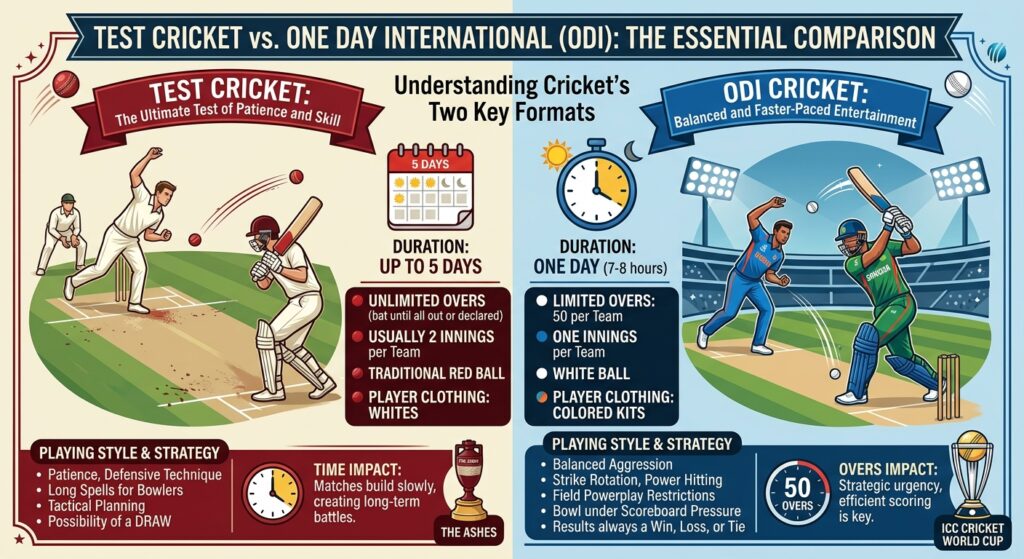
Cricket has evolved into several formats over the years, but Test cricket and One Day International (ODI) cricket remain two of the most important forms of the game. Both formats feature international teams, highly skilled players, and intense competition, yet they offer completely different experiences for players and fans.
Test cricket is often described as the purest form of the game. It tests patience, technique, endurance, and tactical intelligence over several days. ODI cricket, on the other hand, brings a balance between traditional cricket and modern entertainment by completing a match in a single day with a limited number of overs.
For new cricket fans, understanding the difference between Test cricket and ODI cricket can sometimes be confusing. Why does one match last five days while another finishes in a few hours? Why do players use different strategies? Why are batting and bowling approaches so different?
This guide explains Test cricket vs ODI cricket, including their rules, match duration, overs, playing style, strategies, and major differences.
What Is Test Cricket?
Test cricket is the longest and oldest format of international cricket. It is played between countries that have been granted Test status by the International Cricket Council.
A traditional Test match can last up to five days. Each team usually gets two innings to bat and bowl, creating a long tactical battle between the two sides.
Unlike limited-overs cricket, there is no fixed number of overs for an innings in Test cricket. A team can continue batting until:
- All batters are dismissed
- The captain declares the innings closed
- The team reaches the end of the match under special circumstances
The main challenge in Test cricket is consistency. Players must perform over long periods and adapt to changing pitch and weather conditions.
Basic Features of Test Cricket
| Feature | Test Cricket |
|---|---|
| Match Duration | Up to 5 days |
| Overs Per Innings | Unlimited |
| Innings Per Team | Usually 2 |
| Ball Color | Traditionally red |
| Player Clothing | White |
| Result Options | Win, Loss, Draw, Tie |
| Playing Style | Technical and strategic |
Test cricket demands exceptional concentration. A batter may spend several hours at the crease, while bowlers may bowl long spells across multiple sessions.
What Is ODI Cricket?
ODI stands for One Day International. As the name suggests, an ODI match is normally completed in one day.
Each team receives a maximum of 50 overs to score as many runs as possible. After the first team completes its innings, the second team attempts to chase the target.
ODI cricket combines traditional cricket skills with a faster scoring rate. Players must balance aggression with patience because they have a limited number of overs.
Basic Features of ODI Cricket
| Feature | ODI Cricket |
|---|---|
| Match Duration | One day |
| Overs Per Team | 50 |
| Innings Per Team | 1 |
| Ball Color | White |
| Player Clothing | Colored kits |
| Result Options | Win, Loss, Tie, No Result |
| Playing Style | Balanced and faster-paced |
ODI cricket became extremely popular because it provides a complete international match within a single day while still allowing players enough time to build an innings.
Test Cricket vs ODI: Quick Comparison
The easiest way to understand the difference is through a direct comparison.
| Feature | Test Cricket | ODI Cricket |
|---|---|---|
| Match Length | Up to 5 days | One day |
| Overs | Unlimited | 50 per team |
| Innings | Usually 2 per team | 1 per team |
| Ball | Red | White |
| Clothing | White | Colored |
| Field Restrictions | No standard powerplay system | Powerplay restrictions |
| Match Result | Win, Loss, Draw, Tie | Win, Loss, Tie, No Result |
| Batting Approach | Patient and technical | Balanced aggression |
| Bowling Strategy | Long-term planning | Limited-over tactics |
| Pitch Impact | Changes over several days | Usually limited to one day |
Although both formats follow the basic laws of cricket, the way teams approach a match is significantly different.
1. Match Duration
The biggest difference between Test cricket and ODI cricket is the length of the match.
A Test match can continue for up to five days. Each day generally includes multiple sessions of play. This gives teams enough time to build innings, recover from difficult situations, and develop long-term strategies.
An ODI match is completed in approximately one day. Each side bats for a maximum of 50 overs.
Simple Match Duration Comparison
| Format | Maximum Playing Period |
|---|---|
| Test Cricket | 5 days |
| ODI Cricket | Around 7–8 hours |
| T20 Cricket | Around 3 hours |
Because of this difference, players need completely different levels of physical and mental preparation.
A Test batter may need concentration for an entire day, while an ODI batter must score efficiently before running out of overs.
2. Number of Overs
Test cricket does not have a fixed limit on overs.
A batting team can theoretically continue for hundreds of overs if they are not dismissed or do not declare the innings.
In ODI cricket, every team has a strict limit of 50 overs.
Example
Suppose a team scores 300 runs.
In a Test match:
300 runs could take 90 overs or 150 overs, depending on the scoring rate and match situation.
In an ODI:
The team has a maximum of 50 overs, so scoring 300 runs requires a much faster approach.
Run Rate Calculation
The formula for run rate is:
Run Rate = Total Runs ÷ Overs Faced
For example:
300 ÷ 50 = 6.00
Therefore, a team scoring 300 runs in 50 overs has a run rate of 6 runs per over.
In Test cricket, a team might score at only 3 runs per over and still be in a strong position because time and wickets are more important than rapid scoring.
3. Number of Innings
Test cricket usually gives each team two innings.
This creates more opportunities for teams to recover from mistakes.
For example, a team might perform poorly in the first innings but return strongly in the second innings.
ODI cricket allows only one innings per team.
If a team loses early wickets or scores too slowly, there is no second opportunity. This makes every ball and wicket more valuable.
Test Cricket Example
Team A:
First innings – 350 runs
Second innings – 280 runs
Team B:
First innings – 400 runs
Second innings – 231 runs
The result is determined after considering both innings.
ODI Example
Team A: 320/7 in 50 overs
Team B: 321/6 in 48.2 overs
Team B wins because it successfully chases the target in its only innings.
4. Batting Style
Batting in Test cricket requires patience and discipline.
A batter may leave dozens of deliveries outside the off stump because there is no immediate pressure to score quickly.
The primary goal is to protect the wicket and build a long innings.
ODI batting requires a more balanced approach.
A player cannot simply defend for long periods because only 50 overs are available. Batters need to rotate the strike and score boundaries at regular intervals.
Test Cricket Batting
Important qualities include:
- Patience
- Defensive technique
- Concentration
- Shot selection
- Ability to survive difficult conditions
ODI Batting
Important qualities include:
- Strike rotation
- Power hitting
- Boundary scoring
- Running between wickets
- Adapting to required run rate
Modern players often succeed in both formats, but the adjustment is not always easy.
5. Bowling Strategies
Bowling strategies also change significantly between Test cricket and ODI cricket.
In Test cricket, bowlers can develop plans over long spells. They may repeatedly target a batter’s weakness and use field placements designed to create pressure.
For example, a fast bowler may bowl outside the off stump repeatedly before suddenly bringing the ball back toward the stumps.
Spin bowlers can also bowl long spells and gradually create mistakes.
In ODI cricket, bowlers have limited overs and must focus more on controlling the scoring rate.
They need to consider:
- Powerplay overs
- Death overs
- Field restrictions
- Batters attacking more frequently
- Limited bowling spells
A bowler who takes wickets is valuable in both formats, but an ODI bowler must also prevent runs.
6. Field Restrictions
ODI cricket includes fielding restrictions known as powerplays.
During specific periods of the innings, teams are limited in how many fielders they can place outside the inner fielding circle.
This encourages attacking cricket and gives batters opportunities to score quickly.
Test cricket does not use the same standard powerplay structure.
Captains have greater freedom to position fielders according to the match situation.
This allows for creative strategies such as:
- Slip cordons
- Short-leg fielders
- Silly point
- Deep defensive fields
- Close-catching positions
Field placements are often more tactical in Test cricket because captains can develop plans over multiple sessions.
7. The Role of Time
Time plays a major role in Test cricket.
A team may have plenty of runs but still fail to win if it cannot dismiss the opposition before the match ends.
This creates the possibility of a draw, which is one of the most unique aspects of Test cricket.
For example, imagine a team needs 200 runs to win but only has two overs remaining when the match ends.
The match may finish as a draw if neither team achieves victory.
In ODI cricket, there is usually no possibility of a traditional draw because each team has a fixed number of overs.
The limited overs ensure that the match reaches a conclusion unless weather or other interruptions create a no-result situation.
8. Equipment and Clothing
Another visible difference is the appearance of the game.
Test cricket traditionally uses:
- White clothing
- Red cricket ball
- Traditional cricket appearance
ODI cricket usually features:
- Colored team uniforms
- White cricket ball
- Day-night matches
Day-night Test matches may use a pink ball, but traditional Test cricket remains strongly associated with white uniforms and red balls.
Why Different Ball Colors Are Used
White balls are easier to see under stadium lights, making them suitable for day-night ODI matches.
Red balls have traditionally been used in longer-format cricket and can behave differently as they age.
This also affects batting and bowling strategies.
9. Which Format Is More Difficult?
There is no simple answer because both formats test different skills.
However, many cricket experts consider Test cricket the ultimate examination of a player’s complete ability.
A Test player must perform in changing conditions over several days.
They need:
- Physical endurance
- Strong technique
- Mental strength
- Tactical awareness
- Adaptability
ODI cricket presents a different challenge.
Players must make quick decisions and constantly balance risk and reward.
A batter might need to defend carefully during one over and attack aggressively during the next.
Therefore, both formats are difficult in different ways.
Famous Tournaments in Test and ODI Cricket
Test cricket is represented through historic bilateral series and major competitions.
One of the most prestigious rivalries in the sport is The Ashes, played between England cricket team and Australia national cricket team.
ODI cricket is strongly associated with the ICC Cricket World Cup, one of the biggest sporting events in the world.
The tournament has produced legendary performances and unforgettable matches throughout cricket history.
Test Cricket vs ODI: Advantages
Advantages of Test Cricket
- Provides a complete test of cricketing ability
- Allows complex strategies
- Rewards patience and technique
- Creates long-term battles between players
- Offers dramatic changes in match momentum
Advantages of ODI Cricket
- Completed in one day
- Easier for casual fans to follow
- Includes both technical and aggressive cricket
- Produces exciting finishes
- Suitable for major international tournaments
Test Cricket vs ODI: Which Is Better?
The answer largely depends on personal preference.
Fans who enjoy strategy, patience, and long battles may prefer Test cricket.
A Test match can change dramatically from one session to another. A team that appears certain to lose may suddenly recover because of one outstanding bowling spell.
Fans who prefer faster action may enjoy ODI cricket.
The 50-over format provides enough time for players to build an innings while still maintaining the pressure of a limited number of overs.
ODI cricket is often considered a middle ground between traditional Test cricket and the fast-paced world of T20 cricket.
Final Thoughts
The comparison between Test cricket vs ODI shows how one sport can offer completely different challenges through different formats.
Test cricket is a long and demanding battle that tests patience, technique, fitness, and mental strength. With two innings and up to five days available, teams must think carefully about every stage of the match.
ODI cricket is faster and more structured. With only 50 overs available, players must score efficiently while bowlers need to control runs and take wickets under pressure.
Neither format is necessarily better than the other. They simply represent different sides of cricket.
Test cricket celebrates the traditional depth and endurance of the sport, while ODI cricket combines strategy with entertainment and faster scoring. Together, they demonstrate why cricket continues to attract millions of passionate fans around the world.
Whether you enjoy a five-day battle between elite teams or an exciting one-day contest filled with boundaries and dramatic finishes, both Test cricket and ODI cricket have something special to offer.
