


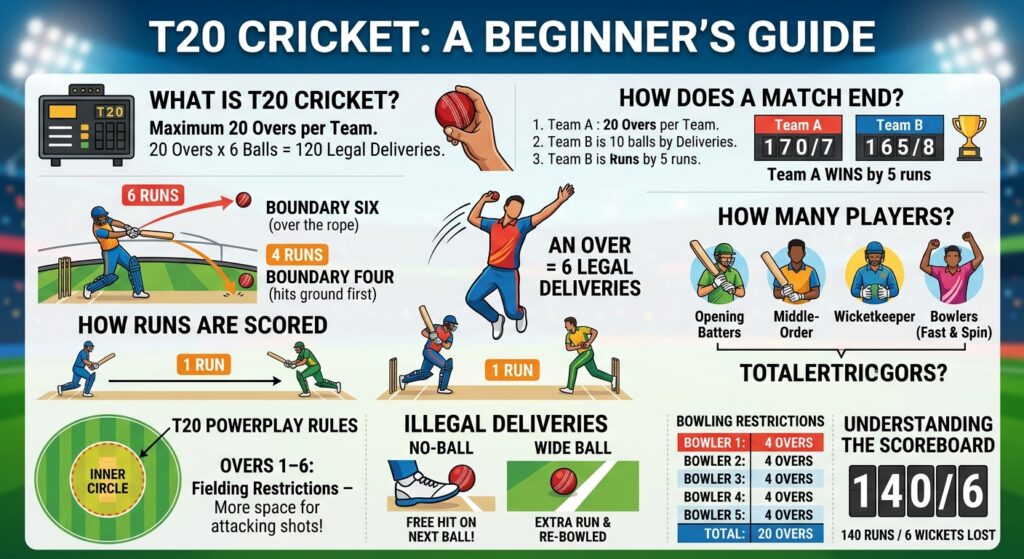
T20 cricket is one of the easiest forms of cricket to understand once you know the basic rules. Unlike Test cricket, which can continue for several days, or One Day Internationals, which usually last around eight hours, a T20 match is designed to be fast, exciting, and completed in a few hours.
For someone watching cricket for the first time, the constant hitting, quick running between the wickets, bowling changes, fielding restrictions, and unusual shots can make the game seem complicated. In reality, the basic idea is quite simple: two teams play one innings each, and the team that scores the most runs wins.
This guide explains the main T20 cricket rules for beginners, including overs, scoring, wickets, powerplays, no-balls, wides, fielding restrictions, innings, and how a winner is decided.
What Is T20 Cricket?
T20 stands for Twenty20 cricket. The name comes from the maximum number of overs allowed for each team’s innings.
In a standard T20 match, each team can face a maximum of 20 overs. An over consists of six legal deliveries, meaning a team can normally face up to:
20 overs × 6 balls = 120 legal deliveries
This limited number of balls makes every delivery important. Batters usually look for opportunities to score quickly, while bowlers try to prevent boundaries and take wickets.
A T20 match normally has two innings:
- Team A bats and scores runs.
- Team B bats and tries to beat Team A’s score.
- The team with more runs wins.
If Team A scores 175 runs, Team B needs 176 runs to win.
How Many Players Are in a T20 Team?
Each side has 11 players. One team bats while the other fields.
Although a team has 11 players, only two batters are normally on the pitch at the same time. The remaining players are fielding.
A typical team includes:
| Role | Main Responsibility |
|---|---|
| Opening batters | Start the innings |
| Middle-order batters | Build or accelerate the score |
| All-rounders | Contribute with bat and ball |
| Fast bowlers | Bowl at high pace |
| Spin bowlers | Use spin and variation |
| Wicketkeeper | Stand behind the stumps |
| Captain | Leads the team and makes tactical decisions |
Teams generally select their XI according to conditions, opposition, pitch, and strategy.
The 20-Over Limit
The biggest rule that separates T20 cricket from other formats is the 20-over limit.
Each team normally receives a maximum of 20 overs. However, an innings can finish earlier if all the batting team’s wickets fall.
For example, if a team is bowled out after 17.3 overs, its innings ends immediately. It does not receive the remaining 2.3 overs.
There can also be fewer than 20 overs when rain or another interruption reduces the match length.
Simple T20 calculation
Suppose a team scores:
- 50 runs in 6 overs
- 60 runs in the next 8 overs
- 55 runs in the final 6 overs
Total:
50 + 60 + 55 = 165 runs
So the team finishes its 20 overs with 165 runs.
How Runs Are Scored
Runs are the foundation of cricket. Batters can score in several ways.
Running Between the Wickets
After hitting the ball, the two batters can run between the wickets. Each completed run adds one run to the team’s total.
If they run twice successfully, they score two runs.
Boundary Four
If the ball reaches the boundary after touching the ground, the batting team normally receives four runs.
Boundary Six
If the batter hits the ball over the boundary without it touching the ground inside the field, the team scores six runs.
A six is one of the most valuable scoring shots in T20 cricket because it adds six runs from a single delivery.
What Is an Over?
An over consists of six legal balls.
For example:
- Ball 1
- Ball 2
- Ball 3
- Ball 4
- Ball 5
- Ball 6
After six legal deliveries, another bowler delivers the next over.
The same bowler cannot normally bowl two consecutive overs. The captain must select another bowler for the next over.
It is important to remember that wides and no-balls do not count as legal deliveries, so the bowler may need to deliver more than six balls to complete an over.
T20 Powerplay Rules
The powerplay is an important part of T20 cricket.
During the initial powerplay, there are restrictions on how many fielders can be positioned outside the designated inner fielding circle. This creates more space for attacking shots and gives batters an opportunity to score quickly.
In a standard full-length T20 innings, the powerplay covers the first six overs.
For example:
| Overs | Phase |
|---|---|
| 1–6 | Powerplay |
| 7–20 | Non-powerplay |
The exact fielding restrictions can vary depending on the playing conditions and competition, so beginners should always check the regulations of the particular tournament.
What Is a Wicket?
A wicket usually means a batter has been dismissed.
There are several ways a batter can get out. The most common include:
- Bowled
- Caught
- Leg before wicket (LBW
- Run out
- Stumped
- Hit wicket
A team normally has 10 wickets available because an innings requires two batters at the crease, and the innings ends when the team loses its tenth wicket.
For example, a score of 140/6 means the team has scored 140 runs and lost six wickets.
What Does 140/6 Mean?
This notation is common on cricket scoreboards.
The first number represents runs, while the second represents wickets lost.
So:
140/6 = 140 runs for 6 wickets
Similarly:
185/3 = 185 runs for 3 wickets
If a team finishes its 20 overs at 185/3, it has scored 185 runs while losing three wickets.
No-Ball Rules
A no-ball is an illegal delivery.
One common reason for a no-ball is when the bowler oversteps the permitted line at the bowling crease. There are also other situations in which a delivery can be called a no-ball under the Laws of Cricket.
A no-ball generally gives the batting team an additional run, and the delivery does not count as one of the six legal balls in the over.
This means a bowler could deliver six legal balls plus several no-balls and therefore bowl more than six actual deliveries during an over.
In limited-overs cricket, a no-ball can also give the batter a free hit on the following delivery under the applicable playing conditions.
Wide Ball Rules
A wide is called when the bowled ball is too far from the batter to be reasonably playable from their normal position, subject to the relevant laws and playing conditions.
The batting team receives an extra run for a wide, and the ball does not count as a legal delivery.
For example, if a bowler delivers six legal balls and also bowls two wides, the over may contain eight deliveries.
The score could therefore increase because of both the wides and any runs scored from the legal deliveries.
Free Hit
The free hit is a popular feature of modern limited-overs cricket.
When the applicable rules award a free hit after a qualifying no-ball, the batter cannot normally be dismissed in the usual ways such as being bowled or caught from that delivery. However, dismissals such as run out can still be possible.
This gives the batter an excellent opportunity to attack.
Because T20 cricket is already aggressive, free-hit deliveries often result in big shots.
Bowling Restrictions in T20 Cricket
T20 cricket also places restrictions on individual bowlers.
In a standard 20-over innings, a bowler can normally bowl a maximum of four overs.
Therefore, one bowler cannot bowl all 20 overs.
A team has to distribute its bowling workload among several players.
For example, a possible bowling plan could be:
| Bowler | Overs |
|---|---|
| Bowler 1 | 4 |
| Bowler 2 | 4 |
| Bowler 3 | 4 |
| Bowler 4 | 4 |
| Bowler 5 | 4 |
| Total | 20 |
Captains often use different combinations depending on the match situation.
How Does a T20 Match End?
A T20 match can finish in several ways.
The simplest situation is when one team scores more runs than the other.
For example:
Team A: 170/7
Team B: 165/8
Team A wins by 5 runs.
The calculation is:
170 − 165 = 5 runs
Alternatively, if Team B scores 171 while chasing 170, Team B wins.
What Is a Target?
The target is the number of runs the chasing team needs to win.
Suppose Team A scores:
160 runs
Team B therefore needs:
160 + 1 = 161 runs
So the target is 161.
If Team B reaches 161 before losing all its wickets or running out of available overs, it wins.
What Happens If the Scores Are Tied?
If both teams finish with exactly the same number of runs, a T20 match can require a Super Over, depending on the competition’s playing conditions.
In a Super Over, each side receives a short additional opportunity to score, with the precise rules governing the procedure set by the competition.
The purpose is to determine a winner instead of leaving the match tied.
Duckworth-Lewis-Stern Method
Rain can cause serious problems in T20 cricket because every team has a limited number of overs.
When a match is interrupted and the number of overs available changes, the Duckworth-Lewis-Stern (DLS) method can be used to calculate a revised target.
For beginners, the important point is simple: the revised target is not always based on a straightforward runs-per-over calculation. The method considers the resources available to each team, particularly wickets and overs.
This allows shortened matches to produce a more balanced target.
Why T20 Cricket Is So Fast-Paced
T20 cricket encourages attacking play because there are only 120 legal deliveries available in a full innings.
A batter cannot afford to spend too many overs simply defending unless the match situation requires it.
This is why you often see:
- Aggressive opening batsmen
- Big sixes
- Innovative shots
- Fast running between wickets
- Specialist death bowlers
- Spin bowling during the middle overs
- Creative field placements
Every over can dramatically change the match.
| Rule | Basic Explanation |
|---|---|
| Players | 11 per team |
| Overs | Maximum 20 per innings |
| Balls per over | 6 legal deliveries |
| Powerplay | First 6 overs in a standard full T20 |
| Bowler limit | Usually maximum 4 overs per bowler |
| Four | Boundary after ball touches ground |
| Six | Ball clears boundary without bouncing |
| Wide | Illegal delivery outside reasonable reach |
| No-ball | Illegal delivery under the applicable laws |
| Wicket | Dismissal of a batter |
| Target | One more run than opponent’s score |
| Tie | May be decided by a Super Over |
Final Thoughts
Understanding T20 cricket rules for beginners does not require memorizing every detail of the Laws of Cricket. Start with the basics: each team has 11 players, each side normally receives 20 overs, six legal balls make an over, and the team scoring the most runs wins.
Once you understand wickets, boundaries, wides, no-balls, powerplays, and the target, watching a T20 match becomes much easier. You will also start to understand why captains change bowlers, why fielders move around the boundary, and why batters take greater risks toward the end of an innings.
The beauty of T20 cricket is that a match can change within a few deliveries. A couple of sixes can transform a chase, while a bowler taking two wickets in an over can completely shift the momentum. That combination of simple scoring, limited overs, and constant pressure is what makes T20 one of the most entertaining forms of cricket.
