


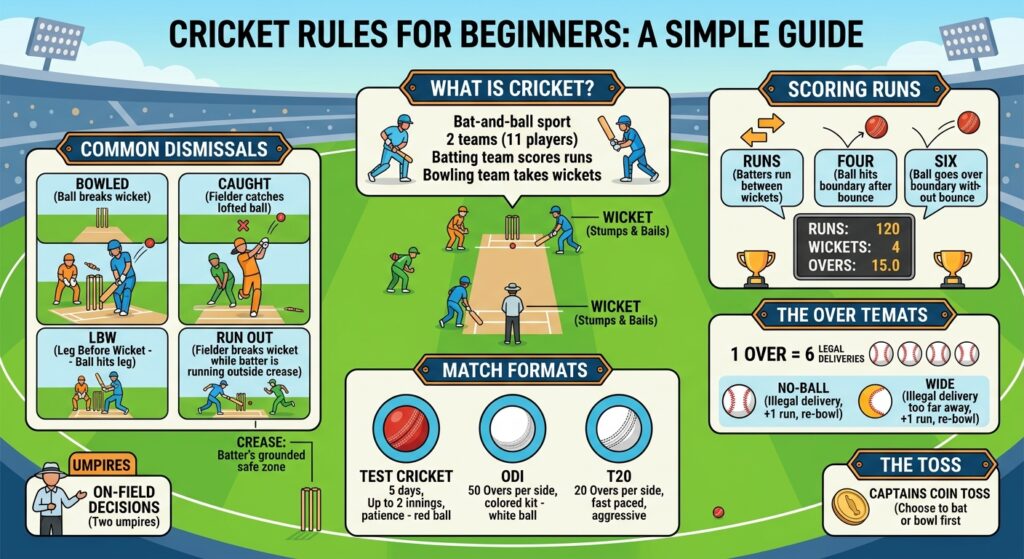
Cricket can look complicated when you first watch it. There are wickets, runs, overs, boundaries, no-balls, wides, catches, and several different ways a batter can be dismissed. On top of that, the game has different formats, each with its own style and rules. The good news is that cricket becomes much easier to understand once you know the basic ideas.
This guide explains the main cricket rules for beginners in simple language. Whether you have just started watching cricket or want to play your first match, these rules will help you understand what is happening on the field.
What Is Cricket?
Cricket is a bat-and-ball sport played between two teams. A standard cricket team has 11 players. During a match, one team generally bats while the other team bowls and fields.
The main objective for the batting team is to score more runs than its opponent. The bowling and fielding team tries to stop runs and dismiss the batters.
A cricket pitch is located in the middle of the field. At each end of the pitch is a set of three wooden stumps with two bails placed on top. These are called the wickets.
Two batters are normally on the field at the same time. One faces the bowler while the other waits at the opposite end.
The Basic Objective of Cricket
The simplest way to understand cricket is this:
Score more runs than the other team.
When a batter hits the ball, the two batters can run between the wickets. Every completed run adds one run to the team’s score.
For example, if the batters successfully run between the wickets three times, they score three runs.
Batters can also score runs without running. If the ball reaches the boundary after touching the ground, the batting team normally receives four runs. If the batter hits the ball over the boundary without it touching the ground, it is normally worth six runs.
| How runs are scored | Runs |
|---|---|
| One completed run | 1 |
| Two completed runs | 2 |
| Ball reaches boundary after bouncing | 4 |
| Ball goes over boundary without bouncing | 6 |
Cricket Teams and Players
Each side has 11 players. A team usually includes specialist batters, bowlers, an all-rounder or two, and a wicketkeeper.
The wicketkeeper stands behind the batter’s wicket and wears protective gloves. The keeper’s job is to stop the ball and attempt stumpings and catches.
Bowlers are responsible for delivering the ball toward the batter. Some players specialize in fast bowling, while others use spin.
Batters concentrate mainly on scoring runs and staying at the crease.
An all-rounder contributes with both batting and bowling.
What Is an Over?
One of the most important cricket terms for beginners is over.
An over normally consists of six legal deliveries bowled by one bowler from one end of the pitch.
After six legal balls, another bowler generally bowls the next over from the opposite end.
For example:
1 over = 6 legal balls
So:
10 overs × 6 balls = 60 legal deliveries
However, a no-ball or wide does not count as one of the six legal deliveries. The bowler must deliver another ball to complete the over.
How Does a Cricket Innings Work?
An innings is the period when a team bats.
The number of innings depends on the format and competition.
In limited-overs cricket, such as One Day Internationals and T20 matches, each team normally gets one innings.
In Test cricket, each team can have up to two innings.
The batting team continues until its innings ends according to the rules of the particular format.
An innings can end because the allotted number of overs has been completed, because enough batters have been dismissed, because the team declares its innings in Test cricket, or for other circumstances defined by the laws and competition regulations.
How Can a Batter Be Out?
There are several ways a batter can be dismissed. Beginners do not need to memorize every rare dismissal immediately, but understanding the common ones makes watching cricket much easier.
Bowled
A batter is bowled when the ball delivered by the bowler hits the wicket and dislodges the bails, subject to the laws of cricket.
This is one of the most recognizable dismissals.
Caught
If the batter hits the ball and a fielder catches it before the ball touches the ground, the batter is generally out caught.
The catch can be taken by the wicketkeeper or another fielder.
LBW
LBW means Leg Before Wicket.
This rule applies when the ball hits the batter’s body rather than the bat and certain conditions are satisfied. The exact LBW law has several details involving where the ball pitched, where it struck the batter, and whether it would have hit the wicket.
For a beginner, the easiest idea is that a batter cannot simply use their legs to prevent a legal delivery from hitting the stumps.
Run Out
A run out can happen while the batters are attempting to complete a run.
If a fielder breaks the wicket with the ball while the relevant batter is outside their crease, the batter can be dismissed run out.
Stumped
A batter can be stumped when they leave their crease while attempting to play a delivery, and the wicketkeeper breaks the wicket with the ball before the batter can regain their ground.
Stumpings are particularly common against spin bowlers because batters may move forward to attack the ball.
Hit Wicket
A batter can also be dismissed hit wicket if they break their own wicket while playing or preparing to play a delivery, subject to the conditions in the laws.
What Is a No-Ball?
A no-ball is an illegal delivery.
There are different reasons why a delivery can be called a no-ball. For example, a bowler may overstep the relevant crease when delivering the ball.
A no-ball normally gives the batting team an additional run, and the delivery does not count as one of the six legal balls in the over.
In some formats, a no-ball can also give the batter a free hit on the following delivery.
The exact free-hit provisions depend on the format and competition.
What Is a Wide?
A wide is another type of illegal delivery.
If the ball is delivered too far away from the batter to be reasonably playable under the applicable conditions, the umpire can call it wide.
The batting team receives an extra run for a wide, and the delivery generally does not count toward the six legal balls of the over.
For example, if a bowler delivers six balls but one is called wide, the over is not finished after those six deliveries. An additional legal delivery is required.
What Is a Boundary?
Boundaries are an important part of cricket scoring.
When the ball reaches or crosses the boundary, the batting side can receive four or six runs depending on how the ball got there.
A four is generally scored when the ball reaches the boundary after touching the ground.
A six is normally scored when the batter hits the ball over the boundary without it touching the ground inside the field.
Boundaries can dramatically change the score, especially in T20 cricket where aggressive batting is common.
The Role of the Umpires
Umpires make important decisions during a cricket match.
They determine whether deliveries are legal, whether batters are out, whether runs count, and whether boundaries have been scored.
There are normally two on-field umpires, with one positioned at each end of the pitch.
At professional levels, technology can also assist officials with certain decisions. Depending on the competition, systems such as video reviews can be used to examine close decisions.
What Is the Toss?
Before the match begins, the two captains usually take part in a coin toss.
The captain who wins the toss chooses whether their team will bat first or bowl first.
This decision can depend on pitch conditions, weather, the format of the match, and how the captain expects the surface to behave during the game.
For example, a captain may choose to bat first if they believe the pitch will become more difficult to bat on later.
Cricket Match Formats
Cricket is played in several formats.
| Format | Typical innings structure | Main feature |
|---|---|---|
| Test cricket | Up to 2 innings per team | Can last up to five days |
| ODI cricket | 1 innings per team | Usually 50 overs per side |
| T20 cricket | 1 innings per team | Usually 20 overs per side |
Test cricket is the longest form and gives teams much more time to build an innings.
ODI cricket provides a middle ground between traditional long-form cricket and short-format cricket.
T20 cricket is much faster. With only 20 overs per side, batters often attack from the beginning and bowlers have less room for error.
How a Team Wins
In a limited-overs match, the team batting second usually needs to score more runs than the first team’s total.
Suppose Team A scores:
250 runs
Team B needs:
251 runs
to win outright by surpassing Team A’s score, subject to the match rules and result conditions.
If Team B is dismissed for 240, Team A wins by 10 runs.
If Team B reaches 251 before using all its available resources, Team B wins.
The calculation is simple:
251 − 250 = 1 run
So Team B would need at least one run beyond Team A’s total to finish ahead.
What Does an Innings End Mean?
In a limited-overs match, an innings normally ends when the team’s allotted overs are completed or when the required number of wickets has fallen, among other possible circumstances.
For example, if a T20 team reaches 150 runs after 20 overs, its batting innings is normally complete.
If it loses all of the relevant wickets before 20 overs are completed, its innings can end earlier.
This is why commentators often talk about both runs and wickets.
A score such as 150/6 means the team has scored 150 runs and lost six wickets.
Why the Crease Matters
The crease is extremely important for both batters.
A batter is considered to have made their ground when the relevant part of their bat or person is grounded behind the popping crease, subject to the laws.
This becomes particularly important during run outs and stumpings.
A batter may be only a few centimeters short of the crease, but that can be enough to result in a dismissal.
Basic Fielding Rules
Fielders are positioned around the ground to stop runs and create opportunities for dismissals.
Their positions depend on the bowler, batter, match situation, and captain’s strategy.
A captain might place more fielders close to the batter when trying to take wickets. When the batting team is looking for boundaries, fielders may be positioned deeper around the edge of the field.
Fielders must also follow restrictions that can apply in particular formats and situations.
What Beginners Should Watch During a Match
When you are watching cricket for the first time, do not try to understand everything at once.
Start by looking at four things:
- The score – How many runs has the team made?
- The wickets – How many batters have been dismissed?
- The overs – How many overs have been completed?
- The target – If a team is chasing, how many runs does it need?
For example, if the scoreboard shows:
120/4 after 15 overs
it means the team has scored 120 runs, lost four wickets, and completed 15 overs.
If the target is 180, the team needs:
180 − 120 = 60 runs
from its remaining overs.
This simple calculation can tell you a lot about the match situation.
Final Thoughts
Learning cricket rules for beginners does not have to be difficult. Once you understand runs, wickets, overs, boundaries, dismissals, wides, no-balls, and innings, most matches become much easier to follow.
The best way to learn is to combine the basic rules with actually watching games. After a few matches, terms that initially sound confusing will start to make sense.
Cricket has plenty of tactical details, but its central idea remains straightforward: one team tries to score runs while the other tries to prevent those runs and take wickets. As you become more familiar with the game, you can gradually learn advanced areas such as fielding restrictions, bowling strategies, batting techniques, reviews, declarations, follow-ons, and different tactical approaches.
For a beginner, however, mastering the fundamentals is the perfect starting point.
Cricket Rules for Beginners: A Simple Guide to Understanding the Game
Cricket can look complicated when you first watch it. There are wickets, runs, overs, boundaries, no-balls, wides, catches, and several different ways a batter can be dismissed. On top of that, the game has different formats, each with its own style and rules. The good news is that cricket becomes much easier to understand once you know the basic ideas.
This guide explains the main cricket rules for beginners in simple language. Whether you have just started watching cricket or want to play your first match, these rules will help you understand what is happening on the field.
What Is Cricket?
Cricket is a bat-and-ball sport played between two teams. A standard cricket team has 11 players. During a match, one team generally bats while the other team bowls and fields.
The main objective for the batting team is to score more runs than its opponent. The bowling and fielding team tries to stop runs and dismiss the batters.
A cricket pitch is located in the middle of the field. At each end of the pitch is a set of three wooden stumps with two bails placed on top. These are called the wickets.
Two batters are normally on the field at the same time. One faces the bowler while the other waits at the opposite end.
The Basic Objective of Cricket
The simplest way to understand cricket is this:
Score more runs than the other team.
When a batter hits the ball, the two batters can run between the wickets. Every completed run adds one run to the team’s score.
For example, if the batters successfully run between the wickets three times, they score three runs.
Batters can also score runs without running. If the ball reaches the boundary after touching the ground, the batting team normally receives four runs. If the batter hits the ball over the boundary without it touching the ground, it is normally worth six runs.
| How runs are scored | Runs |
|---|---|
| One completed run | 1 |
| Two completed runs | 2 |
| Ball reaches boundary after bouncing | 4 |
| Ball goes over boundary without bouncing | 6 |
Cricket Teams and Players
Each side has 11 players. A team usually includes specialist batters, bowlers, an all-rounder or two, and a wicketkeeper.
The wicketkeeper stands behind the batter’s wicket and wears protective gloves. The keeper’s job is to stop the ball and attempt stumpings and catches.
Bowlers are responsible for delivering the ball toward the batter. Some players specialize in fast bowling, while others use spin.
Batters concentrate mainly on scoring runs and staying at the crease.
An all-rounder contributes with both batting and bowling.
What Is an Over?
One of the most important cricket terms for beginners is over.
An over normally consists of six legal deliveries bowled by one bowler from one end of the pitch.
After six legal balls, another bowler generally bowls the next over from the opposite end.
For example:
1 over = 6 legal balls
So:
10 overs × 6 balls = 60 legal deliveries
However, a no-ball or wide does not count as one of the six legal deliveries. The bowler must deliver another ball to complete the over.
How Does a Cricket Innings Work?
An innings is the period when a team bats.
The number of innings depends on the format and competition.
In limited-overs cricket, such as One Day Internationals and T20 matches, each team normally gets one innings.
In Test cricket, each team can have up to two innings.
The batting team continues until its innings ends according to the rules of the particular format.
An innings can end because the allotted number of overs has been completed, because enough batters have been dismissed, because the team declares its innings in Test cricket, or for other circumstances defined by the laws and competition regulations.
How Can a Batter Be Out?
There are several ways a batter can be dismissed. Beginners do not need to memorize every rare dismissal immediately, but understanding the common ones makes watching cricket much easier.
Bowled
A batter is bowled when the ball delivered by the bowler hits the wicket and dislodges the bails, subject to the laws of cricket.
This is one of the most recognizable dismissals.
Caught
If the batter hits the ball and a fielder catches it before the ball touches the ground, the batter is generally out caught.
The catch can be taken by the wicketkeeper or another fielder.
LBW
LBW means Leg Before Wicket.
This rule applies when the ball hits the batter’s body rather than the bat and certain conditions are satisfied. The exact LBW law has several details involving where the ball pitched, where it struck the batter, and whether it would have hit the wicket.
For a beginner, the easiest idea is that a batter cannot simply use their legs to prevent a legal delivery from hitting the stumps.
Run Out
A run out can happen while the batters are attempting to complete a run.
If a fielder breaks the wicket with the ball while the relevant batter is outside their crease, the batter can be dismissed run out.
Stumped
A batter can be stumped when they leave their crease while attempting to play a delivery, and the wicketkeeper breaks the wicket with the ball before the batter can regain their ground.
Stumpings are particularly common against spin bowlers because batters may move forward to attack the ball.
Hit Wicket
A batter can also be dismissed hit wicket if they break their own wicket while playing or preparing to play a delivery, subject to the conditions in the laws.
What Is a No-Ball?
A no-ball is an illegal delivery.
There are different reasons why a delivery can be called a no-ball. For example, a bowler may overstep the relevant crease when delivering the ball.
A no-ball normally gives the batting team an additional run, and the delivery does not count as one of the six legal balls in the over.
In some formats, a no-ball can also give the batter a free hit on the following delivery.
The exact free-hit provisions depend on the format and competition.
What Is a Wide?
A wide is another type of illegal delivery.
If the ball is delivered too far away from the batter to be reasonably playable under the applicable conditions, the umpire can call it wide.
The batting team receives an extra run for a wide, and the delivery generally does not count toward the six legal balls of the over.
For example, if a bowler delivers six balls but one is called wide, the over is not finished after those six deliveries. An additional legal delivery is required.
What Is a Boundary?
Boundaries are an important part of cricket scoring.
When the ball reaches or crosses the boundary, the batting side can receive four or six runs depending on how the ball got there.
A four is generally scored when the ball reaches the boundary after touching the ground.
A six is normally scored when the batter hits the ball over the boundary without it touching the ground inside the field.
Boundaries can dramatically change the score, especially in T20 cricket where aggressive batting is common.
The Role of the Umpires
Umpires make important decisions during a cricket match.
They determine whether deliveries are legal, whether batters are out, whether runs count, and whether boundaries have been scored.
There are normally two on-field umpires, with one positioned at each end of the pitch.
At professional levels, technology can also assist officials with certain decisions. Depending on the competition, systems such as video reviews can be used to examine close decisions.
What Is the Toss?
Before the match begins, the two captains usually take part in a coin toss.
The captain who wins the toss chooses whether their team will bat first or bowl first.
This decision can depend on pitch conditions, weather, the format of the match, and how the captain expects the surface to behave during the game.
For example, a captain may choose to bat first if they believe the pitch will become more difficult to bat on later.
Cricket Match Formats
Cricket is played in several formats.
| Format | Typical innings structure | Main feature |
|---|---|---|
| Test cricket | Up to 2 innings per team | Can last up to five days |
| ODI cricket | 1 innings per team | Usually 50 overs per side |
| T20 cricket | 1 innings per team | Usually 20 overs per side |
Test cricket is the longest form and gives teams much more time to build an innings.
ODI cricket provides a middle ground between traditional long-form cricket and short-format cricket.
T20 cricket is much faster. With only 20 overs per side, batters often attack from the beginning and bowlers have less room for error.
How a Team Wins
In a limited-overs match, the team batting second usually needs to score more runs than the first team’s total.
Suppose Team A scores:
250 runs
Team B needs:
251 runs
to win outright by surpassing Team A’s score, subject to the match rules and result conditions.
If Team B is dismissed for 240, Team A wins by 10 runs.
If Team B reaches 251 before using all its available resources, Team B wins.
The calculation is simple:
251 − 250 = 1 run
So Team B would need at least one run beyond Team A’s total to finish ahead.
What Does an Innings End Mean?
In a limited-overs match, an innings normally ends when the team’s allotted overs are completed or when the required number of wickets has fallen, among other possible circumstances.
For example, if a T20 team reaches 150 runs after 20 overs, its batting innings is normally complete.
If it loses all of the relevant wickets before 20 overs are completed, its innings can end earlier.
This is why commentators often talk about both runs and wickets.
A score such as 150/6 means the team has scored 150 runs and lost six wickets.
Why the Crease Matters
The crease is extremely important for both batters.
A batter is considered to have made their ground when the relevant part of their bat or person is grounded behind the popping crease, subject to the laws.
This becomes particularly important during run outs and stumpings.
A batter may be only a few centimeters short of the crease, but that can be enough to result in a dismissal.
Basic Fielding Rules
Fielders are positioned around the ground to stop runs and create opportunities for dismissals.
Their positions depend on the bowler, batter, match situation, and captain’s strategy.
A captain might place more fielders close to the batter when trying to take wickets. When the batting team is looking for boundaries, fielders may be positioned deeper around the edge of the field.
Fielders must also follow restrictions that can apply in particular formats and situations.
What Beginners Should Watch During a Match
When you are watching cricket for the first time, do not try to understand everything at once.
Start by looking at four things:
- The score – How many runs has the team made?
- The wickets – How many batters have been dismissed?
- The overs – How many overs have been completed?
- The target – If a team is chasing, how many runs does it need?
For example, if the scoreboard shows:
120/4 after 15 overs
it means the team has scored 120 runs, lost four wickets, and completed 15 overs.
If the target is 180, the team needs:
180 − 120 = 60 runs
from its remaining overs.
This simple calculation can tell you a lot about the match situation.
Final Thoughts
Learning cricket rules for beginners does not have to be difficult. Once you understand runs, wickets, overs, boundaries, dismissals, wides, no-balls, and innings, most matches become much easier to follow.
The best way to learn is to combine the basic rules with actually watching games. After a few matches, terms that initially sound confusing will start to make sense.
Cricket has plenty of tactical details, but its central idea remains straightforward: one team tries to score runs while the other tries to prevent those runs and take wickets. As you become more familiar with the game, you can gradually learn advanced areas such as fielding restrictions, bowling strategies, batting techniques, reviews, declarations, follow-ons, and different tactical approaches.
For a beginner, however, mastering the fundamentals is the perfect starting point.
