


A run out is one of the most exciting and dramatic ways a batter can be dismissed in cricket. Unlike a bowled dismissal or a caught dismissal, a run out often happens in a matter of seconds. One inaccurate call, a slow turn, or a brilliant piece of fielding can completely change the course of a match.
From direct hits at the stumps to close finishes decided by television replays, run outs have produced some of cricket’s most memorable moments. However, the rules surrounding a run out can sometimes confuse new fans. Questions such as When is a batter considered safe? Can a batter be run out without attempting a run? What happens if the ball hits a batter? are common.
This guide explains the cricket run out rules in simple language, along with examples, situations, and important exceptions.
What Is a Run Out in Cricket?
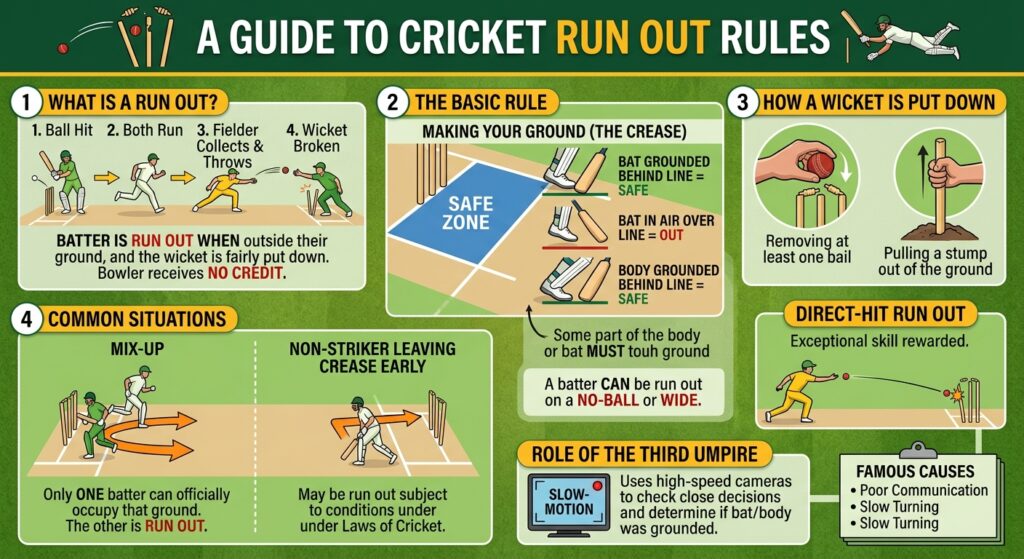
A batter is run out when they are outside their ground while the ball is in play, and the fielding team fairly puts down the wicket at the appropriate end.
In simple terms, a run out usually happens when two batters are running between the wickets and a fielder throws the ball toward the stumps before one of them reaches the crease.
For example:
- The striker hits the ball into the field.
- Both batters decide to run.
- A fielder collects the ball.
- The fielder throws it toward the wicket.
- The wicketkeeper or another fielder breaks the wicket while a batter is outside the crease.
If the batter has not made their ground, they can be given out.
A run out is recorded as a dismissal against the batter, but unlike being bowled or caught, the bowler does not receive credit for the wicket.
The Basic Cricket Run Out Rule
According to the Laws of Cricket, a batter can be run out if:
- The ball is still in play.
- The batter is outside their ground.
- A member of the fielding side puts down the wicket correctly.
- The wicket is put down at the end where the batter is attempting to make their ground.
The most important concept is understanding what it means for a batter to be in their ground.
A batter is generally considered safe when some part of their body or bat is grounded behind the popping crease.
This is why players often stretch their bats toward the crease when completing a run.
What Does “Making Your Ground” Mean?
Making your ground means reaching the safety of the crease.
Imagine a batter running toward the non-striker’s end. If the wicket is broken before any part of the batter’s body or bat touches the ground behind the crease, the batter can be run out.
However, simply holding the bat over the crease is not enough. The bat or body must be grounded.
Example
Suppose a batter dives toward the crease:
- Bat is in the air over the line → Not safe.
- Bat touches the ground behind the crease → Safe.
- Body touches the ground behind the crease → Safe.
This small difference often decides close run-out decisions.
How Is a Wicket Put Down?
For a run out to occur, the wicket must be properly put down.
A wicket can be put down by:
- Removing at least one bail from the stumps with the ball.
- Pulling a stump out of the ground using the ball or hand holding the ball.
A fielder does not necessarily need to throw the ball directly at the stumps. For example, a wicketkeeper can collect the ball and use it to remove a bail while the batter is outside the crease.
Direct-hit run outs are popular because they are spectacular, but many run outs happen after the wicketkeeper receives a throw from the field.
Can a Batter Be Run Out While Running?
Yes. This is the most common type of run out.
When two batters run between the wickets, both need to safely reach the opposite crease. If either batter is outside their ground when the wicket is broken, that player may be dismissed.
Consider this situation:
| Situation | Result |
|---|---|
| Batter safely reaches the crease before wicket is broken | Not out |
| Wicket is broken before batter reaches crease | Run out |
| Batter turns back and leaves the crease | Can be run out |
| Both batters end up at the same end | One batter may be dismissed |
Communication between batters is therefore extremely important.
Many run outs happen not because of poor running speed, but because of hesitation.
A call of “yes,” followed immediately by “no,” can leave one batter stranded in the middle of the pitch.
What Happens If Both Batters Are at the Same End?
This is one of the most interesting run-out situations.
Sometimes both batters run toward the same crease and end up standing at one end of the pitch. Only one batter can officially occupy that ground.
The umpire determines which batter is out based on which player is outside their ground when the wicket is put down.
Usually, the batter who has failed to make their ground is dismissed.
Example
Imagine:
- Batter A runs from one end.
- Batter B runs toward the same end.
- Both arrive at almost the same time.
- The wicket is broken.
If Batter A is safely inside the crease while Batter B is outside, Batter B will be run out.
This situation is often called a mix-up between the wickets.
Can a Batter Be Run Out Without Attempting a Run?
Yes.
A batter does not have to be attempting a run to be dismissed run out.
For example, a non-striker may leave their crease early while the bowler is delivering the ball. If the wicket is fairly put down while that player is out of their ground, a run-out dismissal can occur under the applicable Laws.
Similarly, a batter might leave the crease after playing a shot, believing the ball is dead. If the ball remains in play and the wicket is put down, there can still be a possibility of a run out.
This is why players must always remain aware of the ball’s status.
Run Out at the Non-Striker’s End
One situation that generates regular discussion involves the non-striker leaving their crease before the bowler completes their delivery.
If the non-striker is out of their ground at the relevant moment, the bowler may put down the wicket at that end in accordance with the Laws.
This type of dismissal is sometimes incorrectly described using older informal terminology, but it is officially treated as a form of run out.
The basic principle is simple: a batter who leaves the safety of their ground takes a risk.
The Laws of Cricket provide a clear framework for such dismissals, although the exact timing and method of putting down the wicket are important.
Run Out vs Stumping
Run outs and stumpings may look similar because both involve a batter outside their crease and the wicketkeeper breaking the wicket.
However, they are different forms of dismissal.
| Feature | Run Out | Stumping |
|---|---|---|
| Batter attempting a run | Can be yes or no | Usually no |
| Bowler receives wicket credit | No | Yes |
| Usually completed by | Any fielder | Wicketkeeper |
| Batter leaves crease | During play | After missing the ball |
| Can involve a throw from field | Yes | No |
Simple Example
A batter steps out to hit a spinner and misses the ball. The wicketkeeper removes the bails before the batter returns to the crease.
This is generally a stumping, provided the conditions for a stumping are satisfied.
However, if the batter had attempted to run and was outside the crease when the wicket was put down, it would normally be considered a run out.
Understanding the batter’s actions is important when distinguishing between these dismissals.
Can a Batter Be Run Out If the Ball Hits Them?
Yes, in certain situations.
Imagine a batter hits the ball and begins running. A fielder throws the ball toward the stumps, but the ball accidentally hits the batter before reaching the wicket.
If the ball remains in play and subsequently leads to the wicket being put down while the batter is outside their ground, a run out may still occur.
However, cricket has rules regarding obstruction of the field if a batter deliberately interferes with the fielding side.
The key difference is intent.
Accidentally being hit by the ball is not the same as deliberately blocking or interfering with a fielder.
What Happens If the Ball Is a No-Ball?
A batter can still be run out from a no-ball.
This surprises many beginners because a no-ball protects a batter from certain dismissals, such as being bowled.
However, run out remains a possible method of dismissal.
For example:
- Bowler delivers a no-ball.
- Batter hits the ball.
- Batters attempt a run.
- A fielder collects the ball.
- The wicket is broken before a batter reaches the crease.
The batter can be run out.
Therefore, a no-ball does not mean the batters can run without risk.
Can a Batter Be Run Out on a Wide Ball?
Yes.
A batter can be run out while attempting runs from a wide delivery.
Suppose the wicketkeeper misses a wide ball, and both batters decide to run. The fielding team can attempt a run out while the ball remains in play.
This creates exciting situations in limited-overs cricket, especially when teams are chasing small totals.
Run Outs and Completed Runs
One confusing aspect of run-out laws involves completed runs.
When a batter is run out, the umpire must determine which runs count based on the circumstances of the play.
For casual cricket fans, the easiest principle to remember is that the dismissal and scoring situation are assessed according to the point at which the wicket is put down and the progress of the batters.
Scorekeepers and umpires follow detailed Laws when deciding the exact number of runs credited.
Example Scenario
Suppose:
- Batter hits the ball.
- The pair complete one run.
- They attempt a second.
- One batter is run out attempting the second run.
The first completed run will generally count, while the outcome of the attempted additional run depends on the precise circumstances.
This is one reason professional umpires carefully observe the position of both batters during every run-out appeal.
The Role of the Third Umpire
Technology has made close run-out decisions much easier to judge.
In international cricket and many professional competitions, the on-field umpire can refer a close run-out decision to the television umpire.
The third umpire examines video footage to determine:
- Whether the wicket was properly put down.
- Whether the batter’s bat or body was grounded.
- The exact moment the wicket was broken.
- Whether the ball remained in play.
- Which batter was outside their ground.
Slow-motion cameras are particularly useful when the difference between out and not out is only a few centimeters.
Fans often see the television replay freeze at the exact moment the bail leaves the stump.
Direct-Hit Run Outs
A direct-hit run out occurs when a fielder throws the ball directly onto the stumps.
These dismissals require exceptional skill because the fielder must accurately hit a relatively small target from a distance.
A typical direct-hit sequence looks like this:
- Batter plays the ball.
- Batters attempt a quick run.
- Fielder attacks the ball quickly.
- Fielder picks it up.
- Fielder throws directly at the stumps.
- The ball breaks the wicket.
- Batter is outside the crease.
Direct hits are especially valuable in limited-overs cricket because quick singles are common.
A brilliant run out can also shift momentum dramatically. A batting side may be scoring freely, but losing a key batter to a sharp piece of fielding can immediately change the match.
Famous Causes of Run Outs
Most run outs can be traced back to one of a few common mistakes.
1. Poor Communication
Both batters must clearly communicate whether to run.
A hesitant call can create confusion within seconds.
2. Slow Turning
A batter may initially decide not to run but then change their mind. Turning and accelerating takes time, giving fielders an opportunity.
3. Watching the Ball Too Long
Some players focus on where the ball is going instead of immediately committing to a decision.
4. Overconfidence
A batter may assume a run is easy without considering the strength of the fielder’s throwing arm.
5. Brilliant Fielding
Sometimes the batter does everything reasonably well, but an outstanding piece of fielding produces an exceptional run out.
How Batters Can Avoid Being Run Out
Good running between the wickets is a skill that requires practice.
Here are some useful habits:
- Call loudly and clearly.
- Watch the ball when making the initial decision.
- Trust your partner’s call.
- Turn quickly after reaching the crease.
- Slide or dive when necessary.
- Keep the bat grounded inside the crease.
- Know which fielder has a strong throwing arm.
Communication is arguably the most important factor.
Experienced batting partnerships often develop a strong understanding of each other’s running style. They know when to take risks and when to stay at their respective ends.
Why Run Outs Are So Important in Cricket
Run outs are unique because they reward the entire fielding unit.
A bowled dismissal is often associated mainly with the bowler. A catch may highlight one outstanding fielder. A run out, however, can involve multiple players.
One fielder may stop the ball, another may collect it, and the wicketkeeper may complete the dismissal.
Run outs also demonstrate that cricket is not just about batting and bowling. Athleticism, awareness, speed, and teamwork can all decide the outcome of a match.
In modern cricket, teams place enormous importance on fielding standards. Fast reactions and accurate throws can save runs and create wickets.
Frequently Asked Questions
Is a run out credited to the bowler?
No. A run-out dismissal is not credited as a wicket to the bowler.
Can the striker be run out?
Yes. Either batter can be run out if they are outside their ground and the correct wicket is put down.
Can you be run out on a no-ball?
Yes. A batter can be run out from a no-ball.
Can you be run out on a wide?
Yes. Batters can be run out while attempting runs from a wide ball.
Does the bat have to touch the ground?
Yes, simply holding the bat in the air over the crease does not make the batter safe. The bat or body must be grounded within the crease.
Can a non-striker be run out for leaving the crease early?
Yes, subject to the applicable conditions under the Laws of Cricket.
Final Thoughts
The cricket run out rules may appear complicated at first, but the basic principle is straightforward: when the ball is in play, a batter must make their ground before the fielding side fairly puts down the wicket.
From simple mix-ups to spectacular direct hits, run outs are among the most dramatic moments in the sport. They can reward brilliant fielding, punish poor communication, and completely change the momentum of a match.
For beginners, the best way to understand run outs is to watch the position of the batter, the crease, and the exact moment the wicket is broken. Once these three elements become clear, most run-out decisions are easy to understand.
Whether it happens through a lightning-fast throw from the boundary or a close call reviewed by the third umpire, a run out remains one of cricket’s most exciting forms of dismissal and an essential part of understanding the game.
