


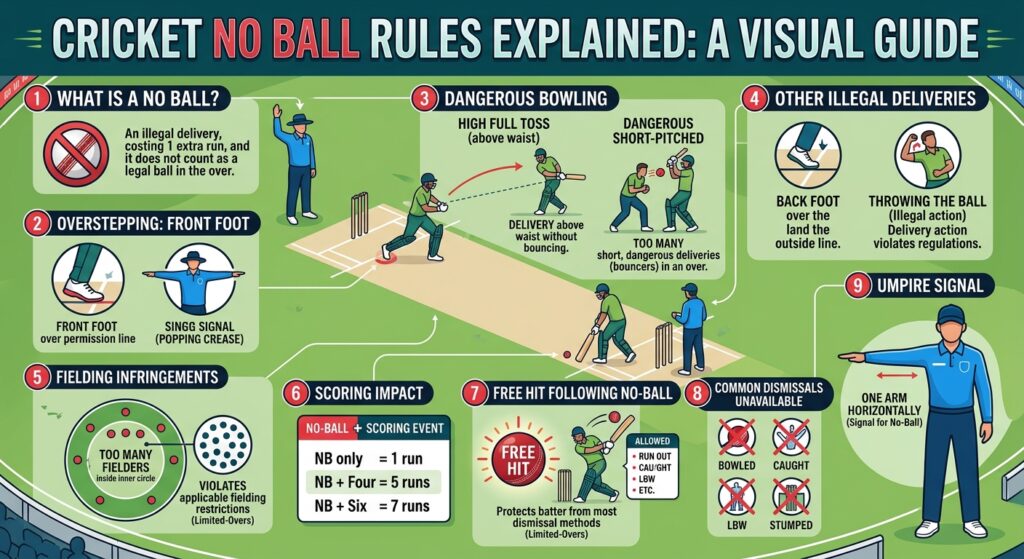
A no-ball is one of the most common cricketing terms, but it can still be confusing for people who are new to the game. You may hear the umpire call “no ball,” see the bowler receive a warning, and then watch the batter score extra runs or even hit a boundary.So I explain “Cricket no ball rules explained” in simple terms.
In simple terms, a no-ball happens when the bowler delivers the ball in a way that breaks one of cricket’s delivery laws. There are several different situations that can result in a no-ball, including overstepping the crease, dangerous bowling, illegal deliveries, and certain fielding violations.
The important thing to remember is that a no-ball is not normally counted as one of the six legal deliveries in an over. The batting side also receives an additional run in most standard situations.
This guide explains the cricket no-ball rules in straightforward language, including what happens after a no-ball, how it affects the score, and why the rule is important.
What is Cricket No Ball Rules Explained?
A no-ball is an illegal delivery called by the umpire when the bowler fails to meet the required conditions for a legal delivery.
When a no-ball is called, the batting team normally receives one penalty run. The delivery itself does not count as one of the six legal balls in the over.
For example, imagine a bowler delivers six balls but one of them is a no-ball. The over will not finish after those six deliveries because the no-ball was not a legal delivery. The bowler must deliver another legal ball.
If the batter hits a no-ball for four, the batting team receives the no-ball extra plus the four runs scored from the bat. If the batter hits a six, the total can become seven runs.
Why Do Umpires Call No Balls?
The no-ball law exists to make sure the bowler delivers the ball fairly and safely.
Cricket gives bowlers significant freedom, but that freedom comes with certain restrictions. For example, a bowler cannot simply run beyond the allowed crease and release the ball from an illegal position.
No-ball rules also help protect batters from dangerous deliveries and prevent teams from gaining an unfair advantage through illegal fielding arrangements.
The Most Common No Ball: Overstepping
One of the easiest no-balls to understand is the front-foot no-ball.
At the moment the bowler delivers the ball, some part of the bowler’s front foot must remain behind the popping crease as required by the Laws of Cricket.
If the bowler’s front foot goes beyond the permitted line, the umpire can call a no-ball.
This is commonly known as an “overstep.”
Example
Suppose a fast bowler runs toward the crease and releases the ball while the front foot lands beyond the popping crease.
The umpire sees the infringement and calls no-ball.
The batting team receives the penalty for the no-ball, and the delivery does not count as one of the legal balls in the over.
This is why fast bowlers must have excellent control over their run-up and delivery stride.
Back-Foot No Ball
The bowler also has restrictions concerning the back foot.
The back foot must not land outside the limits of the return crease when the delivery is made.
If the bowler’s back foot crosses the relevant boundary of the return crease, the delivery can be called a no-ball.
This rule is particularly important because bowlers need to maintain a legal position while generating speed and power.
What Happens After a No Ball?
When an umpire calls a no-ball, several things happen.
First, the batting side is awarded the applicable no-ball penalty.
Second, the delivery is not counted as one of the six legal balls required to complete the over.
Third, play continues unless the ball becomes dead for another reason.
The batter can still score runs from the delivery.
For example:
| Situation | Possible Runs Added |
|---|---|
| No-ball only | 1 extra |
| No-ball + 1 run from bat | 2 total |
| No-ball + 2 runs from bat | 3 total |
| No-ball + boundary four from bat | 5 total |
| No-ball + six from bat | 7 total |
The exact scoring can depend on how the runs are completed and where they come from.
Can a Batter Be Out on a No Ball?
A common misconception is that a batter cannot be dismissed at all from a no-ball.
That is not completely correct.
Most methods of dismissal are not available from a no-ball, but certain dismissals can still occur.
A batter can generally be dismissed on a no-ball by:
- Run out
- Obstructing the field
- Hit the ball twice, subject to the Laws
Other common dismissals, such as bowled, caught, leg before wicket, and stumped, do not normally apply to a no-ball in the same way they would on a legal delivery.
This is one reason no-balls can be particularly valuable to the batting team.
No Ball and the Free Hit
In many limited-overs competitions, a no-ball can lead to a free hit on the following delivery.
A free hit gives the batter protection from several common dismissal methods.
The exact free-hit conditions are determined by the competition’s playing regulations and the type of no-ball involved.
During a free hit, the batter can attack with less fear because certain dismissals are not available.
For example, a batter may use a free hit to attempt a big shot over the boundary.
The free-hit concept has made no-balls even more significant in modern limited-overs cricket.
Can a No Ball Be Hit for Six?
Yes.
A batter can hit a no-ball for six if the ball is legally struck and the shot clears the boundary without bouncing.
In that situation, the batting side can receive the six runs from the shot plus the no-ball penalty.
That can produce a seven-run scoring event.
This is one reason bowlers are under enormous pressure when they bowl no-balls in T20 cricket. A no-ball followed by a boundary can change the momentum of an innings very quickly.
Can a No Ball Be Hit for Four?
Yes.
A batter can hit a no-ball for four.
If the ball reaches the boundary after being struck by the bat, the batting side can receive the boundary runs plus the applicable no-ball penalty.
For example:
No-ball penalty + boundary four = 5 runs.
However, boundary scoring can become more complicated if the ball reaches the boundary without being struck by the bat, so the umpire and scorers must determine how the runs should be recorded under the Laws.
Wide vs No Ball
Beginners often confuse wides and no-balls because both give the batting team an extra.
The main difference is the reason for the illegal delivery.
A wide is generally called when the ball passes too far from the batter to be considered a reasonable opportunity to score from it, subject to the applicable playing conditions.
A no-ball occurs for specific bowling or fielding infringements.
Both can result in an extra run, and neither counts as one of the six legal balls in an over.
| Feature | No Ball | Wide |
|---|---|---|
| Basic reason | Illegal delivery or other infringement | Ball outside the permitted wide area |
| Penalty | Usually 1 run | Usually 1 run |
| Counts as legal delivery? | No | No |
| Batter can score from it? | Yes | Yes |
| Free hit in many limited-overs formats? | Often, depending on competition rules | Generally no |
Dangerous Short-Pitched Bowling
Cricket also has rules concerning dangerous short-pitched deliveries.
A bowler is permitted to bowl bouncers, but there are limits and conditions governing how many short-pitched deliveries can be bowled in an over under particular playing conditions.
If a bowler repeatedly delivers dangerous short-pitched balls or breaches the relevant restrictions, the umpire can intervene.
The rules are designed to balance exciting fast bowling with player safety.
The exact restrictions can vary between formats and competitions, so professional cricket should always be understood according to the playing conditions being used.
Dangerous Full Tosses
A full toss is a delivery that reaches the batter without bouncing.
Not every full toss is a no-ball. However, a delivery that reaches the batter above the permitted height can be considered dangerous and illegal.
For example, a fast bowler delivering a high full toss around the batter’s head area can create a serious safety risk.
The umpire has the responsibility to judge the delivery according to the relevant laws and playing conditions.
Throwing the Ball
Cricket bowling has specific requirements regarding the bowler’s arm.
A bowler cannot simply throw the ball toward the batter.
If the umpire believes the bowler’s delivery action violates the applicable bowling regulations, the delivery may be called illegal.
This area is more technical than a simple front-foot no-ball and can involve match officials and competition procedures.
Fielding Restrictions and No Balls
No-balls are not limited to the bowler’s feet or delivery action.
Fielding infringements can also result in a no-ball.
For example, in certain situations the fielding side must comply with restrictions about where players can stand. Limited-overs cricket has specific fielding restrictions designed to prevent defensive fields from making scoring excessively difficult.
If the fielding team violates an applicable restriction, the umpire may call a no-ball.
The exact restrictions depend on the format and playing conditions.
Why No Balls Matter So Much in T20 Cricket
A no-ball can be especially costly in T20 cricket because every delivery is valuable.
Imagine a team needs 12 runs from the final over.
The bowler delivers a no-ball, giving the batting side an extra run. The batter then hits the next delivery for six.
Suddenly, the batting team has made significant progress without using a legal ball in the over.
If the no-ball also creates a free-hit opportunity under the competition’s rules, the pressure becomes even greater.
This is why bowlers spend considerable time practicing their run-up, landing position, and release.
How No Balls Affect an Over
A standard over consists of six legal deliveries.
No-balls and wides do not count as legal deliveries.
For example, consider this sequence:
| Delivery | Result | Legal Ball Count |
|---|---|---|
| 1 | Dot ball | 1 |
| 2 | Single | 2 |
| 3 | No-ball | 2 |
| 4 | Four | 3 |
| 5 | Wide | 3 |
| 6 | Single | 4 |
| 7 | Dot ball | 5 |
| 8 | Two runs | 6 |
The over has required eight actual deliveries because two deliveries were illegal.
This simple example shows why a bowler can sometimes deliver more than six balls in an over.
How Umpires Signal a No Ball
The umpire has a clear signal for a no-ball.
The umpire extends one arm horizontally to the side.
This signal tells the players, scorers, and spectators that the delivery was illegal.
At professional levels, the signal is particularly important because the scorers need to record the correct type of extra.
Television coverage may also display the no-ball information on the scoreboard almost immediately.
Common No Ball Mistakes by Bowlers
Bowlers can make several mistakes that lead to no-balls.
The most common include:
- Overstepping the front crease
- Landing the back foot illegally
- Bowling a dangerous delivery
- Exceeding restrictions on certain short-pitched deliveries
- Breaking fielding restrictions
- Using an illegal bowling action
Many of these mistakes can be reduced through practice and awareness.
Fast bowlers in particular must find a balance between getting as close to the crease as possible and remaining behind the line.
How Batters Can Take Advantage of a No Ball
A smart batter treats a no-ball as an opportunity.
Since the delivery is already illegal and does not count toward the six legal balls, the batter can often be more aggressive.
In formats where a free hit follows the relevant no-ball, the batter may deliberately attack.
For example, the batter might move across the crease, prepare for a lofted shot, or target a boundary area where the fielding team has fewer players.
However, aggression still carries risk. A batter can mistime the ball or get caught in one of the dismissal methods that remain possible.
Why No Ball Rules Are Important
No-ball rules serve several purposes.
They protect batters from certain dangerous deliveries, keep the bowler’s delivery fair, regulate fielding arrangements, and prevent teams from gaining an unfair advantage.
Without these rules, bowlers could overstep significantly, deliver excessively dangerous balls, or use illegal positioning to make batting unnecessarily difficult.
The no-ball is therefore more than just an extra run. It is part of cricket’s system for maintaining fairness and safety.
Final Thoughts
Cricket no-ball rules may seem complicated at first, but the basic idea is straightforward: a no-ball is called when a delivery or related action does not meet the legal requirements.
The most familiar example is a bowler overstepping the crease. However, no-balls can also involve dangerous deliveries, illegal bowling actions, and certain fielding infringements.
For the batting team, a no-ball can be a valuable opportunity because it normally brings an extra run and gives the batter another delivery. In many limited-overs competitions, it can also result in a free hit.
For bowlers, repeated no-balls can be extremely expensive. They give away extras, provide additional scoring opportunities, and can shift momentum toward the batting side.
Once you understand how no-balls work, watching cricket becomes much easier. The next time you see an umpire raise an arm and call “no ball,” you will know that the delivery was illegal, the batting team has received the applicable penalty, and the bowler still has to complete the required number of legal deliveries in the over.
