


Most people watching cricket assume the game only really pauses between overs, or when there’s a drinks break, or after someone’s given out. But there’s a much smaller, much more frequent kind of pause built right into the middle of the action, and it’s one of the least understood laws in the sport. It’s called the dead ball, and it governs a huge chunk of moments you’ve probably seen without ever clocking that anything official had happened at all — a batter stepping away at the last second, a ball trickling to the boundary, a fielder’s helmet getting clipped by a throw.
The rule sounds almost too simple to need explaining. The ball stops being “live,” nothing that happens afterward counts, end of story. In practice, though, it’s one of the more layered parts of the Laws of Cricket, and it occasionally causes genuine controversy — including a widely discussed pair of incidents in 2026 where two umpires made opposite calls on what looked like near-identical situations, and both were technically correct. That alone tells you this rule deserves a proper look rather than a passing mention.
What “Dead Ball” Actually Means
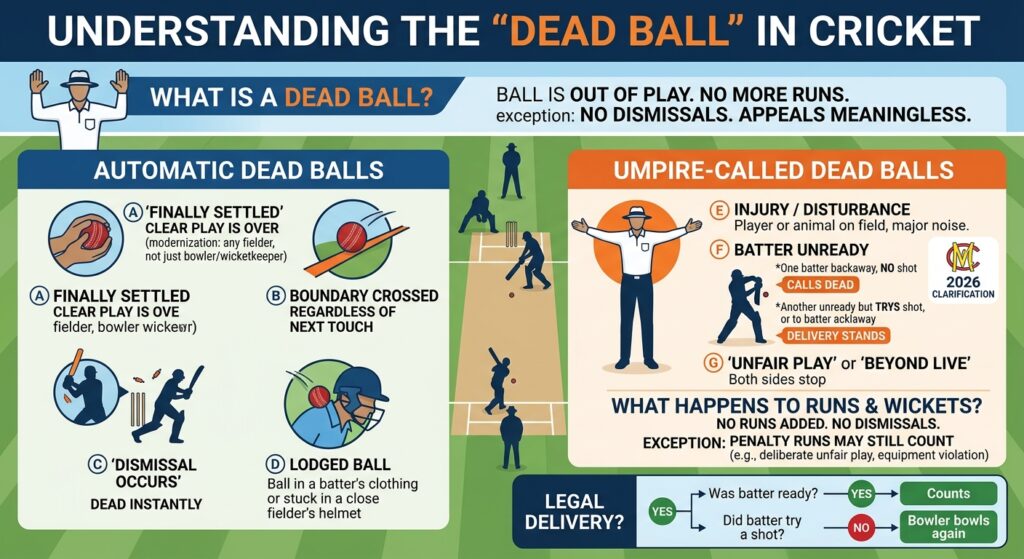
At its simplest, a dead ball is one that is no longer in play. Once the umpire has called it, or once it becomes dead automatically under the Laws, nothing that happens next affects the match — no runs can be scored, no batter can be dismissed, and any appeal made afterward is meaningless. The action has, for all competitive purposes, already ended, even if the ball is still physically moving around the field.
It’s worth stressing that a dead ball isn’t always announced with a dramatic shout or a big signal. Plenty of dead balls happen automatically, without the umpire needing to call or signal anything, simply because the situation itself satisfies the conditions laid out in the Laws. Others require the umpire to actively step in and declare it. Knowing the difference between these two categories is really the key to understanding the whole rule.
The Automatic Situations
Some things simply make a ball dead the instant they happen, with no umpire intervention needed. The most common of these, by far, is the ball becoming “finally settled” — meaning it comes to rest, or is firmly held, in the hands of a fielder, and it’s clear the play arising from that delivery has run its course. Interestingly, under the modern version of the Laws, that settling no longer has to happen specifically in the hands of the bowler or wicketkeeper the way older rulebooks required. It can be any fielder, or the ball can simply be lying stationary on the ground, and the umpire has been given more discretion to judge the moment sensibly rather than sticking to a rigid technical definition.
A boundary is another automatic trigger — the moment the ball reaches or crosses the boundary rope, whether it’s touched the ground first for a four or gone straight over for a six, the ball is dead from that instant, regardless of anything that happens to it physically afterward. A batter being dismissed works the same way: the ball becomes dead the moment the dismissal actually occurs, not when the umpire raises the finger or the fielding side finishes celebrating.
There’s also a slightly odd but memorable one: if the ball gets lodged in a batter’s clothing or equipment, whether or not they attempted to play a shot at it, that’s an automatic dead ball too. The same goes if the ball ends up stuck in a fielder’s helmet, which has become a more talked-about scenario in recent years as protective headgear has become more common around the field, particularly for close catchers.
When the Umpire Has to Step In
Not every dead-ball scenario resolves itself. Sometimes it’s entirely down to the umpire’s judgment, and this is where most of the controversy tends to live. An umpire might call a dead ball because of injury to a player or an animal wandering onto the field, because of some kind of unfair play, because a serious noise or disturbance genuinely distracted a batter mid-shot, or simply because it becomes obvious to the umpire that both sides — fielders and batters alike — have mentally stopped treating the ball as live, even though nobody’s formally done anything about it yet.
One of the clearer examples of this discretionary category, and probably the most talked-about in recent seasons, involves a batter simply not being ready when the bowler runs in. If the striker steps away, holds up a hand, or otherwise signals they aren’t prepared, the umpire is supposed to call dead ball — but only if two conditions are both true: the batter genuinely doesn’t attempt to play a shot at the delivery, and they have what the Laws call an adequate reason for not being ready. If either condition is missing — say, the batter still has a go at the ball despite being unready, or they step away for no real reason at all — the delivery stands and counts as normal.
This exact distinction caused a stir during a pair of Hundred matches in 2026, when two separate umpires reached opposite conclusions in what looked, from the outside, like very similar moments. In one game, a batter backed away as the bowler was already running in, and the umpire called it dead because the batter made no attempt to play the ball. In another match on the same day, a different batter also wasn’t fully ready but still tried to play a shot anyway, and that delivery was allowed to stand. Both decisions were correct under the Laws, because the two situations differed on exactly the point that matters: whether the batter attempted to play the ball or not. The MCC themselves ended up publicly clarifying the distinction afterward, which tells you how easily this particular scenario confuses even experienced watchers of the game.
What Happens to Runs and Wickets Once the Ball Is Dead
Once a ball is properly dead, the general rule is that nothing counts from that point onward. No further runs can be added, and no dismissal can be completed off the back of it. There is, however, one meaningful exception worth knowing: penalty runs. Umpires retain the authority to award penalty runs even after a ball has technically gone dead, in situations involving deliberate unfair play, equipment violations, or a ball striking something it shouldn’t have, like a protective helmet left on the field by the fielding side. So “nothing counts” is mostly true, but not completely — penalties sit in their own separate category and can still be applied.
It’s also worth knowing that a dead ball decision, once made, is final. There’s no mechanism for an umpire to reverse a dead ball call partway through, even if replays later suggest a different reading of the situation might have been fairer. Once it’s called, the players and the scoreboard simply have to live with it.
Does It Count as a Legal Delivery?
This is another spot where confusion creeps in, because the answer genuinely depends on why the ball was called dead in the first place. If a delivery is ruled dead because the batter wasn’t ready and made no attempt to play it, with a valid reason for being unprepared, that ball doesn’t count toward the over — the bowler effectively gets it back and has to bowl again. But if both conditions aren’t met, the delivery is treated as perfectly normal and does count, even though the phrase “dead ball” got mentioned somewhere in the process. This is exactly the nuance that trips people up when they hear commentators debating a decision in real time, because “dead ball” doesn’t automatically mean “the over just got a free pass.”
Lost Balls and Older Rules
Cricket followers who remember older editions of the Laws might recall the “lost ball” call, where any fielder could shout it if the ball genuinely couldn’t be found or retrieved, and the batting side would be credited with either the completed runs (plus the run in progress if the batters had crossed) or six runs, whichever was greater. That specific mechanism has since been folded into the broader dead ball framework rather than existing as its own separate rule, but you’ll still occasionally hear commentators use the old terminology out of habit, especially in longer-format cricket where a lost ball is more plausible given the size of some grounds.
There’s also a practical side-effect worth mentioning: whenever a dead ball is called, if the ball itself needs replacing for any reason, the umpires are required to bring in a replacement in a similar condition of wear, so the contest between bat and ball doesn’t suddenly shift because a scuffed old ball got swapped for a shiny new one mid-innings.
Why This Rule Matters More Than It Looks
On the surface, dead ball feels like housekeeping — a technical pause rather than a genuine talking point. But it quietly touches almost every part of the game. It decides whether a chaotic scramble after a near-collision counts or gets wiped clean. It decides whether a batter who steps away at the wrong moment gets away with it or gets punished with a legal delivery they weren’t ready for. It even shapes strategy at the margins, since bowlers and batters both know exactly how far they can push the boundaries of “ready” and “not ready” before an umpire steps in.
Next time you’re watching a match and see a batter suddenly back off, or a fielder scramble after a ball that’s already trickled past the rope, it’s worth pausing for a second to ask exactly which version of “dead” just happened — automatic, or umpire’s call. More often than not, that one small distinction is doing more work than it gets credit for.
