


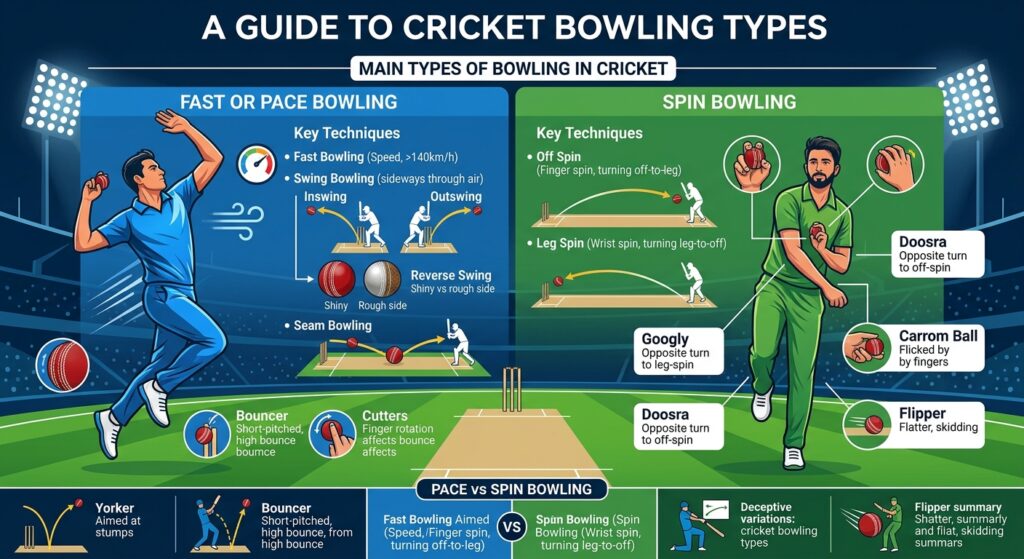
Cricket bowling is one of the most interesting parts of the game. A bowler does far more than simply throw a ball toward the batter. The speed of the delivery, movement through the air, bounce from the pitch, and amount of spin can all change what happens next.
Different bowlers use different techniques to make batting difficult. Some rely on raw pace, while others use swing, seam movement, or spin. Understanding these cricket bowling types makes it much easier to follow a cricket match and appreciate the skill involved.
In this guide, we will explain the main types of cricket bowling, including fast bowling, swing bowling, seam bowling, and the major varieties of spin bowling.
What Are the Main Types of Bowling in Cricket?
Cricket bowling can broadly be divided into two categories:
- Fast or pace bowling
- Spin bowling
Pace bowlers try to trouble batters mainly through speed, bounce, swing, and seam movement. Spin bowlers generally deliver the ball more slowly but make it turn after pitching.
Within these two broad categories are several different techniques.
1. Fast Bowling
Fast bowling is based primarily on speed. A fast bowler runs toward the crease, builds momentum, and releases the ball at a high pace.
The fastest bowlers can regularly bowl above 140 km/h, with a few exceptional players reaching speeds above 150 km/h. At that pace, the batter has very little time to react.
Fast bowlers commonly use:
- Short-pitched deliveries
- Yorkers
- Bouncers
- Full-length deliveries
- Swing
- Seam movement
- Changes of pace
A good fast bowler does not necessarily bowl every delivery at maximum speed. Variation is often more effective than simply trying to bowl faster.
Why Is Fast Bowling Difficult to Face?
The main challenge is reaction time. A fast delivery can reach the batter very quickly, especially when it is aimed at the stumps or body.
A fast bowler can also use bounce to force the batter into an uncomfortable position. This is why pace bowling can be particularly dangerous on pitches that offer good bounce.
2. Medium-Fast Bowling
Medium-fast bowling sits between traditional fast bowling and medium pace.
These bowlers may not have the extreme speed of the quickest international bowlers, but they can still generate enough pace to pressure a batter. Their biggest strength is often control and variation.
Medium-fast bowlers frequently combine pace with:
- Swing
- Seam movement
- Accurate line and length
- Slower balls
- Cutters
A bowler who repeatedly lands the ball in the right area can be extremely effective even without exceptional speed.
3. Swing Bowling
Swing bowling is a technique in which the ball moves sideways through the air before reaching the batter.
The condition of the ball, seam position, wrist position, release, and weather conditions can all influence swing.
There are two traditional forms of swing.
Inswing
An inswinger moves toward the batter after being released.
For a right-handed batter, the ball generally moves toward the batter’s body or leg side. If the batter misjudges the movement, the ball can hit the pads or stumps.
Outswing
An outswinger moves away from the batter.
Against a right-handed batter, it generally moves toward the off side. Outswing is particularly useful because it can tempt a batter into playing at a delivery outside the off stump.
Swing bowling is often most effective when the bowler can maintain a consistent seam position.
4. Reverse Swing
Reverse swing is another form of swing bowling. It usually becomes more noticeable when the cricket ball gets older and one side becomes significantly rougher than the other.
Instead of behaving like a conventional swinging ball, the older ball can move in the opposite direction from what a batter might expect.
Reverse swing became especially famous in Test cricket because skilled bowlers can make an older ball move sharply at high speed.
The technique requires excellent control of the seam, wrist, and ball condition. It can be extremely difficult for a batter to handle because the delivery may appear to be moving one way before suddenly going the other way.
5. Seam Bowling
Seam bowling relies on the cricket ball landing on its seam and moving sideways after pitching.
A seam bowler attempts to keep the seam upright. When the ball hits the pitch at the correct angle, it may deviate left or right.
This movement is called seam movement.
Seam bowling can be particularly effective on pitches with grass or moisture because the surface can provide additional assistance.
The biggest advantage of seam movement is uncertainty. The batter cannot always predict exactly where the ball will go after bouncing.
6. Yorker
A yorker is a fast delivery that pitches very close to the batter’s feet or at the base of the stumps.
It is one of the most important weapons available to a pace bowler.
A well-directed yorker can be difficult to score from because the batter has little room to swing the bat. It can also hit the stumps directly.
Yorkers are especially common at the end of limited-overs innings. Bowlers often use them during the final overs because they can restrict boundaries.
However, a yorker requires precision. If the bowler misses the target and delivers a low full toss, the batter may have an excellent scoring opportunity.
7. Bouncer
A bouncer is a short-pitched delivery that rises toward the batter after bouncing.
The goal is often to make the batter play a defensive shot, change their position, or challenge their ability to control the ball.
Bouncers are commonly used by fast bowlers who can generate significant bounce.
The delivery is particularly effective when combined with fuller balls. After several deliveries aimed at the stumps, a sudden bouncer can surprise the batter.
There are rules governing how many short-pitched deliveries can be bowled in an over, depending on the format and playing regulations.
8. Off Spin
Off spin is one of the main types of finger spin.
An off-spinner generally uses the fingers to rotate the ball so that it moves from the off side toward the leg side after pitching to a right-handed batter.
Off-spin bowling is usually slower than pace bowling, but the turn and changes in flight can make it difficult to attack.
An off-spinner may vary:
- Flight
- Speed
- Length
- Amount of turn
- Angle of delivery
The bowler’s objective is often to create doubt in the batter’s mind about whether to attack or defend.
9. Leg Spin
Leg spin is a wrist-spin technique and is often considered one of the most difficult bowling styles to master.
A leg-spinner normally turns the ball from the leg side toward the off side when bowling to a right-handed batter.
The delivery can turn significantly after pitching, especially on a helpful surface.
Leg-spin bowlers can also use several variations, including the googly.
Because the wrist position and release are complicated, consistent leg-spin requires considerable practice.
10. Googly
The googly is a famous variation used by leg-spinners.
Although it is delivered using a leg-spinner’s action, it turns in the opposite direction from the normal leg-break.
This makes it particularly deceptive.
A batter watching a wrist-spinner closely may expect the ball to turn one way. If the bowler successfully disguises the googly, the ball can move in the opposite direction after bouncing.
A well-bowled googly can beat the outside or inside edge and may result in a bowled dismissal or LBW.
11. Doosra
The doosra is a variation traditionally associated with off-spin bowling.
It generally turns in the opposite direction to the standard off-break for a right-handed batter.
The delivery can be difficult to read because the bowler attempts to maintain a similar action while producing different movement.
The doosra has been particularly associated with modern international cricket and has become an important part of cricket’s bowling vocabulary.
12. Carrom Ball
The carrom ball is another deceptive spin variation.
Instead of releasing the ball in the conventional manner, the bowler uses the fingers to flick it. The delivery can move in an unexpected direction after pitching.
The carrom ball gained popularity in professional cricket because it gives spin bowlers another way to surprise batters.
Its effectiveness depends heavily on disguise. If the batter recognizes the release early, the advantage can disappear.
13. Flipper
The flipper is a variation associated mainly with leg-spin bowling.
Instead of getting significant conventional leg-spin movement, the ball is squeezed or flicked in a way that produces a flatter trajectory and can skid through after pitching.
It is generally quicker than a normal leg-break and can catch a batter expecting a slower, more heavily spinning delivery.
The flipper is difficult to master because it requires precise finger and wrist control.
14. Slower Ball
The slower ball is primarily used by pace bowlers in limited-overs cricket.
The bowler deliberately reduces the speed of the delivery while trying to maintain a similar action.
The purpose is to make the batter mistime their shot.
For example, a batter may expect a delivery traveling at around 140 km/h but receive one that is considerably slower. If the batter commits to the shot too early, the ball may be hit weakly toward a fielder.
There are several ways to bowl a slower ball, including using different grips and cutters.
15. Cutters
Cutters are pace-bowling variations that produce movement after pitching.
An off-cutter generally moves toward the leg side for a right-handed batter, while a leg-cutter moves in the opposite direction.
The bowler changes the way the ball is released, creating additional movement from the pitch.
Cutters are particularly useful on slower surfaces where the ball grips the pitch.
Pace Bowling vs Spin Bowling
| Feature | Pace Bowling | Spin Bowling |
|---|---|---|
| Main weapon | Speed and movement | Turn and variation |
| Typical speed | Fast | Relatively slow |
| Main movement | Swing, seam, bounce | Spin after pitching |
| Common deliveries | Yorker, bouncer, slower ball | Leg-break, off-break, googly |
| Useful conditions | Bounce, seam, swing | Dry or turning surfaces |
| Main challenge | Reaction time | Reading movement |
Which Bowling Type Is Best?
There is no single bowling type that is best in every situation.
A fast bowler can be extremely effective when the pitch offers bounce or the weather helps swing. A spinner may become more dangerous as a pitch gets older and starts offering turn.
The best bowlers are usually those who can adapt to conditions and understand the batter’s weaknesses.
A bowler might begin with conventional swing, switch to a bouncer, and then surprise the batter with a yorker. Similarly, a spinner may change flight, speed, and turn to create an opportunity.
Final Thoughts
Cricket bowling contains far more variety than simply throwing a ball toward the stumps. Fast bowlers can use speed, swing, seam movement, yorkers, bouncers, cutters, and slower deliveries. Spin bowlers can rely on off-spin, leg-spin and deceptive variations such as the googly, doosra, carrom ball, and flipper.
Learning these bowling types helps beginners understand why a particular delivery is dangerous and how bowlers try to dismiss batters.
Once you know the basic differences between pace and spin, watching cricket becomes even more enjoyable. You begin to notice the bowler’s plans, the changes in delivery, and the small details that can decide an entire innings.
