


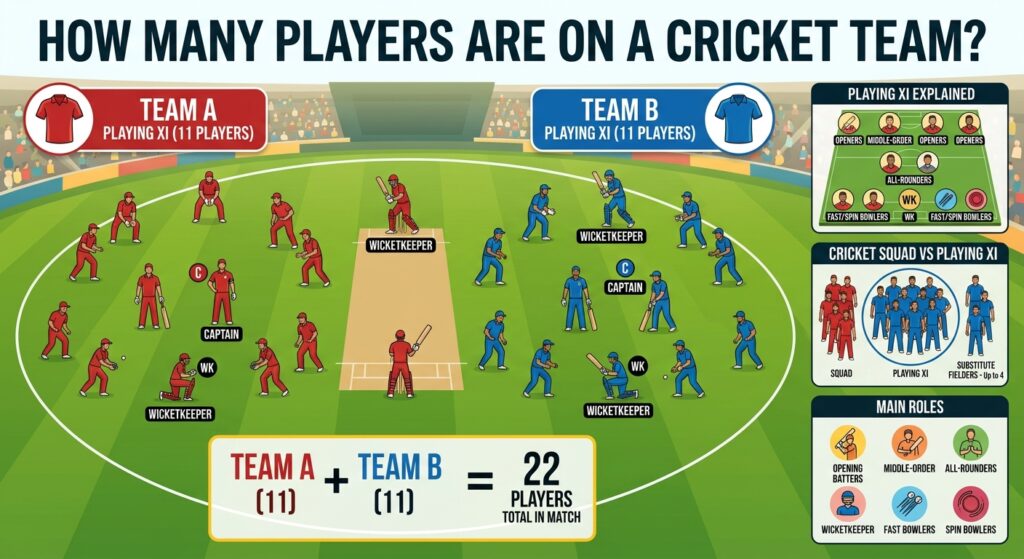
If you are new to cricket, one of the first questions that often comes to mind is: how many players are in a cricket team? The simple answer is 11 players per side during a cricket match. This rule applies to the main formats of the game, including Test cricket, One Day Internationals (ODIs), and Twenty20 (T20) cricket.
That means when two teams meet on the cricket field, there are normally 22 playing players in total — 11 representing one team and 11 representing the other. The International Cricket Council (ICC) playing conditions state that a match is played between two sides, with each side consisting of 11 players, including a captain.
However, there is a little more to the answer than simply saying “11.” Teams usually have additional squad members and substitute fielders, and modern cricket also has special replacement rules. Understanding the difference between a playing XI, a squad, and substitutes makes the whole subject much easier.
How Many Players Are in a Cricket Team?
A cricket team has 11 players on the field or in the playing XI for a match.
The basic calculation is straightforward:
One team = 11 players
Two teams = 11 + 11 = 22 players
So, although a tournament squad can contain more than 11 players, only 11 players from each side make up the official playing team for a particular match.
| Cricket Team | Number of Players |
|---|---|
| Playing XI | 11 |
| Opposition Playing XI | 11 |
| Total players in match | 22 |
| Captain | 1 from each team |
| Substitute fielders | Additional players may be nominated |
The ICC’s current playing conditions for men’s international cricket specify 11 players for each side and allow teams to nominate substitute fielders in addition to their playing XI.
Why Does a Cricket Team Have 11 Players?
The number 11 has been part of organized cricket for a very long time. Having 11 players gives a team enough people to cover batting, bowling, wicketkeeping and fielding responsibilities without making the game too crowded.
Every player can contribute differently. Some may be specialist batters, while others concentrate on bowling. All-rounders can contribute with both bat and ball, and the wicketkeeper has a particularly important role behind the stumps.
There is also a practical reason for having 11 fielders. A cricket field is large, and the captain needs enough players to cover different areas.
During an innings, nine fielders normally take positions around the field while the bowler and wicketkeeper perform their specific roles. The exact positioning changes depending on the batter, bowler, match situation and fielding restrictions.
The Playing XI Explained
When people say “cricket team,” they are usually talking about the playing XI.
The playing XI is the group of 11 players selected to take part in the match. Before the match begins, the captain names the players who will represent the team.
A typical team could contain:
- Opening batter
- Opening batter
- Top-order batter
- Middle-order batter
- Middle-order batter
- All-rounder
- Wicketkeeper-batter
- Spin bowler
- Fast bowler
- Fast bowler
- Spin or seam bowler
This is only an example. Teams can choose different combinations depending on conditions.
A side playing on a dry pitch might select more spin bowling, while a team playing on a fast or bouncy pitch could prefer additional fast bowlers.
Main Roles in a Cricket Team
The 11 players are not necessarily divided into fixed positions in the same way as players in football. Cricket is more flexible. A player can have more than one responsibility.
1. Opening Batters
Opening batters are the first two batters sent to the crease.
Their job is to face the new ball and give the team a solid beginning. In Test cricket, surviving the opening spell of fast bowlers can be particularly important.
Openers generally need good defensive technique, concentration and the ability to score when opportunities appear.
2. Middle-Order Batters
Middle-order players normally come in after the opening pair.
Their responsibilities can change depending on the situation. If the opening batters score heavily, the middle order may build a large total. If wickets fall quickly, middle-order batters may need to repair the innings.
3. All-Rounders
An all-rounder contributes with both batting and bowling.
Having an all-rounder can give a captain extra flexibility. For example, a team may have five specialist bowlers plus an all-rounder who can provide additional overs.
This can be particularly useful when the captain needs another bowling option.
4. Wicketkeeper
Every cricket team needs someone to perform the wicketkeeping role during the match.
The wicketkeeper stands behind the stumps and receives deliveries from the bowler. They also attempt catches, stumpings and run-outs.
Modern wicketkeepers are often excellent batters as well, making the role even more valuable.
5. Fast Bowlers
Fast bowlers try to dismiss batters through pace, movement and variations.
A team may select two, three or even four specialist fast bowlers depending on the conditions and format.
In Test cricket, fast bowlers may be especially important because they can operate over long periods.
6. Spin Bowlers
Spin bowlers use different types of spin and flight to make the ball difficult to hit.
The two major categories are generally off-spin and leg-spin, although there are several variations.
Spin can become extremely important on pitches that offer assistance to slower bowlers.
Is the Captain Included in the 11 Players?
Yes.
The captain is one of the 11 players in the playing XI. The ICC playing conditions specifically state that each side consists of 11 players, one of whom shall be captain.
For example, if a team has 10 other players plus its captain, the total is:
10 + 1 captain = 11 players
The captain is not an extra player.
The captain performs many responsibilities, including setting the field, deciding bowling changes, managing the team’s strategy and making tactical decisions during the match.
What Is a Cricket Squad?
This is where the answer can become confusing.
A squad is larger than the playing XI.
A team might travel to a tournament with a group of players much larger than 11. However, only 11 are selected to play in a particular match.
For example:
Squad = 15 players
Playing XI = 11 players
Players not in Playing XI = 4
Those four players are not automatically allowed to enter the match as normal substitutes. Their ability to participate depends on the applicable playing conditions.
The ICC‘s international playing conditions allow teams to nominate substitute fielders in addition to their 11 selected players. Current ICC conditions commonly specify a maximum of four substitute fielders for international matches.
What Is a Substitute Fielder?
A substitute fielder is a player who takes the field in place of another player under the permitted circumstances.
However, cricket substitutes work differently from substitutions in football.
A substitute fielder generally does not simply replace another player’s batting and bowling responsibilities whenever the captain wants. The laws and competition regulations place restrictions on what substitute fielders can do.
For ordinary fielding purposes, a substitute can take the field for a player who is temporarily absent, subject to the relevant rules and umpire procedures.
This is one reason why saying “a cricket team has 12 players on the field” would be incorrect.
There are still only 11 players forming the playing side.
Can a Substitute Bat?
Under normal circumstances, a substitute fielder does not take over the batting position of the player they replace.
This is an important difference between cricket and sports where substitutes can freely enter the game and perform every role.
There are special replacement provisions in modern cricket, including rules concerning concussion replacements. The precise conditions depend on the competition and playing regulations. ICC playing conditions include specific provisions for concussion replacements.
Therefore, if you see a substitute player on the field, that does not necessarily mean the original player has been permanently replaced in every aspect of the match.
How Many Players Are Needed to Start a Cricket Match?
The standard playing side consists of 11 players.
This is different from asking how many people are needed to form a complete squad for a tournament. Tournament regulations can specify larger squads, while the actual match uses a playing XI.
The ICC maintains separate playing conditions for different formats and competitions, including Tests, ODIs and T20Is.
So, if you are watching an international cricket match, the safest simple answer is:
11 players per team.
Do Test, ODI and T20 Teams Have 11 Players?
Yes.
The three major international formats all use an 11-player playing side.
| Format | Players in Playing XI |
|---|---|
| Test cricket | 11 |
| ODI cricket | 11 |
| T20 International | 11 |
| Two-team match total | 22 |
The length of the match changes dramatically between formats, but the number of players in the playing XI remains 11.
Test cricket can last several days, while an ODI normally consists of a maximum of 50 overs per side and a T20 match normally consists of 20 overs per side. The team size, however, stays at 11.
Why Teams Need Different Types of Players
Having 11 players does not mean all 11 have identical jobs.
Cricket requires a combination of skills.
A team that selects too many specialist batters may struggle to take wickets. A team with too many bowlers may find it difficult to build a strong total.
This creates an interesting selection puzzle for the captain and coaching staff.
For example, imagine a team chooses:
- 5 specialist batters
- 1 wicketkeeper-batter
- 2 all-rounders
- 3 specialist bowlers
The calculation is:
5 + 1 + 2 + 3 = 11 players
Another team might choose:
- 4 specialist batters
- 1 wicketkeeper
- 2 all-rounders
- 4 bowlers
Again:
4 + 1 + 2 + 4 = 11 players
Both combinations meet the basic requirement, but they provide different strengths.
Does Every Player Have to Bat?
No.
In cricket, all members of the playing XI can potentially be involved in the batting order, but the team’s batting order determines when they come to the crease.
A specialist bowler may be selected mainly for bowling rather than batting. However, when their turn comes, they may still need to bat.
This is especially noticeable in Test cricket, where teams often have specialist bowlers at the lower end of the batting order.
Does Every Player Have to Bowl?
No.
Not every player is required to bowl.
Teams normally have several bowling options, while specialist batters may rarely or never bowl.
All-rounders are valuable because they can provide an additional bowling option while also contributing runs.
The captain decides who bowls and when, within the regulations of the particular format.
What Happens If a Player Gets Injured?
Injuries can make team numbers more complicated.
If a player is injured during a match, the relevant playing conditions determine what can happen. A substitute fielder may be permitted in certain circumstances, while special replacement provisions can apply to specific injuries.
Concussion is one notable example. ICC regulations provide for concussion replacements when the required conditions are satisfied.
The exact process is controlled by the playing conditions and match officials rather than being an unrestricted substitution system.
Cricket Team Size vs Cricket Squad Size
This distinction is worth remembering:
Playing XI: The 11 players selected to participate as the main team.
Squad: The larger group of players available to the team for a tournament, series or competition.
Substitute fielder: An eligible player who can field under the applicable regulations when permitted.
Replacement player: A player who may replace another player in specifically defined circumstances.
These terms are sometimes used interchangeably by casual viewers, but they do not mean exactly the same thing.
Final Answer: Cricket Team How Many Players?
So, how many players are in a cricket team? The straightforward answer is 11 players.
Each side selects a playing XI, making 22 players in total when two teams meet. The 11 players can have different responsibilities, including batting, bowling, wicketkeeping and all-round duties. The captain is included in the 11 rather than being an additional player.
Teams can also have additional squad members and nominated substitute fielders. Current ICC international playing conditions provide for 11 playing players and, in relevant competitions, up to four substitute fielders. Special replacement rules can also apply in circumstances such as concussion.
The easiest way to remember it is:
One cricket team = 11 players
Two cricket teams = 22 players
Once you understand the difference between the playing XI, squad and substitutes, the structure of a cricket team becomes much clearer. Whether you are watching a Test match, ODI or T20, the core playing side remains the same: 11 players working together to score runs, take wickets and win the match.
