


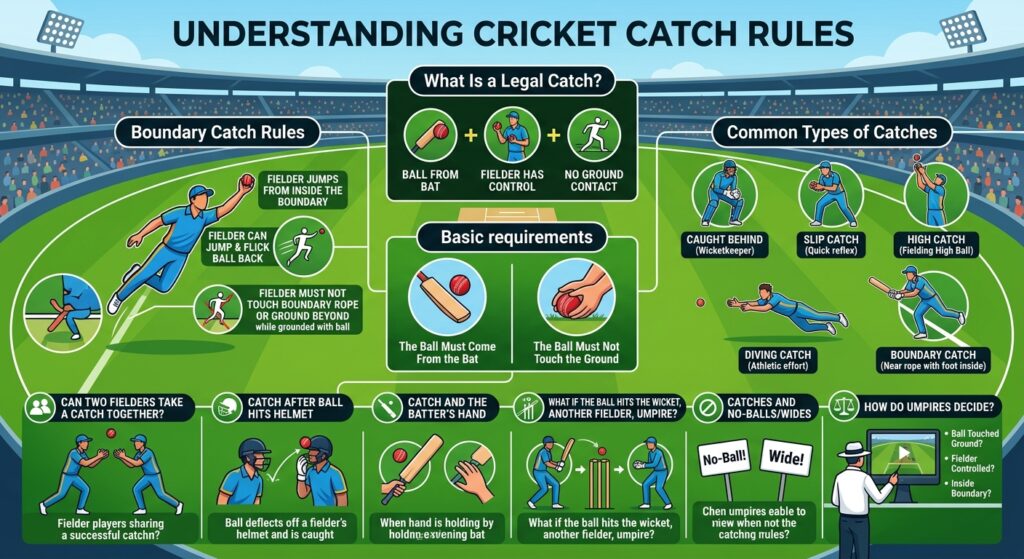
Catching is one of the most exciting parts of cricket. A perfectly timed catch can end a batter’s innings in a fraction of a second, while a dropped catch can completely change the direction of a match. Although catching may look simple from the outside, the Laws of Cricket contain several conditions that must be satisfied before an umpire can declare a batter out caught.
For someone new to cricket, questions often arise. Can a fielder catch the ball after it touches the ground? What happens if the fielder crosses the boundary? Can a catch be completed after the ball touches another player? What if the ball hits the bat and then the batter’s hand?
This guide explains the most important cricket catch rules in simple language and covers the situations that commonly confuse beginners.
What Is a Catch in Cricket?
A catch occurs when a batter hits the ball with the bat, or with a hand holding the bat, and a fielder legally completes the catch before the ball touches the ground.
If all the conditions are satisfied, the batter is given out Caught.
The catch must be completed according to the Laws of Cricket. The fielder must have control of the ball and, in most normal situations, must remain in contact with the ground within the boundary while completing the catch.
Catches can happen almost anywhere on the field. A fielder might take a simple catch close to the pitch, a diving catch in the outfield, or an athletic catch near the boundary.
Basic Rules for a Legal Catch
There are several basic requirements for a catch to be valid.
1. The Ball Must Come From the Bat
For a batter to be dismissed caught, the ball must touch the bat or a hand holding the bat.
If the ball hits only the batter’s body or protective equipment without making contact with the bat, a caught dismissal normally cannot be given.
This is one reason the exact point of contact is important when umpires review a close catch.
2. The Ball Must Not Touch the Ground
The fielder must complete the catch before the ball touches the ground.
If the ball touches the ground before the fielder has complete control of it, the batter is not out caught.
For example, if a fielder dives forward and the ball lands in their hands but then touches the ground before they establish control, it is generally not a completed catch.
This is why television replays often focus closely on the position of the ball and the fielder’s fingers or hands.
3. The Fielder Must Have Control
Simply touching the ball is not enough.
The fielder needs to demonstrate control of the ball and their movement. A ball that briefly touches a player’s hand before falling to the ground does not normally count as a completed catch.
A good catch means the fielder has secured the ball and completed the catching action.
What Happens If the Fielder Drops the Ball?
If a fielder gets both hands around the ball but loses it before completing the catch, the batter is not out caught.
The ball can slip through the hands, bounce against the fielder, or come loose while the fielder is falling. If the ball touches the ground before control is established, the catch has not been completed.
This is commonly called a dropped catch.
Dropped catches can be costly because the batter receives another opportunity to score runs.
Boundary Catch Rules
Boundary catches are among the most complicated and spectacular situations in cricket.
A fielder can sometimes catch a ball near the boundary even if they leave the ground. However, the Laws place important restrictions on contact with the boundary.
A fielder must not be grounded beyond the boundary while making the catch.
For example, imagine a batter hits a high ball toward the boundary. A fielder runs toward it, jumps from inside the boundary, catches the ball in the air, and lands outside the boundary. Under the relevant boundary laws, that situation can result in a boundary rather than a legal catch.
Modern cricket has produced many remarkable boundary catches in which fielders jump, release the ball before touching the ground outside the boundary, and then attempt to complete the catch.
Because these situations can be extremely difficult to judge in real time, umpires may use television replays.
Can a Fielder Throw the Ball in the Air?
Yes, under certain circumstances.
A fielder close to the boundary may jump and touch the ball while airborne, then throw or knock it back toward the playing area before making contact with the ground beyond the boundary.
The boundary laws contain specific requirements concerning where the fielder was grounded and how the catch is completed.
This is why some spectacular catches appear to involve a fielder stepping or jumping beyond the boundary but still result in a dismissal after careful review.
Can Two Fielders Take a Catch Together?
Yes.
A catch does not necessarily have to be completed by one fielder alone.
Two or more fielders can be involved in completing a catch, provided the relevant requirements are met. For instance, one fielder may initially touch the ball and another may secure it before it touches the ground.
However, the ball must remain under control and the fielders must comply with the boundary and other relevant laws.
These catches can be particularly difficult to judge because the ball may move quickly between players.
Catch After the Ball Hits the Helmet
Another interesting situation occurs when a fielder’s helmet is involved.
If a ball is accidentally deflected off a fielder’s helmet and then caught by another fielder before touching the ground, the dismissal can depend on the circumstances and applicable Laws.
The Laws of Cricket contain specific provisions regarding catches involving fielding equipment. This is an area where the exact sequence of events matters.
The important lesson for beginners is that not every deflection automatically makes a catch illegal.
Catch and the Batter’s Hand
The Laws make an important distinction concerning the batter’s hand.
For a caught dismissal, the ball can be considered to have touched the bat if it touches a hand that is holding the bat.
However, if the ball hits a hand that is not holding the bat, it is not treated in the same way as contact with the bat for a caught dismissal.
This can become particularly important when a batter attempts to protect themselves or move their hands while playing a shot.
Can a Catch Be Taken After the Ball Hits the Wicket?
A catch has to satisfy the requirements of the relevant dismissal.
If the ball hits the wicket after making contact with the batter’s bat and before a fielder catches it, the outcome depends on the circumstances. In many such situations, the batter could already be out Bowled, meaning the catch is no longer the method of dismissal.
The sequence of events is therefore extremely important.
What If the Ball Hits Another Fielder First?
A catch can still be possible if the ball touches another fielder before being caught, provided it does not touch the ground and the requirements for a legal catch are satisfied.
For example, a fielder may get a fingertip to a powerful shot, causing the ball to pop into the air. Another fielder may then catch it.
If the ball remains airborne and the catch is completed legally, the batter can be given out.
These types of catches are often among the most difficult for umpires to judge.
What If the Ball Hits the Umpire?
An umpire is part of the field of play, and the Laws provide for situations where the ball makes contact with an umpire.
If a batter hits the ball and it subsequently touches an umpire before being caught by a fielder, the circumstances have to be considered under the Laws.
The key point is that the ball must not have touched the ground before the catch is completed.
Caught Behind
One of the most common catches in cricket is caught behind, usually taken by the wicketkeeper.
A batter may edge the ball while attempting to play a shot. The ball travels behind the batter and is caught by the wicketkeeper.
The wicketkeeper does not have to be directly behind the stumps to take the catch, although their position is governed by other Laws.
Caught-behind decisions can be extremely close. The ball may barely touch the edge of the bat, making technology such as UltraEdge or Snickometer-style systems useful in some competitions.
Slip Catches
Slip fielders specialize in catching edges from batters.
The first slip is positioned near the wicketkeeper, with additional slips positioned farther away.
When a fast bowler produces an outside edge, the ball can travel quickly toward the slips. The fielder has very little time to react.
Slip catching requires excellent reflexes and concentration.
Catches and No-Balls
A no-ball can affect whether a batter can be dismissed caught.
Under the law, a batter generally cannot be dismissed caught from a no-ball. There are, however, other forms of dismissal that can remain possible after a no-ball.
This is why a fielder may take an apparently brilliant catch but the batter can remain not out if the delivery was called a no-ball.
The umpire’s decision on the legality of the delivery therefore comes before the final dismissal decision.
Catches and Wide Balls
A wide delivery also has special rules.
If the batter makes contact with the ball and it is caught, the circumstances may affect the scoring and dismissal. The ball being called a wide depends on the applicable conditions and whether the batter has made contact.
For beginners, it is useful to remember that the classification of a delivery can change the possible dismissal.
How Do Umpires Decide Difficult Catches?
Umpires use several things to make a decision.
In straightforward situations, the on-field umpire can immediately give the batter out.
For difficult catches, especially those involving the boundary or a possible ground contact, the third umpire may examine video footage.
Slow-motion replays can help determine:
- Whether the ball touched the ground
- Whether the fielder controlled the ball
- Whether the fielder was inside the boundary
- Whether the ball touched the bat
- Whether another fielder was involved
- Whether the delivery was legal
Technology has made many close catching decisions easier to analyze, although some situations can still be extremely complicated.
Common Types of Catches in Cricket
| Type of Catch | Typical Situation |
|---|---|
| Caught Behind | Wicketkeeper catches an edge |
| Slip Catch | Slip fielder catches an edge |
| High Catch | Ball is hit high into the air |
| Diving Catch | Fielder dives to reach the ball |
| Boundary Catch | Fielder catches near the boundary |
| Running Catch | Fielder moves quickly to catch the ball |
| Reflex Catch | Very fast reaction close to the batter |
| Two-Fielder Catch | More than one fielder helps complete the catch |
Why Catching Is So Important
Catching can have a major effect on a cricket match.
A batter who is difficult to dismiss may score a large number of runs if given an extra opportunity after a dropped catch. On the other hand, an outstanding catch can remove an important player at exactly the right moment.
This is why professional teams spend considerable time practicing catching. Fielders work on high catches, close catching, boundary situations, slip catching, and reactions.
Good catching is not only about strong hands. It also requires concentration, positioning, communication, balance, and confidence.
Final Thoughts
Cricket catch rules may seem complicated at first, but the basic idea is straightforward: when a batter makes a legal contact with the bat, a fielder must complete the catch without the ball touching the ground and while satisfying the relevant fielding and boundary requirements.
From a simple wicketkeeper catch to a spectacular boundary grab, every successful catch can become an important moment in a match.
Understanding these rules also makes controversial decisions easier to follow. When a catch goes upstairs for review, you will know why the umpire is checking the ball, the fielder’s hands, the ground, and the boundary.
For beginners, the best way to understand catching is to watch these different situations during live matches. After seeing enough examples, the rules become much easier to recognize in real time.
