


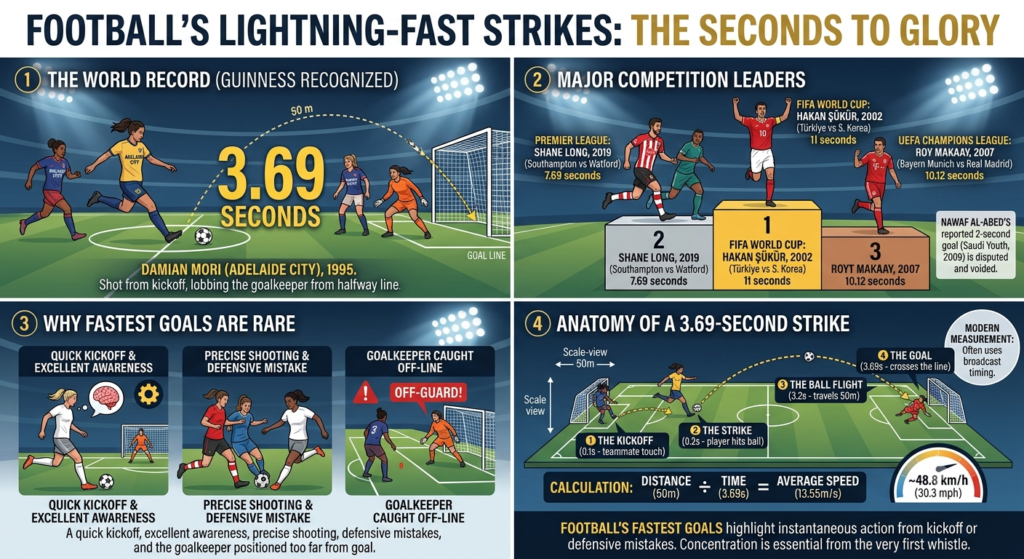
Football matches usually take 90 minutes to decide a winner, but sometimes the action begins almost instantly. A perfectly planned kickoff, a goalkeeper caught off the line, or a defensive mistake can produce a goal within seconds of the referee’s whistle.
Over the years, football has witnessed several astonishing goals scored almost immediately after kickoff. Some have become official world records, while others remain disputed because of differences in competition rules or record-keeping.
In this article, we’ll explore the fastest goal in football history, look at other lightning-fast goals, explain how these records are measured, and examine why scoring within seconds is so rare.
What Is the Fastest Goal in Football History?
Determining the fastest goal in football history is not as simple as it seems. Different organizations recognize different records depending on whether the match was played at the professional, amateur, or youth level.
According to Guinness World Records, the fastest goal in a top-flight men’s professional football match was scored by Damian Mori of Adelaide City in Australia after just 3.69 seconds on 6 December 1995. He scored directly after kickoff by shooting from near the halfway line when he spotted the goalkeeper off his line.
Fastest Football Goals at a Glance
| Rank | Player | Time | Competition | Year |
|---|---|---|---|---|
| 1 | Damian Mori | 3.69 seconds | Australian National Soccer League | 1995 |
| 2 | Nawaf Al-Abed* | 2.0 seconds (disputed) | Saudi Youth Competition | 2009 |
| 3 | Shane Long | 7.69 seconds | Premier League | 2019 |
| 4 | Hakan Şükür | 11 seconds | FIFA World Cup | 2002 |
| 5 | Ledley King | 9.82 seconds | Premier League | 2000 |
*Nawaf Al-Abed’s famous two-second goal is widely reported but remains disputed because the match was later declared void due to player eligibility issues.
Damian Mori’s Record-Breaking Goal
Australian striker Damian Mori produced one of football’s most remarkable moments.
Immediately after kickoff:
- A teammate lightly touched the ball.
- Mori noticed the goalkeeper standing well outside the penalty area.
- He struck the ball first time from near the halfway line.
- The ball flew over the goalkeeper and into the net.
Record Details
| Detail | Information |
|---|---|
| Player | Damian Mori |
| Club | Adelaide City |
| Opponent | Sydney United |
| Time | 3.69 seconds |
| Date | 6 December 1995 |
| Record Status | Guinness-recognized professional record |
This remains the benchmark for the fastest goal in a top-flight men’s professional match.
The Controversial Two-Second Goal
Many football fans have heard of Nawaf Al-Abed’s incredible strike, reportedly scored just two seconds after kickoff.
The goal was spectacular, but there is an important reason why it isn’t universally accepted as the all-time official record.
After the match, officials ruled the game void because ineligible players had taken part in the age-restricted competition. As a result, many statisticians do not recognize the goal as an official world record.
This is why Damian Mori’s 3.69-second goal is commonly cited as the official professional record.
Fastest Goals in Major Competitions
Different tournaments have their own fastest-goal records.
| Competition | Player | Time |
|---|---|---|
| FIFA World Cup | Hakan Şükür | 11 seconds |
| Premier League | Shane Long | 7.69 seconds |
| UEFA Champions League | Roy Makaay | 10.12 seconds |
These goals are especially memorable because they were scored on football’s biggest stages.
Hakan Şükür’s World Cup Record
The fastest goal in FIFA World Cup history belongs to Turkish striker Hakan Şükür.
He scored after only 11 seconds against South Korea in the third-place playoff at the 2002 FIFA World Cup.
World Cup Record
| Category | Record |
|---|---|
| Player | Hakan Şükür |
| Country | Türkiye |
| Opponent | South Korea |
| Time | 11 seconds |
| Tournament | FIFA World Cup 2002 |
More than two decades later, this remarkable World Cup record still stands.
Shane Long’s Premier League Record
On 23 April 2019, Southampton striker Shane Long set the Premier League record by scoring after just 7.69 seconds against Watford.
He closed down a defender immediately after kickoff, blocked a clearance, rounded the goalkeeper, and calmly finished.
The goal broke the previous Premier League record held by Ledley King.
How Are Fastest Goals Measured?
The timer starts when:
- The referee blows the whistle.
- The kickoff is taken.
The timer stops:
- The moment the entire ball crosses the goal line.
Modern competitions often use broadcast timing and official match data, making records more accurate than in previous decades.
Why Are Fastest Goals So Rare?
Scoring within the opening few seconds requires several things to happen perfectly.
- A quick kickoff.
- Excellent awareness.
- Precise shooting.
- Defensive mistakes.
- Sometimes the goalkeeper being positioned too far from goal.
Even world-class players may never score within the first minute of a match.
Calculation: How Fast Is a 3.69-Second Goal?
Assume the ball travels approximately 50 meters from near the halfway line into the goal.
Average speed:
Speed = Distance ÷ Time
50 ÷ 3.69 = 13.55 meters per second
Converting to kilometers per hour:
13.55 × 3.6 ≈ 48.8 km/h (30.3 mph)
In reality, the ball often travels even faster immediately after being struck before slowing due to air resistance and contact with the ground.
Interesting Facts
| Fact | Detail |
|---|---|
| Fastest professional goal | Damian Mori – 3.69 seconds |
| Fastest World Cup goal | Hakan Şükür – 11 seconds |
| Fastest Premier League goal | Shane Long – 7.69 seconds |
| Fastest goals often come from | Kickoff or defensive mistakes |
| Goalkeepers most at risk | When standing well outside the penalty area |
Conclusion
The fastest goals in football history highlight how quickly a match can change. Whether it’s Damian Mori’s Guinness-recognized 3.69-second strike, Hakan Şükür’s unforgettable World Cup record, or Shane Long’s Premier League milestone, these moments prove that concentration is essential from the very first whistle.
While new records may be set in the future, scoring within just a few seconds remains one of football’s rarest and most exciting achievements.
