


Football is known for its fast pace, dramatic goals, and emotional moments. But it has also seen its fair share of controversial referee decisions. A missed handball, an incorrect offside call, or a wrongly awarded penalty can completely change the outcome of a match.
To help reduce these mistakes, football introduced VAR (Video Assistant Referee) a technology designed to support referees by reviewing important decisions using video footage.
Since its introduction, VAR has become one of the most talked-about topics in football. Some fans believe it has made the game fairer, while others think it interrupts the excitement of live matches.
So, what exactly is VAR, how does it work, and when is it used?
In this guide, you’ll learn everything you need to know about VAR in football, including its history, rules, process, advantages, disadvantages, and real-life examples.
What Does VAR Stand For?
VAR stands for Video Assistant Referee.
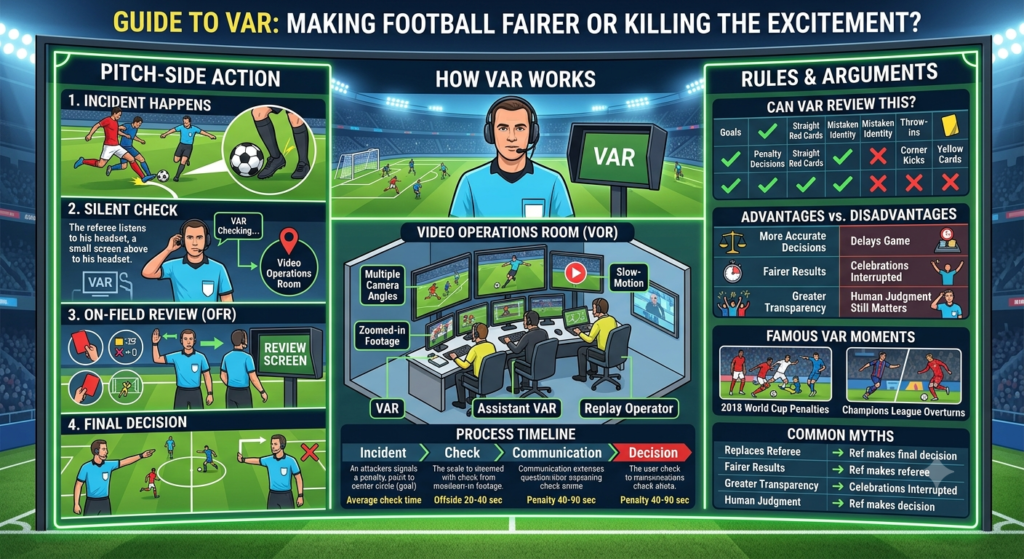
Rather than replacing the referee on the pitch, VAR acts as an extra set of eyes. A team of match officials watches the game from a dedicated video operations room equipped with multiple camera angles.
Whenever a potentially game-changing incident occurs, the VAR team reviews the footage. If they believe the referee may have made a clear and obvious mistake, they recommend a review.
The final decision, however, always belongs to the referee on the field.
Why Was VAR in Football Introduced?
Before VAR, football relied entirely on the referee and assistant referees.
Although officials are highly trained, football moves incredibly quickly. Players sprint, tackles happen in seconds, and referees have only one viewing angle.
This sometimes led to major errors, including:
- Incorrect penalty decisions
- Wrong offside calls
- Goals scored using handballs
- Cases of mistaken identity
- Red-card incidents being missed
VAR was introduced to reduce these mistakes without changing the basic flow of the game.
Its main objective is simple:
Correct clear and obvious errors in important match situations.
Brief History of VAR
The idea of using video technology in football had been discussed for many years.
Here’s a quick timeline:
| Year | Event |
|---|---|
| 2012 | FIFA began discussing video review systems. |
| 2016 | VAR trials started in selected competitions. |
| 2018 | FIFA World Cup became the first World Cup to use VAR. |
| 2019 | UEFA Champions League introduced VAR. |
| 2019–20 | Most major European leagues adopted VAR. |
Today, VAR is used in competitions such as:
- FIFA World Cup
- UEFA Champions League
- Premier League
- Serie A
- Bundesliga
- La Liga
- UEFA European Championship
- FIFA Club World Cup
How Does VAR Work?
During the match, a separate team watches every incident from several camera angles.
The VAR team usually consists of:
| Official | Responsibility |
|---|---|
| Video Assistant Referee | Reviews key incidents. |
| Assistant VAR | Supports the main VAR official. |
| Replay Operator | Controls camera angles and replays. |
Unlike the referee on the field, VAR officials can instantly access slow-motion replays, zoomed-in footage, and multiple broadcast cameras.
The VAR Review Process
The review process follows a clear sequence.
Step 1: Incident Happens
A possible foul, offside, or handball occurs.
↓
Step 2: VAR Checks
The video officials immediately review the incident.
↓
Step 3: Communication
VAR communicates with the referee through a headset.
↓
Step 4: Decision
The referee either:
- accepts VAR’s advice, or
- watches the replay on the pitch-side monitor.
↓
Step 5: Final Decision
The referee announces the final decision.
Which Decisions Can VAR Review?
VAR cannot review every foul or throw-in.
Instead, it focuses only on four types of game-changing incidents.
| Situation | Can VAR Review? |
|---|---|
| Goals | Yes |
| Penalty Decisions | Yes |
| Straight Red Cards | Yes |
| Mistaken Identity | Yes |
| Throw-ins | No |
| Corner Kicks | No |
| Yellow Cards | Usually No |
This keeps reviews limited to the most important moments.
1. Goal Decisions
Every goal is automatically checked before play restarts.
VAR looks for possible issues such as:
- Offside
- Handball
- Foul during build-up
- Ball leaving the field
- Incorrect attacking foul
If no offence is found, the goal stands.
Example
A striker scores after a through ball.
VAR checks whether:
- the attacker was offside,
- the assistant referee missed the call,
- another foul happened earlier.
Only after these checks is the goal officially confirmed.
2. Penalty Decisions
Penalty incidents often happen quickly inside crowded penalty areas.
VAR reviews:
- Fouls
- Handballs
- Simulation (diving)
- Whether contact occurred inside the penalty area
If the referee missed a clear foul, VAR may recommend awarding a penalty.
Similarly, if a penalty was awarded incorrectly, VAR can advise cancelling it.
3. Direct Red Cards
VAR reviews only straight red-card offences.
Examples include:
- Serious foul play
- Violent conduct
- Dangerous tackles
- Elbowing an opponent
- Punching or kicking another player
Second yellow cards are not reviewed by VAR.
4. Mistaken Identity
Sometimes referees accidentally book or send off the wrong player.
VAR can quickly identify the correct player using video evidence.
This prevents incorrect punishments.
How Long Does a VAR Check Take?
The review time depends on how complicated the incident is.
| Incident | Average Time |
|---|---|
| Offside | 20–40 seconds |
| Goal Check | 20–60 seconds |
| Penalty Review | 40–90 seconds |
| Serious Red Card | 60–120 seconds |
Simple reviews finish quickly, while more complex incidents involving multiple camera angles can take longer.
Is Every Incident Reviewed?
Yes—but not every review is visible to fans.
VAR silently checks all major incidents in the background.
If everything looks correct, play continues without interruption.
Fans usually notice VAR only when:
- the referee delays play,
- the referee signals a review,
- the referee goes to the pitch-side monitor.
Does the Referee Always Use the Monitor?
No.
There are two types of VAR reviews.
| Review Type | Description |
|---|---|
| Silent Check | VAR reviews the incident without stopping play. |
| On-Field Review | The referee watches the replay on the monitor before making the final decision. |
Offside decisions usually don’t require the referee to view the monitor because they’re based on objective positioning.
Penalty and red-card incidents are more subjective, so the referee often watches the replay personally.
Common Signals Used by Referees
When fans see the referee drawing a rectangle in the air with their hands, it means a VAR review is taking place.
| Signal | Meaning |
|---|---|
| Rectangle gesture | VAR review |
| Point to center circle | Goal awarded |
| Point to penalty spot | Penalty awarded |
| Red card shown | Player sent off |
Why Is VAR So Controversial?
Despite improving accuracy, VAR continues to divide football fans.
Some supporters appreciate the fairness it brings, while others dislike the interruptions and close offside decisions measured by only a few centimeters.
These debates have become a regular part of modern football and continue to shape discussions among players, coaches, referees, and fans alike.
Advantages of VAR
Since its introduction, VAR has corrected many important mistakes that would previously have changed the outcome of matches. While it isn’t perfect, the system has improved the accuracy of key decisions in professional football.
Here are some of the biggest benefits.
| Advantage | How It Helps |
|---|---|
| More Accurate Decisions | Reviews important incidents from multiple camera angles. |
| Fairer Results | Reduces match-changing referee mistakes. |
| Protects Referees | Gives officials extra support during difficult decisions. |
| Discourages Cheating | Players are less likely to dive or commit hidden fouls. |
| Greater Transparency | Fans can often see when a review is taking place. |
Disadvantages of VAR
Although VAR has improved decision-making, it also has critics. Some fans and players believe it can interrupt the natural rhythm of a football match.
1. Delays the Game
A review can take anywhere from a few seconds to over a minute. During this time, players and supporters must wait for the final decision.
2. Celebrations Are Interrupted
Scoring a goal is one of football’s most exciting moments. However, many fans now hesitate to celebrate until the VAR check is complete.
3. Very Tight Offside Calls
Some offside decisions are determined by only a few centimeters. These close calls often spark debate about whether such tiny margins reflect the spirit of the game.
4. Human Judgment Still Matters
VAR provides video evidence, but referees still interpret many incidents, such as handballs and fouls. Different officials may reach different conclusions when reviewing the same footage.
Advantages vs. Disadvantages
| Advantages | Disadvantages |
|---|---|
| Reduces major errors | Can slow the match |
| Fairer decisions | Interrupts celebrations |
| Improves referee accuracy | Close decisions remain controversial |
| Reviews serious incidents | Not every decision satisfies everyone |
How VAR Detects Offside
Offside decisions are among the most common uses of VAR.
The system uses multiple synchronized cameras to determine the exact positions of attackers and defenders when the ball is played.
Officials draw virtual lines to compare the attacking player’s position with the second-last defender.
Example
Imagine a striker receives a pass and scores.
VAR checks:
- The exact moment the pass was made.
- The position of the attacker.
- The position of the second-last defender.
- Whether the attacker became involved in active play.
If the attacker was ahead of the second-last defender when the ball was played by a teammate, the goal is disallowed for offside.
VAR and Handball Decisions
Handball decisions are often difficult because not every touch of the ball with a hand or arm is an offence.
VAR helps referees review incidents involving:
- Deliberate handballs.
- Unnatural arm positions.
- Handballs that directly lead to a goal.
- Handballs inside the penalty area.
The referee may choose to review the footage on the pitch-side monitor before making a final decision.
Famous VAR Moments
Since its introduction, VAR has played a role in several memorable football matches.
2018 FIFA World Cup
The 2018 FIFA World Cup was the first World Cup to use VAR. Several penalties were awarded after video reviews, and FIFA considered the tournament a successful test of the technology.
UEFA Champions League
VAR has overturned goals for offside, confirmed penalties, and identified fouls that officials initially missed during Champions League knockout matches.
Domestic Leagues
Competitions such as the Premier League, La Liga, Serie A, and the Bundesliga now use VAR regularly, with reviews becoming a standard part of high-level football.
Does Every League Use VAR?
No.
VAR is mainly used in professional competitions with the necessary technology and trained officials.
Competitions That Commonly Use VAR
| Competition | Uses VAR |
|---|---|
| FIFA World Cup | Yes |
| UEFA Champions League | Yes |
| Premier League | Yes |
| La Liga | Yes |
| Serie A | Yes |
| Bundesliga | Yes |
| Ligue 1 | Yes |
| Many Lower Leagues | Not Always |
Lower divisions often do not use VAR because of the significant costs involved in installing cameras, communication systems, and video operation rooms.
Can VAR Change Any Decision?
No.
VAR is limited to four categories of incidents:
- Goals.
- Penalty decisions.
- Direct red cards.
- Mistaken identity.
Routine decisions such as throw-ins, corners, free kicks in midfield, or yellow cards are generally not reviewed.
Common Myths About VAR
| Myth | Reality |
|---|---|
| VAR replaces the referee. | False. The referee always makes the final decision. |
| Every foul is reviewed. | False. Only specific match-changing incidents are reviewed. |
| VAR is completely automatic. | False. Human officials review and interpret the footage. |
| Every review requires the monitor. | False. Many reviews are completed without an on-field review. |
| VAR guarantees perfect decisions. | False. Football still involves subjective judgment. |
Tips for Understanding VAR While Watching Football
If you’re new to the game, these tips can help you follow VAR decisions more easily:
- Wait until the referee confirms a goal before celebrating.
- Watch for the referee making a rectangle shape with their hands.
- Listen for stadium announcements during reviews in some competitions.
- Remember that not every stoppage is caused by VAR.
- Understand that the referee has the final authority, even after reviewing the footage.
Final Thoughts
VAR has changed modern football by providing referees with valuable video assistance during the most important moments of a match. While it has sparked debate over delays and close decisions, it has also reduced many clear officiating errors and improved fairness in top-level competitions.
The system is not designed to eliminate every disagreement. Instead, its purpose is to help referees make more accurate decisions in situations that can significantly affect the outcome of a game.
As technology continues to develop, VAR will likely become even more efficient, allowing football to balance tradition with greater accuracy while preserving the excitement that makes the sport so popular around the world.
