


Football is now played almost everywhere in the world. From huge international stadiums to small school grounds, millions of people spend their time kicking a ball around. Modern footballs are carefully designed, tested, and manufactured with advanced synthetic materials. They are round, light, waterproof, and built to behave consistently in different conditions.
But the football used today is the result of a very long journey.
When people search for the first football in the world, there is no single simple answer. Football-like games existed centuries before the modern sport was officially organized, and the earliest balls were very different from the ones used today. Some were made from animal skins, while others were constructed around inflated bladders or similar materials.
Understanding the first football means looking at the history of both the ball itself and the game that eventually became modern association football.
What Was the First Football in the World?
The earliest footballs were not manufactured in factories and did not have the carefully arranged panels we see today. They were basic objects that could be kicked, carried, or thrown during traditional games.
One of the oldest known ball games connected with football history is cuju, an ancient Chinese game. It was played many centuries ago and involved kicking a ball. The ball used in early versions of the game was considerably different from a modern football, but the basic idea of controlling a ball with the feet makes cuju an important part of football’s long history.
There were also ball games in other ancient civilizations. However, it is important not to describe every ancient ball game as modern football. The rules, equipment, playing areas, and objectives were often completely different.
Modern association football developed much later.
The First Football were made From Natural Materials
Before modern rubber, synthetic leather, and machine stitching became available, people had to use materials that could be found around them.
Animal skin was one of the most practical choices. A piece of leather could be shaped into a container and filled with another material. In many early examples, an inflated animal bladder was used as the inside of the ball.
The bladder provided the basic air-filled shape, while leather helped protect it.
This sounds primitive compared with today’s football, but it was an important technological step. An inflated ball was easier to kick and control than a solid object.
The biggest problem was durability.
An animal bladder could lose its shape, and natural leather could become heavy when wet. The quality of the ball could also vary considerably depending on how it was made.
That meant two footballs could behave very differently on the same playing field.
Football Before the Modern Rules
The development of the football was closely connected with the development of football itself.
During the nineteenth century, different schools, clubs, and communities in Britain played their own versions of football. There was no universal set of rules. Some versions allowed players to handle the ball, while others emphasized kicking.
The situation began to change in England during the 1800s.
In 1863, representatives of football clubs and schools met in London and formed The Football Association. The original Laws of the Game began to take shape during this period. FIFA’s historical account notes that the Football Association was formed in October 1863 and that a match between Barnes and Richmond in December that year was played under the new laws.
This was a major turning point.
Once football started developing standardized rules, the ball also became increasingly important. Players needed equipment that could be used consistently from one match to another.
What Did an Early Football Look Like?
An early football would look surprisingly different from a modern match ball.
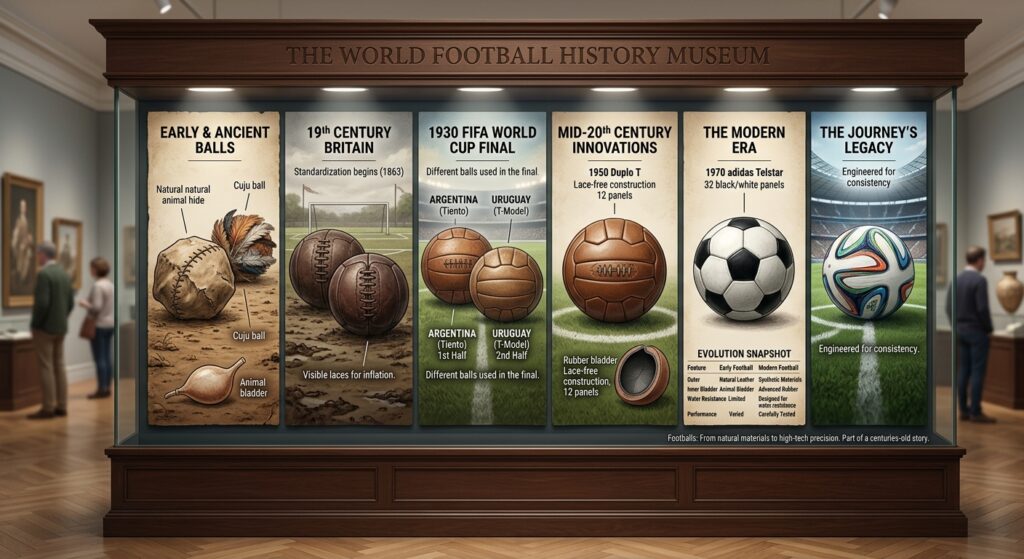
It was generally made from leather panels sewn together around an inflated bladder. The leather provided strength, but the construction often included a noticeable lace or opening through which the bladder could be inserted and inflated.
The result was roughly spherical, but it was not always perfectly round.
The shape could change during a match, particularly if the ball was poorly inflated or became wet.
This created another problem: leather absorbs water.
A football used in rainy weather could become much heavier. Players had to deal with a ball that was harder to kick, head, and control.
The evolution from these early leather balls to today’s highly engineered footballs therefore involved solving several practical problems.
| Feature | Early Football | Modern Football |
|---|---|---|
| Outer material | Natural leather | Synthetic materials |
| Inner bladder | Animal bladder or early bladder systems | Advanced rubber/bladder construction |
| Shape | Often irregular | Highly consistent sphere |
| Water resistance | Limited | Designed for water resistance |
| Panels | Basic stitched panels | Precisely engineered panels |
| Manufacturing | Mostly handmade | Industrial production |
| Performance | Varied | Carefully tested |
The Importance of the Rubber Bladder
One of the most important developments in football history was the use of rubber.
A rubber bladder could hold air more effectively than an animal bladder and provided a more reliable foundation for the ball.
This did not immediately solve every problem, but it allowed manufacturers to make footballs that were more consistent.
The outer leather still mattered enormously. Leather panels had to be cut and stitched together carefully to create a usable ball.
As manufacturing techniques improved, footballs became increasingly round and reliable.
The Lace Was Once a Familiar Part of Footballs
Modern footballs usually have no external lacing, but older footballs often had visible leather laces.
These laces served a practical purpose. They helped close the opening used to insert and inflate the bladder.
However, the laces could also affect the way the ball behaved.
A player heading the ball could feel the laces, and striking the ball in different areas could produce different results. Compared with today’s carefully engineered surfaces, early footballs were much less predictable.
The move toward lace-free designs was therefore another significant step in football’s evolution.
The First FIFA World Cup Ball
The history of the football becomes especially interesting when the FIFA World Cup enters the story.
The first FIFA World Cup was held in Uruguay in 1930. At that tournament, there was no single official match ball in the modern sense.
The final between Uruguay and Argentina famously involved two different balls.
Both teams wanted to use their own ball, so the Belgian referee Jean Langenus arranged for each ball to be used for one half. Argentina’s ball was used during the first half, while Uruguay’s ball was used during the second. FIFA records that Argentina led 2–1 at half-time before Uruguay’s ball was introduced, after which Uruguay came back to win 4–2.
This unusual incident shows just how different the football world was at the time.
Today, an important international tournament has highly controlled equipment standards. In 1930, even the finalists could disagree over which ball should be used.
The Tiento and the T-Model
Two footballs became especially famous because of the 1930 World Cup final.
Argentina used a ball known as the Tiento, while Uruguay had the T-Model.
The Tiento was used during the first half, and Argentina went into the interval with a 2–1 advantage. Uruguay’s T-Model was then used in the second half, when the hosts scored three times and won the match 4–2.
FIFA identifies the Tiento and T-Model as the two balls involved in that historic final.
The story is fascinating because it demonstrates that the football itself could become part of a match’s tactical and psychological environment.
Footballs Continued to Change After 1930
The football did not suddenly become modern after the first World Cup.
Instead, its development continued gradually.
The 1934 World Cup used the Federale 102, a leather ball manufactured in Italy. FIFA describes it as having 13 polygonal panels and a brown cowhide exterior.
The 1938 World Cup featured the Allen ball, which was also made from brown cowhide and had 13 panels.
By 1950, the Duplo T represented another step forward. FIFA notes that it had a lace-free construction and 12 identical panels, moving away from the hand-sewn lace arrangements associated with earlier footballs.
These changes might appear small, but they gradually improved the shape and usability of the football.
From Leather to the Telstar
One of the biggest changes came in 1970.
The FIFA World Cup in Mexico introduced the adidas Telstar, which became one of the most recognizable footballs ever produced.
The Telstar had 32 panels and used a black-and-white design that was particularly effective on television. FIFA describes it as the first official World Cup ball supplied by adidas, beginning the company’s long association with World Cup match balls.
The black-and-white pattern became iconic.
It also helped establish the visual image many people still associate with a traditional football.
Before the Telstar, footballs were often brown because of their leather construction. The arrival of a highly visible black-and-white ball represented a major change in both design and presentation.
How the Modern Football Developed
After the Telstar, football technology continued moving rapidly.
Synthetic materials gradually replaced traditional leather. Manufacturers experimented with different panel arrangements, surface textures, internal bladder systems, and bonding methods.
The objective was simple: make the ball more stable, more waterproof, more accurate, and more predictable.
FIFA’s historical overview shows how World Cup balls continued to evolve through models such as the Tango, Azteca, Etrusco Unico, Questra, Tricolore, Fevernova, and later designs.
The changes were not simply cosmetic.
Manufacturers wanted to influence how the ball moved through the air, how quickly it traveled, how it responded to a player’s foot, and how consistently it maintained its shape.
The First Football vs. Today’s Football
The difference between an early football and a modern match ball is enormous.
Consider what happens during a professional match today. Players expect the ball to have predictable weight, pressure, size, and shape.
The Laws of the Game specify requirements for the ball, including a spherical shape, a circumference of approximately 68–70 cm, a weight of roughly 410–450 grams at the start of a match, and a specified pressure range.
An early leather ball did not provide that same level of consistency.
A wet nineteenth-century football could become much heavier, while an older ball could lose its shape or pressure.
That difference explains why modern footballers can perform techniques that would have been much more difficult with early equipment.
Why the First Football Matters
It might be tempting to look at an old leather football and think of it as a simple piece of sporting equipment.
But that ball represents something much bigger.
The first footballs helped create a sport that eventually became a worldwide phenomenon.
Every modern pass, free kick, penalty, header, and long-range shot depends on the ball. Without a suitable ball, football as we know it could not exist.
The story of football is therefore also a story of engineering and experimentation.
People gradually discovered better materials, improved stitching methods, developed rubber bladders, changed panel designs, and eventually introduced synthetic construction.
Each improvement helped make the game faster and more reliable.
Was the First Football Made in One Country?
There is no definite single country that can be credited with inventing the very first football.
Ball games appeared in different societies at different times, and early balls were created using locally available materials.
If the question is about the modern association football, England played a central role in establishing standardized rules during the nineteenth century.
If the question is about the first football used in a FIFA World Cup, the answer takes us to Uruguay in 1930, where the Tiento and T-Model became part of football history.
If the question is about the first official World Cup ball supplied by adidas, that was the Telstar in 1970.
These are three different historical milestones, and keeping them separate prevents confusion.
A Simple Timeline of Football Development
| Period | Important Development |
|---|---|
| Ancient period | Various ball games developed in different cultures |
| Medieval period | European folk football games became widespread |
| 1800s | Football rules began to become standardized |
| 1863 | The Football Association was formed in England |
| 1930 | First FIFA World Cup and famous Tiento/T-Model final |
| 1934 | Federale 102 used at the World Cup |
| 1950 | Duplo T introduced a lace-free construction |
| 1970 | adidas Telstar became the first official World Cup ball supplied by adidas |
| 1990s onward | Synthetic materials and advanced construction became increasingly common |
| Modern era | High-tech balls are engineered for accuracy, consistency, and stability |
The Legacy of the First Football
The first football was obviously not as advanced as the ball sitting on a modern professional pitch.
It did not have computer-designed panel geometry, textured synthetic surfaces, advanced internal structures, or electronic technology.
Yet it played the most important role of all: it started the journey.
From animal bladders and stitched leather to highly engineered tournament balls, football equipment has changed dramatically. FIFA’s own history of World Cup balls illustrates how each generation introduced new materials, panel arrangements, and design ideas.
The ball used in a modern match may look simple from a distance, but there is a remarkable amount of history behind it.
Final Thoughts
So, what was the first football in the world?
There is no single ball that can accurately be called the first football ever made. Humans played ball games long before modern football existed, and early balls were made from natural materials such as leather and animal bladders.
The modern game began taking a recognizable shape in nineteenth-century England, particularly after the creation of standardized rules in 1863. Later, the first FIFA World Cup in 1930 gave football another historic milestone, with the Tiento and T-Model becoming famous as the two balls used in the final.
From those early leather constructions, footballs eventually evolved into the carefully engineered balls used today.
The next time you watch a football match, it is worth remembering that the ball at the center of the action has a history stretching back far beyond modern stadiums, television broadcasts, and international tournaments. What began as a relatively simple object became one of the most recognizable pieces of sporting equipment in the world.
