


If you’ve ever watched a football match with friends, you’ve probably heard someone shout, “That’s offside!” only for another person to disagree completely. Few rules in football create as much confusion as the offside law. Even lifelong supporters sometimes struggle to understand why a goal counts in one situation but is ruled out in another.
The good news is that the offside rule isn’t as complicated as it first appears. Once you understand the basic idea and learn a few common examples, everything starts to make sense.
In this guide, we’ll explain the offside rule in simple language, show practical examples, include helpful tables, and answer the most common questions football fans ask.
What Is the Offside Rule?
The offside rule is designed to prevent attacking players from gaining an unfair advantage by standing close to the opponent’s goal and waiting for an easy pass.
Simply put:
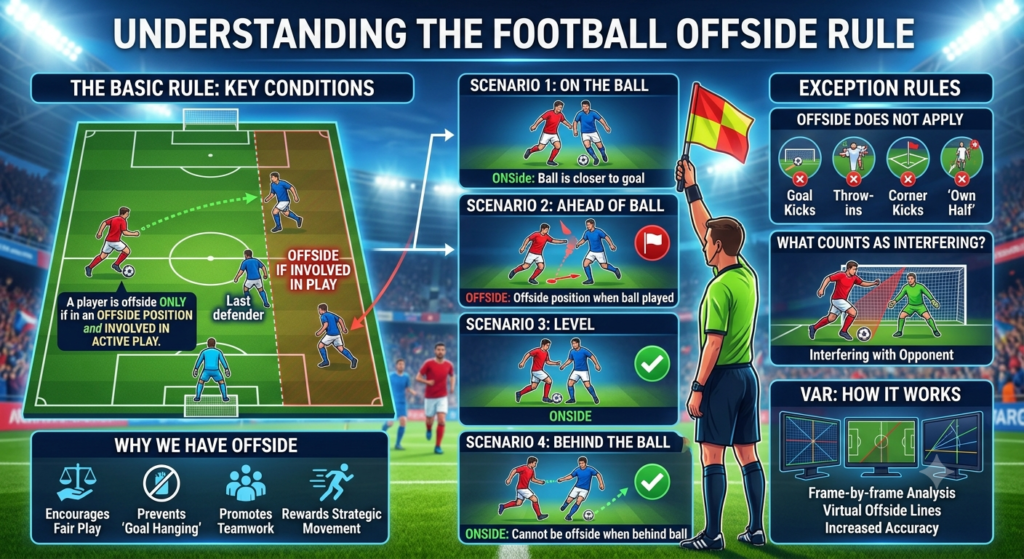
A player is only offside if they are in an offside position and become involved in active play.
Being in an offside position alone is not an offence.
This is the part that many beginners misunderstand.
Why Does Football Have an Offside Rule?
Imagine a striker standing beside the goalkeeper for the entire match, waiting for a long pass. Without the offside rule, defending would become almost impossible.
The rule exists to:
- Keep the game fair
- Encourage teamwork
- Reward good attacking movement
- Prevent “goal hanging”
- Create tactical battles between attackers and defenders
Because of this law, players must carefully time their runs instead of simply waiting near the goal.
Understanding the Basic Rule
When a teammate passes the ball, the attacking player must meet certain conditions.
A player is considered offside if:
| Requirement | Explanation |
|---|---|
| In opponent’s half | The player must be inside the opponent’s half of the pitch. |
| Ahead of the ball | The player is closer to the goal than the ball. |
| Fewer than two defenders ahead | Usually this means only the goalkeeper is between the attacker and the goal. |
| Involved in play | The player receives the pass, challenges an opponent, or interferes with play. |
If all these conditions happen together, the assistant referee raises the flag for offside.
The Two-Defender Rule
Many people believe a player only has to stay behind the goalkeeper.
That isn’t correct.
The law actually says:
The attacker must have at least two opponents between themselves and the goal line when the ball is played.
Normally those two players are:
- Goalkeeper
- One defender
However, if the goalkeeper has moved forward, another defender can count instead.
Example
| Situation | Offside? |
|---|---|
| Goalkeeper + Defender ahead | No |
| Only Goalkeeper ahead | Yes |
| No defenders ahead | Yes |
| Ball is behind attacker | No |
When Is the Decision Made?
One of the biggest misconceptions is that the referee waits until the attacker receives the ball.
Actually, the decision is made the exact moment the teammate kicks or heads the ball.
Everything depends on that single instant.
For example:
- Player A passes.
- Player B starts running.
- The referee checks Player B’s position when Player A touched the ball, not when Player B collected it.
This timing is why VAR often freezes the image at the exact moment the pass is made.
Common Offside Situations
Scenario 1: Clearly Onside
A midfielder passes the ball while the striker is level with the last defender.
Result:
Play continues.
Being level with the second-last defender is considered onside.
Scenario 2: Clearly Offside
The striker stands behind every defender before the pass arrives.
The pass is made.
The striker collects the ball and scores.
Result:
Offside.
The goal is disallowed.
Scenario 3: Running Back
A striker begins in an offside position.
The midfielder passes the ball.
The striker runs backwards before receiving it.
Result:
Still offside.
The player’s original position at the moment of the pass is what matters.
Scenario 4: Behind the Ball
The attacker is behind the ball when the teammate passes.
Result:
Never offside.
Even if there are no defenders ahead, being behind the ball keeps the player onside.
Situations Where Offside Does NOT Apply
Many fans are surprised to learn there are situations where the offside law is ignored.
| Restart Type | Offside Applies? |
|---|---|
| Goal Kick | No |
| Throw-in | No |
| Corner Kick | No |
| Kick-off | Yes (during open play afterward) |
| Free Kick | Yes |
These exceptions encourage quick attacking play from restarts.
What Counts as “Interfering with Play”?
A player in an offside position is only penalized if they become actively involved.
This includes:
Playing the Ball
The player receives or touches the pass.
Blocking a Defender
The player prevents a defender from reaching the ball.
Blocking the Goalkeeper’s View
Even without touching the ball, standing in front of the goalkeeper and affecting their vision can result in an offside offence.
Playing a Rebound
If the ball rebounds from the goalkeeper, goalpost, or crossbar and an offside player then plays it, offside is usually given.
How Assistant Referees Spot Offside
The assistant referee (often called the linesman) has one of the hardest jobs in football.
They must judge:
- The exact moment the ball is kicked.
- The positions of attackers and defenders.
- Whether an attacker interferes with play.
All of this happens in a fraction of a second.
Professional officials train for years to improve their positioning and decision-making.
How VAR Has Changed Offside Decisions
Video Assistant Referee (VAR) has made offside decisions more accurate by reviewing goals and major incidents.
VAR uses:
- Multiple camera angles
- Freeze-frame technology
- Virtual offside lines
- Frame-by-frame analysis
Advantages
| Benefit | Explanation |
|---|---|
| Greater accuracy | Fewer incorrect offside decisions. |
| Fairer outcomes | Goals are checked carefully before being awarded. |
| Consistency | Similar incidents are judged using the same technology. |
Criticisms
Some supporters feel VAR can be frustrating because:
- Reviews may interrupt the flow of the match.
- Very close decisions can lead to lengthy delays.
- Goals are sometimes disallowed by extremely small margins.
Even so, VAR aims to reduce clear and obvious errors.
Simple Tips for Understanding Offside While Watching a Match
If you’re new to football, keep these points in mind:
- Watch the attacker at the moment the pass is made.
- Ignore where they receive the ball.
- Remember that being level with the second-last defender is onside.
- A player cannot be offside in their own half.
- Goal kicks, throw-ins, and corner kicks cannot result in offside.
With practice, spotting offside becomes much easier.
Common Myths About the Offside Rule
| Myth | Reality |
|---|---|
| A player is offside whenever they’re behind the defenders. | False. They must also become involved in active play. |
| The goalkeeper always determines offside. | False. The second-last opponent counts, whether or not that’s the goalkeeper. |
| A player can be offside from a throw-in. | False. |
| Being level with the defender is offside. | False. Being level is onside. |
| VAR changed the offside law. | False. VAR helps officials apply the existing law more accurately. |
Why the Offside Rule Matters
The offside law shapes nearly every football match. Defenders use coordinated movement to catch attackers offside, while forwards practice timing their runs to stay onside. This tactical battle adds excitement and strategy to the game, making goals more rewarding and defending more disciplined.
Without the offside rule, football would look very different. Teams could leave attackers near the goal throughout the match, reducing the importance of passing combinations, movement, and defensive organization.
Final Thoughts
The offside rule may seem confusing at first, but its purpose is straightforward: to keep the game fair and encourage skillful attacking play. Remember that simply standing in an advanced position is not an offence. A player is only penalized if they are in an offside position when the ball is played by a teammate and then become involved in active play.
Whether you’re watching your first match or looking to understand the game more deeply, learning the offside rule will make football far more enjoyable. The next time a goal is reviewed or an assistant referee raises the flag, you’ll have a much clearer idea of why the decision was made
