


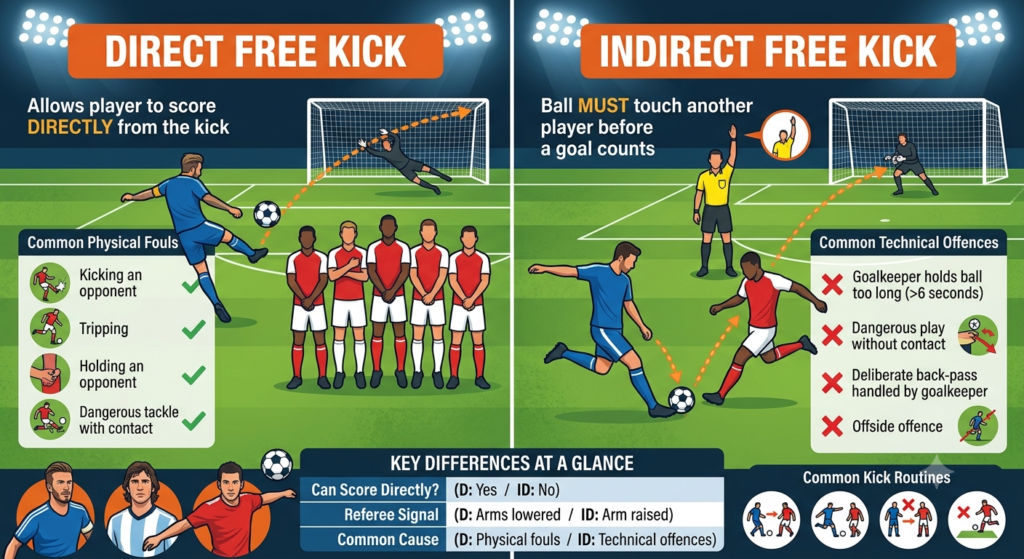
If you’ve watched a football match, you’ve probably seen the referee stop play, point in a direction, and award a free kick. Sometimes the player shoots directly at goal and scores. Other times, the ball has to touch another player before a goal can count.
This difference often confuses new fans.
So, what exactly separates a direct free kick from an indirect free kick?
The answer comes down to how the goal can be scored and what type of foul has been committed.
In this guide, we’ll explain both types of free kicks in simple language, provide real match examples, compare the rules in an easy-to-read table, and answer the questions fans ask most often.
What Is a Free Kick?
A free kick is awarded when one team commits an offence against the other. Instead of allowing play to continue, the referee stops the match and gives possession to the non-offending team.
There are two kinds of free kicks in football:
- Direct Free Kick
- Indirect Free Kick
Although both restart play, the rules are different.
Direct Free Kick Explained
A direct free kick allows a player to shoot straight at goal.
If the ball goes directly into the opponent’s net without touching another player, the goal counts.
This is why direct free kicks are among the most exciting moments in football. Specialists such as David Beckham, Cristiano Ronaldo, Lionel Messi, and James Ward-Prowse have scored memorable goals from these situations.
Simple Definition
A direct free kick allows the player to score directly from the kick.
When Is a Direct Free Kick Awarded?
Direct free kicks are usually given for more serious fouls involving physical contact.
Common offences include:
| Offence | Direct Free Kick? |
|---|---|
| Kicking an opponent | Yes |
| Tripping | Yes |
| Pushing | Yes |
| Holding an opponent | Yes |
| Jumping into an opponent | Yes |
| Charging carelessly | Yes |
| Handball (except goalkeeper in own penalty area) | Yes |
| Tackling dangerously with contact | Yes |
These fouls often interrupt attacking moves and may even lead to yellow or red cards.
Direct Free Kick Near the Penalty Area
When a direct free kick is awarded close to the penalty box, the attacking team has a genuine chance to score.
The defending team forms a defensive wall, while the goalkeeper positions themselves carefully to cover the goal.
Distance matters.
For example:
| Distance from Goal | Chance of Scoring |
|---|---|
| 18–22 metres | High |
| 23–28 metres | Medium |
| 29–35 metres | Lower |
| Over 35 metres | Very Low |
Although long-range goals happen, accuracy becomes much more difficult.
Indirect Free Kick Explained
An indirect free kick works differently.
The player cannot score directly.
Before a goal can count, the ball must touch another player.
If the kicker sends the ball straight into the opponent’s goal without another touch, no goal is awarded. Instead, the defending team receives a goal kick.
Simple Definition
An indirect free kick requires another player to touch the ball before a goal can be scored.
How Does the Referee Signal an Indirect Free Kick?
One of the easiest ways to identify an indirect free kick is by watching the referee.
Instead of lowering their arm immediately, the referee raises one arm straight above the head and keeps it raised until another player touches the ball or play ends.
This signal tells everyone that a direct shot cannot result in a goal.
When Is an Indirect Free Kick Awarded?
Indirect free kicks are generally given for technical offences rather than physical fouls.
Examples include:
| Offence | Indirect Free Kick? |
|---|---|
| Dangerous play without contact | Yes |
| Goalkeeper holds the ball too long | Yes |
| Goalkeeper handles a deliberate back-pass | Yes |
| Goalkeeper handles a throw-in from teammate | Yes |
| Offside offence | Yes |
| Preventing goalkeeper from releasing the ball | Yes |
These offences usually involve breaking the Laws of the Game without committing a physical foul.
Direct vs Indirect Free Kick: Quick Comparison
| Feature | Direct Free Kick | Indirect Free Kick |
|---|---|---|
| Can score directly? | Yes | No |
| Needs another touch? | No | Yes |
| Usually follows | Physical foul | Technical offence |
| Referee raises arm? | No | Yes |
| Can be awarded inside own half? | Yes | Yes |
| Can lead to penalty if inside defending penalty area? | Yes | Depends on offence |
Which Free Kick Is More Dangerous?
Direct free kicks create far more goal-scoring opportunities.
Professional players spend countless hours practising:
- Curling shots
- Knuckleball strikes
- Power shots
- Placement over the defensive wall
Indirect free kicks usually require teamwork instead of individual brilliance.
Common routines include:
- Short passes
- Dummy runs
- Lay-offs
- Crosses into the penalty area
Famous Direct Free Kick Specialists
Several football legends became famous for scoring spectacular direct free kicks.
| Player | Known For |
|---|---|
| David Beckham | Curl and precision |
| Lionel Messi | Placement and accuracy |
| Cristiano Ronaldo | Powerful knuckleball technique |
| Juninho Pernambucano | One of the greatest free-kick takers ever |
| James Ward-Prowse | Exceptional consistency |
Their technique combines balance, timing, and years of practice.
What Happens If the Ball Goes Straight Into Goal?
The outcome depends on the type of free kick.
| Situation | Result |
|---|---|
| Direct free kick goes straight into opponent’s goal | Goal |
| Indirect free kick goes straight into opponent’s goal | Goal kick |
| Direct free kick goes into own goal | Corner kick |
| Indirect free kick goes into own goal without another touch | Corner kick |
Example Scenarios
Scenario 1
A defender trips an attacker 25 metres from goal.
Decision: Direct free kick.
The attacker may shoot immediately.
Scenario 2
The goalkeeper catches a deliberate back-pass from a teammate.
Decision: Indirect free kick.
Another attacking player must touch the ball before a goal can count.
Scenario 3
An attacker is caught offside.
Decision: Indirect free kick for the defending team.
Play restarts from the location of the offside offence.
Why Do These Rules Exist?
Football separates physical fouls from technical infringements to keep the game fair.
Physical offences often stop attacking opportunities unfairly, so the attacking team is rewarded with a direct chance to score.
Technical offences are usually less severe, meaning teams restart play without receiving an immediate shooting opportunity.
This balance helps maintain fairness while encouraging skillful play.
Tips for New Football Fans
If you’re watching football and aren’t sure which free kick has been awarded:
- Look at the referee’s arm.
- If the arm stays raised, it’s an indirect free kick.
- If the arm is lowered, it’s usually a direct free kick.
- Watch whether players prepare to shoot immediately or set up a passing routine.
These clues quickly become easy to recognise after watching a few matches.
Final Thoughts
Understanding the difference between a direct and indirect free kick makes watching football much easier. The key distinction is simple: a direct free kick allows an immediate shot on goal, while an indirect free kick requires another player to touch the ball before a goal can be scored.
Knowing the referee’s signals, the types of fouls involved, and how each restart works will help you follow matches with greater confidence. Whether you’re new to the sport or looking to refresh your knowledge, mastering this rule is an important step in understanding the game.
