


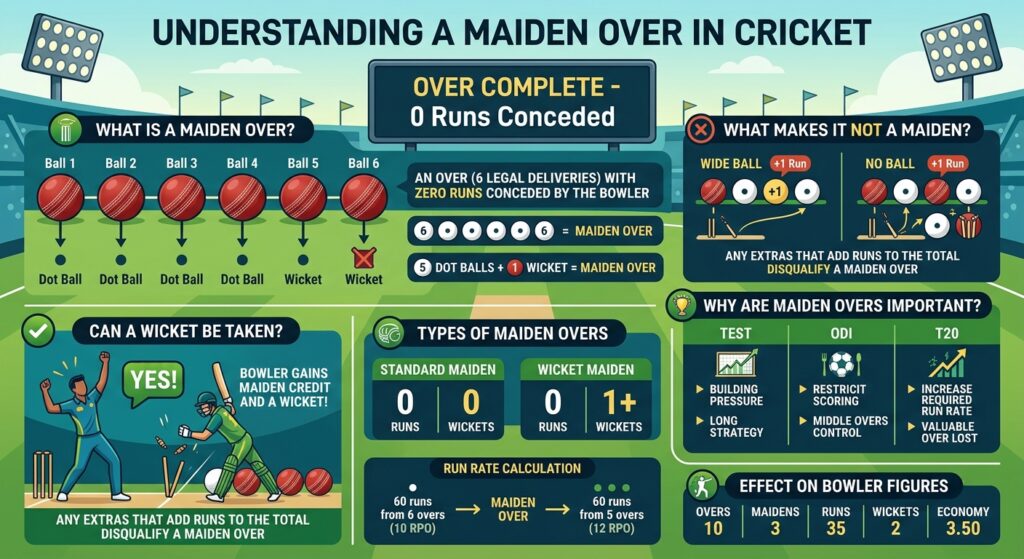
A maiden over in cricket is one of the simplest terms in cricket, but it can be confusing for someone who is just starting to follow the game. You may hear a commentator say, “That was a maiden,” after a bowler completes an over without conceding a run. For experienced cricket fans, the meaning is obvious. For beginners, however, there are a few details worth understanding.
In basic terms, a maiden over is an over in which the batting team does not score any runs from the bowler. The bowler completes the over without conceding runs to the batting side.
That sounds straightforward, but not every delivery has to be a legal ball for an over to be considered a maiden. Extras and wickets can also affect how an over is recorded. Understanding these small details makes the concept much clearer.
What Does Maiden Over in Cricket?
A maiden over is an over in which the bowler concedes zero runs.
In standard cricket, an over consists of six legal deliveries. If the bowler delivers six legal balls and the batting team scores no runs from them, the over is recorded as a maiden.
For example:
| Delivery | Result |
|---|---|
| Ball 1 | Dot ball |
| Ball 2 | Dot ball |
| Ball 3 | Dot ball |
| Ball 4 | Dot ball |
| Ball 5 | Dot ball |
| Ball 6 | Dot ball |
| Total | 0 runs |
The bowler has therefore bowled a maiden over.
The term “maiden” is generally used in scorecards and commentary to describe an over in which the bowler has not conceded any runs.
How Many Balls Are in a Maiden Over?
A normal over contains six legal deliveries.
So, if a bowler bowls six legal deliveries and the batting team scores zero runs, that is a maiden over.
The important word here is legal.
If a bowler delivers a no-ball or wide, that delivery does not count as one of the six legal balls. The bowler must continue until six legal deliveries have been completed.
For example, suppose the sequence is:
Wide, dot, dot, dot, dot, dot, dot
The wide does not count as one of the six legal balls. The bowler has therefore delivered six legal balls after the wide, but the batting team received one extra run from the wide.
As a result, the over is not a maiden because the bowler conceded a run.
Can a Bowler Take a Wicket in a Maiden Over?
Yes.
A bowler can take one or more wickets during a maiden over and still receive credit for a maiden, provided no runs are conceded.
For example:
- Ball 1: Dot ball
- Ball 2: Wicket
- Ball 3: Dot ball
- Ball 4: Dot ball
- Ball 5: Dot ball
- Ball 6: Dot ball
The batting team has scored zero runs, so the bowler has completed a maiden over.
This type of over is particularly valuable because the bowler has stopped the scoring while also removing a batter.
Is a Wicket Counted as a Run?
No.
A wicket itself does not give the batting team a run. Therefore, a bowler can dismiss a batter during an over and still bowl a maiden.
However, there are exceptions involving certain types of dismissals and extras. If runs are scored during the dismissal—for example, through byes, leg byes or other extras—the over may no longer qualify as a maiden depending on the scoring.
The basic rule is simple: the bowler must concede no runs that are charged against the over for it to be a maiden.
What Is a Maiden Over Worth?
A maiden over is not worth a fixed number of points.
Instead, it affects the bowler’s figures and the team’s scoring rate.
Suppose a team has scored 60 runs after 10 overs.
The run rate is:
Run rate = Total runs ÷ Overs
So:
60 ÷ 10 = 6 runs per over
If the next over is a maiden, the team remains on 60 runs after 11 overs.
The new run rate becomes:
60 ÷ 11 = 5.45 runs per over
This shows why maiden overs can have an important impact, particularly in limited-overs cricket.
Why Are Maiden Overs Important?
A maiden over can put pressure on the batting team.
Cricket is not only about taking wickets. Bowlers also try to control the number of runs being scored. A batter may become uncomfortable if they face several deliveries without being able to score.
In a T20 match, this can be especially significant.
Imagine a team needs 60 runs from the final six overs. If a bowler delivers a maiden, the batting side has effectively lost an entire over without adding to its total.
The required scoring rate can rise quickly.
For example:
60 runs needed from 6 overs
Required rate:
60 ÷ 6 = 10 runs per over
After a maiden:
60 runs needed from 5 overs
New required rate:
60 ÷ 5 = 12 runs per over
The difference is substantial.
A single maiden has increased the required scoring rate from 10 to 12 runs per over.
Maiden Overs in Test Cricket
Maiden overs are common in Test cricket.
Test matches can last for several days, and bowlers often focus on patience, accuracy and building pressure rather than constantly searching for wickets.
A bowler may bowl several maiden overs in succession while trying to make the batter play defensively.
For example, a fast bowler might repeatedly deliver the ball around the off stump. If the batter refuses to play risky shots, several consecutive overs could pass without a run.
This can create pressure and eventually lead to a mistake.
In Test cricket, a maiden is therefore often part of a longer strategy. The bowler is not necessarily trying to produce an immediate wicket. Instead, they may be trying to restrict scoring and force the batter into an uncomfortable position.
Maiden Overs in ODI Cricket
One Day International cricket sits between Test cricket and T20 cricket in terms of time and scoring pressure.
A maiden over can be useful because every over represents a significant portion of the innings.
If a team is batting for a maximum of 50 overs, losing one over without scoring can affect its final total.
Bowlers may use tight lines and fields to prevent easy singles and boundaries. If the batting team cannot rotate the strike, a maiden can result.
In the middle overs, where batters often look for singles and twos, stopping the scoring completely can be a strong achievement.
Maiden Overs in T20 Cricket
Maiden overs are generally harder to achieve in T20 cricket because batters are encouraged to score quickly.
A T20 innings contains only 20 overs, so every over is valuable.
A maiden over means the batting team has received six legal deliveries without increasing its score through runs credited to the bowler.
This can dramatically change the pressure on the batting side.
For example, consider a team that scores:
- Over 1: 8 runs
- Over 2: 7 runs
- Over 3: 0 runs
- Over 4: 12 runs
The third over is a maiden.
The team has scored:
8 + 7 + 0 + 12 = 27 runs
Without the maiden, if it had scored only 6 runs in that over, its total would have been:
8 + 7 + 6 + 12 = 33 runs
The difference is six runs after just four overs.
That is one reason a maiden can be particularly valuable in short-format cricket.
What Is a Dot Ball?
A dot ball is a delivery from which no run is scored.
Six consecutive dot balls normally produce a maiden over, assuming all six deliveries are legal and no runs are awarded through extras.
However, a maiden over does not necessarily have to contain six conventional dot balls.
A bowler can take a wicket without conceding a run. Therefore, an over containing five dot balls and one wicket can still be a maiden.
The key difference is:
Dot ball = no run from one delivery
Maiden over = no runs conceded during the entire over
Can an Over With Byes or Leg Byes Be a Maiden?
This is an area where beginners often become confused.
Byes and leg byes are extras credited to the batting team’s total, but they are not charged to the bowler.
For example, if a legal delivery goes past the wicketkeeper and the batters complete a bye, the batting team receives a run, but that run is not charged to the bowler.
The precise treatment of maidens can depend on the scoring definition being used, so scorecards and statistical records should be interpreted carefully.
For ordinary beginner understanding, the easiest rule to remember is that a standard maiden means the bowler has completed the over without conceding runs.
What Is a Wicket Maiden?
A wicket maiden is a maiden over in which the bowler also takes at least one wicket.
For example:
| Ball | Result |
|---|---|
| 1 | Dot |
| 2 | Dot |
| 3 | Wicket |
| 4 | Dot |
| 5 | Dot |
| 6 | Dot |
Runs conceded: 0
Wickets taken: 1
This is a wicket maiden.
Wicket maidens are highly valued because the bowler achieves two things at once: restricting runs and removing a batter.
Consecutive Maiden Overs
Sometimes a bowler can bowl several maiden overs in a row.
Suppose a bowler delivers:
- Over 1: 0 runs
- Over 2: 0 runs
- Over 3: 0 runs
The bowler has completed three consecutive maiden overs.
That means:
3 overs × 6 legal balls = 18 legal deliveries
During those 18 deliveries, the bowler has conceded zero runs.
Such spells can create enormous pressure, especially when the batters are unable to rotate the strike.
How Maiden Overs Affect Bowling Figures
A bowler’s figures normally show several important statistics, including:
- Overs bowled
- Maidens
- Runs conceded
- Wickets taken
For example:
10 overs – 3 maidens – 35 runs – 2 wickets
This means the bowler delivered 10 overs, three of those overs were maidens, and the bowler conceded 35 runs while taking two wickets.
The economy rate can then be calculated as:
Economy rate = Runs conceded ÷ Overs bowled
Therefore:
35 ÷ 10 = 3.50
The bowler’s economy rate is 3.50 runs per over.
Three maiden overs have helped keep that figure low.
Final Thoughts
A maiden over in cricket is an over in which the bowler concedes no runs. It normally consists of six legal deliveries, although wides and no-balls can make an over longer because those deliveries do not count toward the six legal balls.
Maiden overs are valuable in every format of cricket. In Test matches, they can help a bowler build pressure over a long period. In ODIs, they can restrict a team’s scoring options during a 50-over innings. In T20 cricket, where every delivery carries greater importance, a maiden can have an even bigger effect on the required run rate.
The most important thing to remember is simple:
Six legal balls do not automatically make a maiden. The bowler must concede zero runs during the over.
When a bowler combines accurate bowling, good field placement and intelligent variation, a maiden over can become much more than six quiet deliveries. It can change the rhythm of an innings, increase pressure on the batter and sometimes create the opening needed for a wicket.
