


Choosing the right cricket bat can make a surprising difference to a player’s game. A bat that feels too heavy may make it difficult to control shots, while one that is too small can restrict a player’s reach and development. This is why cricket bat size matters, especially for children and beginners who are still learning the basics of batting.
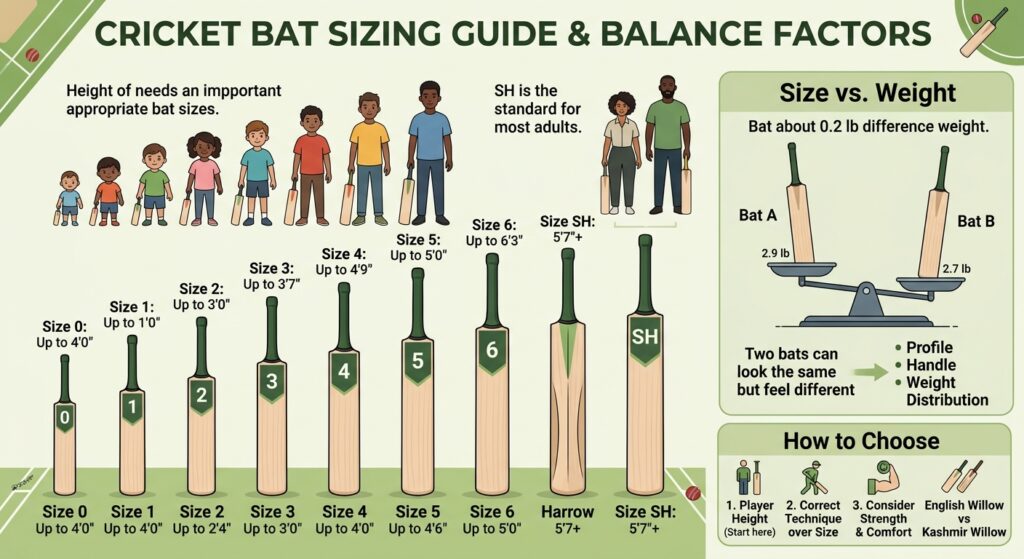
Cricket bats are not made in one universal size. They are available in different sizes, usually from Size 0 through Size 6, followed by Harrow and Full Size bats. The correct option depends mainly on the player’s age, height, and physical development.
For senior players, the standard full-size cricket bat is generally used. Junior players, however, need smaller bats that are easier to control. Selecting the right size is not simply about buying the biggest bat available. A comfortable bat that allows proper technique is usually a much better choice.
What Is the Standard Cricket Bat Size?
A full-size cricket bat, commonly known as Size SH (Short Handle), is the standard choice for adult players. Under the Laws of Cricket, a bat has limits on its overall dimensions.
The maximum permitted length of a cricket bat is:
38 inches (96.52 cm)
The maximum width is:
4.25 inches (10.8 cm)
These measurements apply to the bat itself rather than suggesting that every bat must reach exactly those dimensions.
A bat can be shorter or narrower and still be perfectly suitable for a player. Manufacturers produce different profiles, handle lengths, blade shapes and weights to suit different players.
| Bat Type | Typical Player |
|---|---|
| Size 0 | Very young children |
| Size 1 | Young beginners |
| Size 2 | Junior players |
| Size 3 | Junior players |
| Size 4 | Older junior players |
| Size 5 | Larger junior players |
| Size 6 | Tall junior players |
| Harrow | Teenagers / smaller players |
| Short Handle (SH) | Most adult players |
The exact recommended age and height can vary between manufacturers, so the manufacturer’s size chart should also be checked.
Cricket Bat Sizes Explained
Size 0
Size 0 is one of the smallest cricket bat options.
It is intended for very young children who are beginning to learn cricket. The smaller blade and lighter construction make it easier for a young player to lift and control.
At this stage, comfort is more important than power. Children should be able to move the bat naturally rather than struggling with an oversized piece of equipment.
Size 1
Size 1 is another junior option for young children.
It provides a little more blade length than Size 0 while remaining relatively easy to handle. It is often suitable for children who are starting to play organized cricket.
Size 2
Size 2 is designed for a slightly older or taller junior player.
The bat becomes longer and generally heavier than the smaller sizes. However, it is still significantly more manageable than a full-size adult bat.
Size 3
Size 3 is another common junior size.
Players moving into this size are generally developing more advanced batting skills. They need enough bat length to cover their stance and reach without making the bat difficult to control.
Size 4
Size 4 is intended for older or taller children.
At this stage, the player’s physical strength is beginning to increase, so a larger blade can be handled more effectively.
Size 5
Size 5 is a larger junior bat.
It is often used by players who are approaching their teenage years or who are taller for their age. The increased size gives the player a longer blade while maintaining a more manageable weight than a senior bat.
Size 6
Size 6 is one of the largest junior sizes.
It is commonly chosen by tall junior players who are not quite ready for a full-size adult bat. Moving directly from a small junior bat to a full-size bat can be uncomfortable, so Size 6 can provide a useful transition.
Harrow
Harrow bats sit between junior sizes and adult bats.
They are frequently used by teenagers or players who find a standard adult bat too large. The Harrow size gives developing players more blade length without immediately requiring them to use the largest standard bat.
Full Size or Short Handle
The Short Handle (SH) is the standard full-size bat for most adult cricketers.
It provides the maximum permitted bat length and is available in a wide range of weights and profiles.
Professional and amateur players may choose different models depending on their batting style, strength, height and personal preference.
Cricket Bat Size Chart
A basic size guide can help parents and players understand the differences.
| Size | Approximate Height Guide | General Age Guide |
|---|---|---|
| Size 0 | Up to about 4’0″ | 4–5 years |
| Size 1 | About 4’0″–4’3″ | 5–7 years |
| Size 2 | About 4’3″–4’6″ | 6–8 years |
| Size 3 | About 4’6″–4’9″ | 7–9 years |
| Size 4 | About 4’9″–4’11” | 9–10 years |
| Size 5 | About 4’11″–5’2″ | 10–12 years |
| Size 6 | About 5’2″–5’5″ | 11–13 years |
| Harrow | About 5’4″–5’7″ | 12–14+ years |
| SH | Around 5’7″+ | Teenagers/adults |
These are general guidelines rather than strict rules. Two players of the same age can have very different heights and strength levels.
Does Height Matter When Choosing a Cricket Bat?
Height is one of the most useful factors when selecting a bat.
Age alone does not tell the whole story. A 12-year-old player who is tall and physically strong may require a different bat from another 12-year-old who is considerably shorter.
The bat should allow the player to maintain a comfortable stance and move the blade without excessive effort.
A simple test can help.
Ask the player to stand naturally with the bat beside them. The bat should feel manageable, and the player should be able to move it into a batting position without struggling.
A coach can provide an even better assessment because they can watch the player’s stance, grip and backlift.
Why Bat Weight Is Just as Important as Size
Bat size and bat weight are closely connected, but they are not the same thing.
Two bats can have similar dimensions but feel completely different because of their weight distribution.
For example:
Bat A: 2.7 lb
Bat B: 2.9 lb
The difference is:
2.9 − 2.7 = 0.2 lb
That is approximately:
0.2 × 453.6 = 90.7 grams
So a difference of only 0.2 pounds is roughly 91 grams.
That may not sound like much, but a batter can notice the difference when repeatedly lifting and swinging the bat.
Should Beginners Use a Heavy Bat?
Usually, beginners should avoid choosing a bat simply because it is heavy.
A heavy bat can produce powerful shots when handled correctly, but power is useless if the player cannot control the blade.
A beginner needs to learn:
- Correct grip
- Balanced stance
- Backlift
- Foot movement
- Shot selection
- Timing
- Bat control
A lighter, well-balanced bat can make these skills easier to develop.
Once the player becomes stronger and more experienced, they can gradually move toward a heavier model if it suits their style.
Bat Size and Batting Technique
The wrong bat size can interfere with technique.
If the bat is too long, a young player may struggle to control the bottom of the blade. They may also compensate by changing their stance or grip.
If the bat is too short, the player may feel uncomfortable when reaching for deliveries.
The ideal bat should allow the player to focus on batting rather than fighting with the equipment.
This is particularly important for children because poor equipment choices can encourage bad habits.
Cricket Bat Length and Width
Cricket’s equipment laws place specific limits on bat dimensions.
The overall length cannot exceed:
38 inches
The maximum width is:
4.25 inches
There are also regulations concerning the thickness of the blade and other aspects of bat construction.
These restrictions ensure that bats remain within reasonable limits and that equipment does not become excessively large.
Modern bats can have large edges and substantial profiles, but they still have to remain within the permitted dimensions.
Why Are Modern Cricket Bats So Thick?
Modern bats often look much larger than older cricket bats.
This is partly because manufacturers have developed techniques that allow more wood to be positioned behind the hitting area.
A thicker profile can provide a large sweet spot and help players generate power.
However, a larger-looking bat is not automatically a better bat.
The player still needs to be able to control it.
A young player using an oversized bat may actually perform worse because timing and maneuverability are affected.
English Willow vs Kashmir Willow
The type of willow can also influence the bat’s feel and performance.
English willow is widely used for high-level cricket bats. It is generally associated with premium cricket bats and is graded according to the quality of the willow.
Kashmir willow is another popular choice and is often more affordable.
Both can be used effectively, particularly when the bat is correctly matched to the player’s needs.
For a beginner, choosing the right size and weight is often more important than simply buying the most expensive willow available.
How to Choose the Right Cricket Bat Size
When selecting a cricket bat, consider these factors:
1. Player Height
Start with the player’s height rather than relying only on age.
2. Age
Age can provide a useful starting point, particularly for children, but it should not be the only consideration.
3. Strength
A stronger player may comfortably handle a slightly heavier bat.
4. Batting Style
Some players prefer lighter bats for quick movement, while others prefer heavier bats for power.
5. Comfort
The bat should feel natural in the player’s hands.
6. Coach’s Advice
A qualified cricket coach can identify whether the player is struggling because of the equipment or technique.
Common Mistakes When Buying a Cricket Bat
One of the biggest mistakes parents make is buying a bat that is too large because they expect the child to “grow into it.”
That approach can backfire.
A bat that is too heavy can make it difficult for a young player to develop proper technique. The child may struggle to lift the bat, play straight shots or control the backlift.
Another mistake is choosing a bat based entirely on appearance.
A large profile, bright stickers and impressive edges may look attractive, but the bat still needs to match the player.
Price is another common issue. An expensive bat does not automatically make someone a better batter.
The right size, weight and balance are much more important.
Final Thoughts
Cricket bat size plays an important role in comfort, technique and performance. From tiny Size 0 bats for young beginners to full-size Short Handle bats for adults, there is an option for almost every player.
The maximum permitted length of a cricket bat is 38 inches, while its maximum width is 4.25 inches. However, choosing the correct bat is not simply a matter of finding the biggest legal model.
For young players, height, age and physical strength should all be considered. A bat should be easy enough to control while still providing room for the player to develop.
For adults, personal preference becomes increasingly important. Some batters prefer lighter bats that allow quick hands, while others like heavier bats that feel powerful through the shot.
Ultimately, the best cricket bat is the one that feels comfortable, suits the player’s technique and allows them to play naturally. A well-sized bat will not replace practice, but it can certainly make practice more enjoyable and help a player build better habits from the beginning.
