


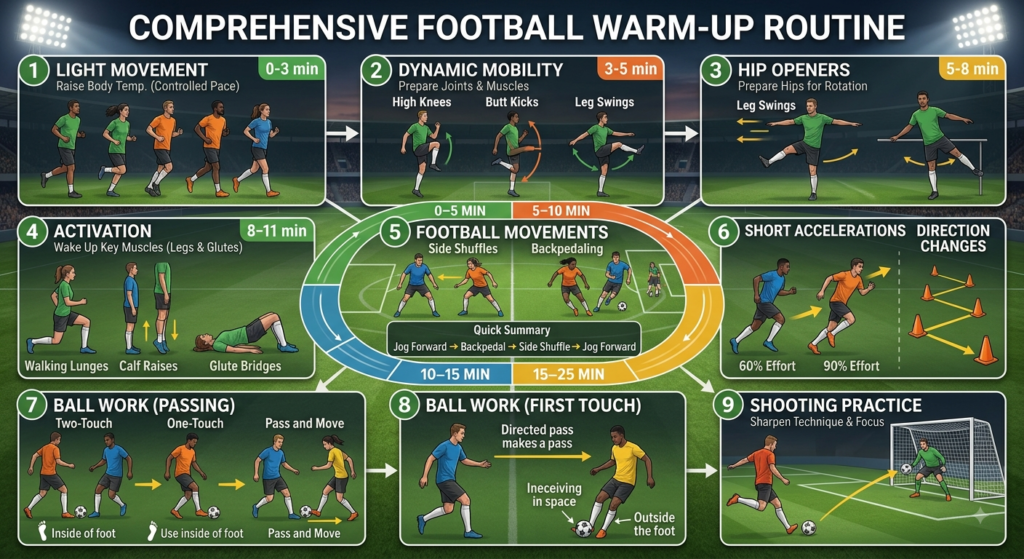
A football match can change quickly. One moment a player is walking onto the pitch, and a few seconds later they may be sprinting, turning sharply, jumping for a header, or challenging an opponent for the ball. The body needs to be ready for those movements before the match begins. That is why a good warm-up is an important part of football preparation.
A proper football warm-up is not simply about running around the field for a few minutes. It should gradually increase the heart rate, loosen the joints, activate important muscles, and prepare the player for movements that are likely to happen during the match.
The best football warm up exercises before a match usually combine light jogging, dynamic movements, mobility exercises, activation drills, short accelerations, and ball work. The exact routine can vary depending on the player’s age, fitness level, weather, position, and coaching philosophy.
Why Is a Warm-Up Important Before Football?
Football places many different demands on the body. Players repeatedly accelerate, slow down, change direction, kick, jump, and maintain balance.
Starting a match without preparing the body can make the first few minutes feel uncomfortable. A player may feel stiff, slow to react, or unprepared for sudden movements.
A warm-up can help players gradually move from a resting state into match activity. It also gives them an opportunity to focus mentally before kickoff.
Some of the main purposes of a football warm-up include:
- Increasing body temperature
- Preparing muscles for activity
- Moving joints through useful ranges of motion
- Activating the muscles used during football
- Practicing football-specific movements
- Preparing for short bursts of speed
- Improving concentration and match readiness
A warm-up should leave a player feeling prepared, not exhausted.
How Long Should a Football Warm-Up Last?
There is no single warm-up length that works perfectly for every player or team. However, many football warm-ups can be organized into a routine of roughly 15 to 25 minutes.
The intensity should gradually increase.
For example:
| Warm-Up Stage | Approximate Time | Main Purpose |
|---|---|---|
| Light movement | 3–5 minutes | Raise body temperature |
| Dynamic mobility | 3–5 minutes | Prepare joints and muscles |
| Activation | 3–5 minutes | Wake up key muscles |
| Football movements | 3–5 minutes | Prepare for match actions |
| Short accelerations | 2–3 minutes | Prepare for speed |
| Ball work | 3–5 minutes | Prepare technique and focus |
These numbers are only a guide. A professional team may have a highly structured routine, while a recreational player may need something much simpler.
1. Light Jogging
Light jogging is a simple way to begin.
Start at a comfortable pace and move around the pitch or designated warm-up area. The goal is not to test your fitness. You are simply trying to get the body moving and gradually raise your heart rate.
You can jog forward for a short distance, turn around, and continue moving around the area.
After a few minutes, you should feel warmer without being tired.
Avoid starting with repeated maximum-speed sprints. The first stage of a warm-up should generally be controlled and progressive.
2. High Knees
High knees are a useful dynamic exercise for football players.
Run slowly while bringing each knee upward toward your waist. Keep your upper body controlled and use your arms naturally.
You do not need to perform high knees at maximum speed. The purpose is to introduce a more active movement pattern after light jogging.
Try:
2 × 15–20 metres
or perform the movement for approximately 15–20 seconds.
Keep the movement smooth rather than trying to make it exhausting.
3. Butt Kicks
Butt kicks are another common dynamic movement.
Jog forward while bringing your heels toward your backside. Keep the movement light and controlled.
This exercise adds another movement pattern to the warm-up and can be performed immediately after high knees.
A short distance is enough.
For example:
2 × 15–20 metres
The exercise should feel comfortable. There is no benefit in turning a simple warm-up drill into a conditioning session immediately before a match.
4. Walking Lunges
Walking lunges can help prepare the legs for movements that involve bending and extending the hips and knees.
Step forward with one leg and lower your body under control. Push through the front foot to continue forward with the opposite leg.
Keep your torso relatively upright and avoid rushing.
A short set of approximately 8–10 lunges per side can be enough for a pre-match warm-up, depending on the player’s needs.
Because lunges can become tiring when performed in large numbers, the goal before a match should be preparation rather than fatigue.
5. Leg Swings
Leg swings are an easy mobility exercise that can be performed before football.
Stand beside a stable support if necessary. Swing one leg forward and backward in a controlled manner. After several repetitions, switch legs.
You can also perform gentle side-to-side leg swings.
The movement should gradually become comfortable rather than forcefully stretching the leg.
A simple approach is:
- 8–12 forward-and-back swings per leg
- 8–12 side-to-side swings per leg
Controlled movement is more important than trying to achieve a huge range of motion.
6. Hip Openers
Football involves plenty of running and changes of direction, so hip mobility can be useful during a warm-up.
One simple movement is to bring the knee upward and gently rotate the leg outward before placing the foot down.
You can also use walking hip-opening movements.
Perform several repetitions on each side while keeping your balance.
The idea is to prepare the hips for movement rather than hold a long static stretch.
7. Calf Raises
The calves work continuously during football. Players push off the ground while running, accelerating, jumping, and changing direction.
Calf raises are a simple activation exercise.
Stand with your feet approximately hip-width apart and slowly rise onto your toes. Lower yourself under control.
Perform around 10–15 repetitions.
There is no need to perform a large number of repetitions before kickoff. A small amount of controlled activation is enough for many players.
8. Glute Activation
The glute muscles play an important role in running and acceleration.
One simple exercise is the glute bridge.
Lie on your back with your knees bent and feet on the ground. Raise your hips until your body forms a comfortable straight line from your shoulders toward your knees. Pause briefly and lower yourself.
Try approximately:
8–12 controlled repetitions
The exercise should activate the muscles without leaving the player fatigued.
9. Side Shuffles
Football rarely involves running only in a straight line. Players constantly move sideways while defending, marking opponents, creating space, and changing direction.
Side shuffles are therefore useful during a football warm-up.
Stay in a slightly athletic stance and move sideways for approximately 5–10 metres. Then return in the opposite direction.
Keep your feet active and avoid crossing them unnecessarily.
Repeat several times at gradually increasing intensity.
10. Backpedaling
Backpedaling helps players prepare for movements that occur while facing the ball or an opponent.
Move backward under control for approximately 5–10 metres before transitioning into a forward jog.
Do not move too quickly at first.
A useful sequence could be:
Jog forward → backpedal → side shuffle → jog forward
This creates a small movement circuit similar to the changes of direction seen during football.
11. Short Accelerations
Near the end of the warm-up, players can introduce short accelerations.
This is different from immediately performing maximum sprints.
Start from a relaxed jog and gradually accelerate over approximately 10–20 metres. Walk or jog back for recovery.
Perform a few repetitions, increasing the speed slightly each time.
For example:
Acceleration 1: about 60% effort
Acceleration 2: about 70% effort
Acceleration 3: about 80–90% effort
The exact intensity should depend on the player and coaching plan.
The purpose is to prepare the body for the faster movements that may happen during the match.
12. Change-of-Direction Drills
Football players need to stop and turn constantly.
A simple warm-up drill can involve jogging toward a cone, slowing down, changing direction, and accelerating toward another cone.
For example:
Jog → plant → turn → accelerate
Keep the first few repetitions controlled. As the warm-up progresses, the movement can become faster.
This also gives players a chance to focus on balance and body control.
13. Ball Passing
Once the body is warm, football-specific exercises can be introduced.
Passing is an excellent way to transition from physical preparation into match preparation.
Players can work in pairs and make short passes using both feet.
Start with simple passes before gradually increasing the distance.
A basic sequence might be:
- Two-touch passing
- One-touch passing
- Pass and move
- Receive and turn
- Short combination play
Ball work also helps players regain their technical rhythm before the match begins.
14. First-Touch Exercises
A player’s first touch can make a major difference during a match.
A simple warm-up exercise involves one player passing the ball while the other receives it and moves the ball into space.
Players can practice receiving with:
- Inside of the foot
- Outside of the foot
- Sole
- Different angles of approach
The exercise should remain controlled. The purpose is to sharpen technique and concentration before kickoff.
15. Shooting Practice
Shooting can be included toward the end of the warm-up.
Players should not immediately start taking maximum-power shots. Begin with controlled finishes and gradually increase the intensity.
For example:
- Short passes
- Controlled finishes
- Shots from different angles
- First-time finishes
- A few stronger strikes
Goalkeepers can also use this stage to get comfortable handling shots and moving across the goal.
Dynamic Stretching vs Static Stretching
One of the most common questions about football warm-ups concerns stretching.
Dynamic movements involve actively moving through a range of motion. Examples include leg swings, walking lunges, high knees, and controlled mobility exercises.
Static stretching involves holding a position for a period of time.
Before a football match, many warm-ups emphasize dynamic movement rather than spending a long time holding static stretches.
That does not mean static stretching has no place in football. It can be useful in other parts of a training routine depending on the player’s needs. However, immediately before competition, the warm-up should generally focus on movements that prepare the player for the activity ahead.
A Simple 20-Minute Football Warm-Up
Players looking for a straightforward routine can use the following structure:
| Time | Exercise |
|---|---|
| 0–3 min | Light jogging |
| 3–5 min | High knees and butt kicks |
| 5–8 min | Leg swings and hip mobility |
| 8–11 min | Lunges, calf raises, and glute activation |
| 11–14 min | Side shuffles and backpedaling |
| 14–17 min | Short accelerations and direction changes |
| 17–20 min | Passing and first-touch work |
This is only an example. Coaches can adjust the routine according to the age and experience of the players.
Warm-Up Mistakes Football Players Should Avoid
A warm-up can become less useful if it is too intense or poorly organized.
One common mistake is doing too much too soon. A player who performs repeated maximum sprints before kickoff may arrive at the starting whistle already tired.
Another mistake is using only static stretches and ignoring movement preparation.
Players should also avoid copying another person’s routine without considering their own needs. A goalkeeper, midfielder, defender, and striker may have different movement requirements.
Other mistakes include:
- Skipping the warm-up completely
- Starting with maximum-speed running
- Performing excessive repetitions
- Ignoring mobility
- Forgetting ball work
- Treating the warm-up as a fitness workout
- Not drinking enough fluids when conditions require it
- Wearing inappropriate footwear for the surface
Warm-Up for Cold Weather
Cold conditions can make the body feel stiff, so players may need to spend a little more time moving before kickoff.
The warm-up should still progress gradually.
Players should also avoid standing still for long periods after becoming warm. If there is a delay before kickoff, light movement can help maintain readiness.
Warm-Up in Hot Weather
Hot weather creates a different challenge.
The goal is still to prepare the body, but players should be careful not to turn the warm-up into an unnecessary endurance session.
Keep the intensity controlled and follow the team’s hydration and heat-management procedures.
If a player feels dizzy, unusually weak, or unwell during a warm-up, they should stop and inform the appropriate coach or medical staff.
Final Thoughts
A football warm-up should prepare the player for the match without taking energy away from it. The best routines gradually increase intensity and move from general activity toward football-specific movements.
Light jogging, dynamic mobility, lunges, leg swings, side shuffles, short accelerations, passing, first-touch exercises, and controlled shooting can all have a place in a well-organized routine.
The key is progression.
You do not need to run at full speed during the first minute. You do not need hundreds of repetitions. You do not need to leave the warm-up exhausted.
Instead, the aim is to finish the routine feeling warm, mobile, alert, confident, and ready to play.
For football players, those final few minutes before kickoff can make a real difference. A thoughtful warm-up helps bridge the gap between standing on the sideline and suddenly having to sprint, turn, tackle, pass, or shoot at match intensity.
