


American football is one of the most recognizable sports in the United States. From packed college stadiums to the massive popularity of the NFL, the game has developed into a sport with its own language, traditions, strategies, and culture. But when people ask, “Who was the inventor of American football?”, the answer is not quite as simple as naming one person and moving on.
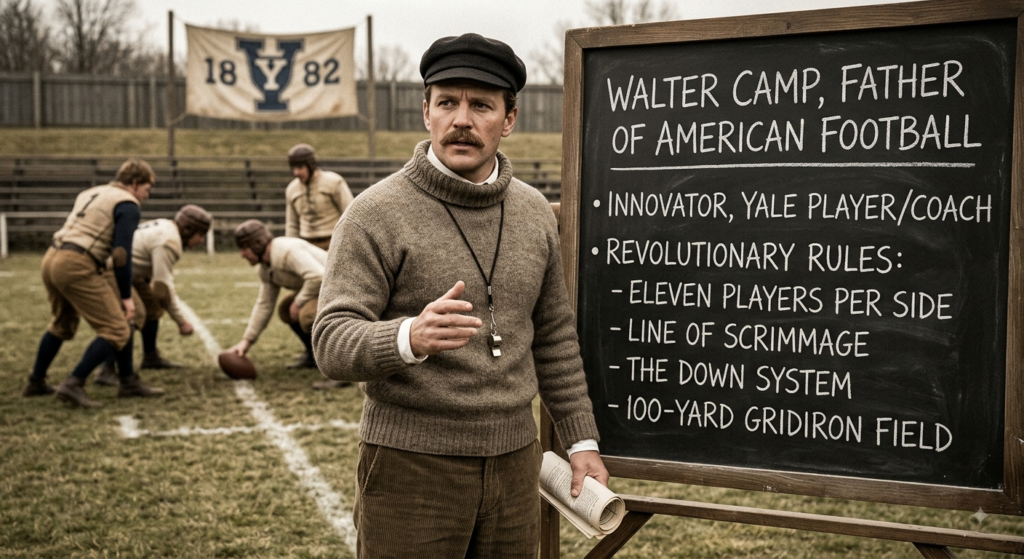
The man most commonly known as the “Father of American Football” is Walter Camp, a Yale player, coach, and sports administrator who played a major role in transforming the rough rugby-style football played at American colleges during the late 19th century into something much closer to the game we recognize today. Yale itself credits Camp with developing modern football from rugby and introducing important ideas such as the 11-man team, downs, and the 100-yard gridiron field.
Camp did not invent football from nothing. Earlier forms of football existed in Britain, while rugby had already developed its own rules. American colleges had also been playing football-style games before Camp became involved. His importance comes from the changes he helped introduce that gave American football its distinct identity.
Was Walter Camp Really the Inventor of American Football?
Calling Walter Camp the sole inventor of American football can be misleading.
It would be more accurate to say that Walter Camp was the most influential architect of early American football.
The sport developed over several decades, with contributions from many schools, players, coaches, administrators, and rule-makers. Early American football borrowed heavily from rugby, and the first college games were played before Camp’s major rule changes.
What Camp did was take an existing game and push it in a new direction.
He helped introduce a system in which the team possessing the ball had a limited number of opportunities to advance it. He also helped establish the line of scrimmage and reduced the number of players on each side from 15 to 11. These changes made the game more organized and increasingly different from rugby. Yale describes Camp as the father of American football and specifically credits him with the down system, eleven-man teams, and the 100-yard field.
So, if someone asks who invented modern American football, Walter Camp is the name most historians and football institutions associate with that transformation.
Who Was Walter Camp?
Walter Chauncey Camp was born in Connecticut in 1859. He attended Yale University, where he became heavily involved in football.
Camp played football at Yale from 1876 to 1882 and later became involved in coaching and administration. Yale News notes that he was also head coach at Yale from 1888 to 1892.
His influence went far beyond playing games.
Camp was interested in how the sport should actually work. He attended meetings where college football representatives discussed rules and argued over how the game should be played.
At the time, football was not nearly as standardized as it is today. There was no modern NFL rulebook covering every situation. Different schools could have different ideas about the number of players, scoring, field dimensions, and possession.
Camp became one of the people pushing for a more organized American version of the sport.
Walter Camp at a Glance
| Detail | Information |
|---|---|
| Full name | Walter Chauncey Camp |
| Born | April 7, 1859 |
| University | Yale University |
| Sport | American football |
| Position | Halfback |
| Known as | Father of American Football |
| Major period of influence | Late 19th century |
| Major contributions | Downs, line of scrimmage, 11-player teams |
| Died | March 14, 1925 |
Where Did American Football Come From?
Before understanding Camp’s contribution, it helps to look at the sports that came before American football.
The word “football” once described a broad family of games. Different schools and communities played their own versions. Some versions allowed carrying the ball, while others emphasized kicking.
Rugby became particularly influential in the United States during the 19th century.
In May 1874, Harvard played McGill University of Montreal in a series of matches. Harvard became interested in McGill’s rugby-style approach, and rugby rules subsequently had a strong influence on American college football. By 1875, Harvard and Yale had played their first major intercollegiate football game, and the rugby style was becoming increasingly popular among American colleges.
This is an important part of the story because American football was not created in isolation.
It grew out of older football and rugby traditions.
Walter Camp then helped change those traditions into a distinctly American game.
Camp’s First Major Idea: Eleven Players
One of Camp’s important contributions was reducing the number of players on a team.
Early versions of American college football could feature 15 players on each side. Camp believed that fewer players would create more space and make speed and strategy more important.
His proposal was not accepted immediately.
According to the Yale Alumni Magazine, Camp proposed reducing teams to 11 players more than once before the idea was finally accepted in 1880.
Today, the 11-player format seems completely normal.
Every NFL fan knows that a team has 11 players on the field at a time. But that arrangement was once a rule change that had to be debated and accepted.
The reduction can also be expressed simply:
15 players − 11 players = 4 fewer players per side
That may sound like a small adjustment, but it had a major effect on the character of the sport.
With fewer players crowded around the ball, there was more room for players to move and for coaches to develop specific formations and tactics.
The Line of Scrimmage
Another enormous contribution associated with Camp was the development of the line of scrimmage.
Modern American football begins every play with the two teams lined up on opposite sides of an imaginary line. The offense controls the ball, and the defense lines up across from it.
That basic concept is fundamental to the sport.
Yale News specifically credits Camp with inventing the line of scrimmage.
The change helped separate American football from rugby’s traditional scrummage.
Instead of having players fight over the ball in a more chaotic contest, the American game increasingly became a sequence of organized plays beginning from a defined position.
That structure eventually allowed the development of playbooks, formations, blocking schemes, offensive systems, and defensive strategies.
The Invention of Downs
Perhaps Camp’s most recognizable contribution is the system of downs.
Anyone who watches American football today knows the basic concept:
A team has a limited number of plays to gain the required distance and keep possession.
Modern football uses four downs to gain 10 yards, although the early system was different.
Camp developed the idea because teams could otherwise hold possession for too long without being forced to make progress. Yale Alumni Magazine describes how a game between Yale and Princeton helped demonstrate the problem: teams could simply retain possession rather than risk giving the ball away. Camp responded by developing a system that gave an offense a limited number of opportunities to advance.
This was a huge change.
Imagine American football without downs.
There would be no:
- First down
- Second down
- Third down
- Fourth down
- “Fourth-and-one”
- “Third-and-long”
- Fourth-down decisions
- Modern clock-management strategy
The entire rhythm of the sport would be different.
The down system gave American football one of its defining characteristics: possession is valuable, but possession must also produce progress.
Why the Field Became a Gridiron
The field itself also became an important part of Camp’s vision.
The modern football field is famous for its horizontal yard lines, hash marks, numbers, and end zones. This grid-like appearance is why American football is often called “gridiron football.”
Yale credits Camp with the development of the 100-yard field marked like a gridiron.
The markings were not merely decorative.
They made it easier for players, officials, and spectators to understand how far a team had moved.
Once the game included downs and yardage requirements, accurate field markings became increasingly important.
For example, if an offense had three attempts to gain a particular distance, spectators needed a way to judge whether the team had succeeded.
Camp’s solution helped make the game measurable.
The Snap and Organized Play
Camp was also associated with the development of the snap from the center and the organization of players into specific positions.
The modern offense has specialized roles such as:
- Quarterback
- Running back
- Fullback
- Wide receiver
- Tight end
- Offensive
- Offensive guard
- Center
The defense has its own specialized positions.
This level of specialization did not appear overnight, but Camp’s structural changes helped move the sport toward an organized system rather than a continuous rugby-style contest.
Once the ball was placed at a line of scrimmage and possession became structured around downs, coaches could design specific plays.
That opened the door to the tactical side of American football.
Did Walter Camp Invent the Forward Pass?
No.
This is a common misconception.
Walter Camp was enormously influential, but he did not invent the modern forward pass.
The legal forward pass was introduced much later, in the early 20th century, as football authorities attempted to make the sport safer and less dependent on mass formations and brutal collisions.
Camp’s major influence came earlier, through the basic structure of the game.
This distinction matters because American football continued changing after Camp’s most important rule innovations.
The game that exists today is the product of many generations of changes.
The Role of Other People
Although Camp is usually given the title “Father of American Football,” it would be unfair to pretend that he created everything alone.
Other college leaders, players, coaches, and administrators influenced the sport.
Harvard, Yale, Princeton, Columbia, and other universities were involved in early rule discussions. The Intercollegiate Football Association provided a forum where representatives debated the rules and tried to create standards for college football.
Camp became one of the strongest voices in those discussions.
Yale Alumni Magazine describes how early football rule-makers dealt with issues including field dimensions, scoring, the number of players, and the way possession should work.
So American football should be viewed as an evolution, not a single invention made on one particular afternoon.
How American Football Changed After Camp
The game continued evolving after Walter Camp.
One of the biggest changes was the introduction of the forward pass. Other changes affected blocking, tackling, player safety, scoring, formations, substitutions, and equipment.
The sport eventually developed into professional football, with the National Football League becoming the dominant professional league in the United States.
Today’s game is dramatically different from the football Camp knew.
Modern quarterbacks throw the ball dozens of times in some games. Players wear advanced helmets and protective equipment. Coaches use video analysis and detailed statistics. Stadiums have giant screens and sophisticated technology.
Yet many basic concepts associated with Camp remain.
The offense still operates from a line of scrimmage.
There are still downs.
There are still 11 players on each side.
The field is still measured in yards.
Those connections make Camp’s influence easy to see more than a century later.
Why Walter Camp Is Still Important
Walter Camp died in 1925, but his name remains deeply connected to American football.
His influence is not limited to one rule.
He helped establish the basic framework around which the sport could develop.
Consider how many modern football conversations depend on concepts connected to his reforms:
“How many yards does the offense need?”
That depends on the down-and-yardage system.
“Where is the line of scrimmage?”
That comes from the organized structure of the game.
“Why are there 11 players on the field?”
That connects directly to the reduction Camp helped establish.
“Why does the field have yard lines?”
That relates to the need to measure progress.
These ideas are so familiar that fans rarely stop to think about where they came from.
Walter Camp vs. the Invention of Football
It is useful to make one final distinction.
Walter Camp did not invent football itself.
Football existed before him.
He also did not invent rugby.
Instead, Camp helped create the American version of football by changing rugby-influenced college football into a more structured game.
That is why calling him the “Father of American Football” is more accurate than simply saying he invented football.
A Simple Timeline
| Year | Event |
|---|---|
| 1870s | Rugby-style football becomes influential at American colleges |
| 1875 | Harvard and Yale play their first football game |
| 1876 | Camp begins playing football at Yale |
| 1880 | Eleven-player teams and the line of scrimmage become major rule developments |
| 1882 | Camp develops the early system of downs |
| 1888–1892 | Camp serves as Yale’s head coach |
| Early 1900s | The sport continues changing, including the eventual legalization of the forward pass |
| 1925 | Walter Camp dies |
| Today | His fundamental ideas remain part of American football |
Final Answer: Who Was the Inventor of American Football?
If you need the short answer, Walter Camp is widely regarded as the father and principal architect of American football.
He did not invent the sport from scratch. American football evolved from earlier forms of football and rugby, and many people contributed to its development.
However, Camp’s influence was enormous.
He helped establish the 11-player team, line of scrimmage, downs, organized possession, and gridiron-style field structure. Yale identifies him as the person who developed modern football from rugby, while Yale News specifically credits him with the line of scrimmage and downs.
The easiest way to understand his importance is to imagine removing his major ideas from today’s game. Without the down system, the line of scrimmage, and the 11-player structure, American football would look completely different.
So the next time someone asks, “Who was the inventor of American football?”, the best answer is not simply “Walter Camp invented it.”
A better answer is this:
Walter Camp was the leading figure who transformed rugby-influenced college football into the organized American game that eventually became modern gridiron football.
His changes gave the sport its structure, and later generations built the enormous game that millions of people watch today.
