


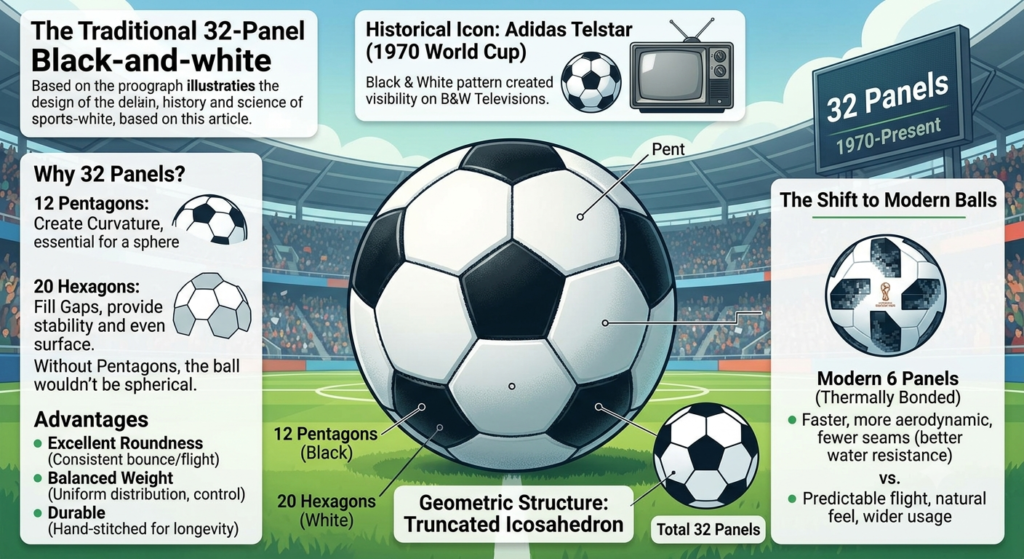
For decades, the classic black-and-white football has been recognized around the world. Whether you’re watching a professional match, playing in the park, or remembering the footballs used during past FIFA World Cups, one design stands out above all others—the traditional 32-panel football.
But have you ever wondered why footballs have exactly 32 panels? Is the number chosen simply for appearance, or is there a scientific reason behind it?
The answer lies in a fascinating combination of geometry, engineering, aerodynamics, durability, and manufacturing history. Although many modern match balls now feature fewer panels, the 32-panel football remains one of the most successful ball designs ever created.
In this article, we’ll explore the history of the 32-panel football, explain why it became the global standard, discuss its advantages and disadvantages, and look at why manufacturers eventually moved toward newer designs.
The Origin of the 32-Panel Football
Before the 1960s, footballs came in many different shapes and designs. Early leather balls were made from stitched leather strips, often with laces that could become uncomfortable when heading the ball.
As manufacturing techniques improved, designers searched for a ball that would be:
- More spherical
- Easier to manufacture
- More durable
- More predictable in flight
The breakthrough came from an unexpected source—mathematics.
The Science Behind the 32 Panels
The traditional football is based on a geometric shape called the truncated icosahedron.
Although the name sounds complicated, it’s actually a very familiar shape.
A truncated icosahedron contains:
| Shape | Number |
|---|---|
| Pentagons | 12 |
| Hexagons | 20 |
| Total Panels | 32 |
This arrangement creates a nearly perfect sphere while using flat pieces of material.
Because flat leather or synthetic panels cannot naturally form a perfect ball, combining pentagons and hexagons allows manufacturers to approximate a sphere with excellent consistency.
Why Exactly 12 Pentagons?
A common question is why designers chose 12 pentagons.
The answer is simple:
A sphere made entirely from hexagons isn’t possible because hexagons alone form flat surfaces, like a honeycomb. Pentagons introduce the necessary curvature that bends the structure into a rounded shape.
Without the 12 pentagons, the football wouldn’t become spherical.
Why Are There 20 Hexagons?
The 20 hexagonal panels fill the spaces between the pentagons.
Together they create:
- Smooth curvature
- Even pressure distribution
- Consistent surface area
- Excellent balance
This combination results in a football that rolls and flies predictably.
Panel Breakdown
| Panel Type | Quantity | Purpose |
|---|---|---|
| Pentagon | 12 | Creates curvature |
| Hexagon | 20 | Completes the spherical shape |
| Total | 32 | Traditional football design |
The Influence of the Adidas Telstar
The popularity of the 32-panel football exploded after the introduction of the Adidas Telstar for the 1970 FIFA World Cup.

Its black pentagons and white hexagons weren’t chosen only for style—they made the ball easier to see on black-and-white television broadcasts, which were common at the time.
As millions watched the World Cup, the Telstar’s appearance became iconic. Soon, the 32-panel pattern became the standard football design used worldwide.
Advantages of the 32-Panel Design
The traditional design wasn’t just visually appealing—it offered several practical benefits.
1. Excellent Roundness
The combination of 12 pentagons and 20 hexagons creates a ball that is very close to a perfect sphere.
Better roundness means:
- More predictable movement
- Consistent bouncing
- Accurate passing
- Reliable shooting
2. Balanced Weight Distribution
Because the panels are evenly arranged around the ball, the weight is distributed uniformly.
Benefits include:
- Stable flight
- Improved control
- Better spin characteristics
- Consistent performance
3. Easy Manufacturing
For many years, stitching together 32 individual panels was the most efficient way to produce a high-quality football.
Manufacturers could:
- Cut identical panels
- Stitch them accurately
- Maintain consistent quality
This design became an industry standard for decades.
4. Greater Durability
Traditional stitched footballs were extremely durable.
Even after hundreds of matches, many retained:
- Their shape
- Air pressure
- Surface grip
This made them ideal for clubs, schools, and recreational players.
5. Reliable Flight Characteristics
One reason professional players loved the classic 32-panel ball was its predictable flight.
Compared with some modern low-panel balls, traditional footballs were less likely to produce unexpected swerves, making passing and long-range shooting more consistent.
Comparison of Traditional and Modern Football Designs
| Feature | 32 Panels | Modern 14–20 Panels |
|---|---|---|
| Shape | Very round | Extremely round |
| Manufacturing | Stitched | Thermally bonded |
| Flight | Predictable | Faster, sometimes less predictable |
| Water resistance | Moderate | Excellent |
| Durability | High | Very high |
| Surface seams | More | Fewer |
Why Modern Footballs Have Fewer Panels
Advances in materials and manufacturing have allowed companies to produce footballs with fewer, larger panels that are thermally bonded instead of stitched.
Fewer seams can improve:
- Water resistance
- Aerodynamics
- Surface consistency
However, many players still appreciate the classic feel and predictable behavior of the traditional 32-panel design
Why Manufacturers Moved Away from the 32-Panel Design
Although the 32-panel football became the standard for decades, technology never stopped evolving. As new materials and production methods emerged, manufacturers discovered they could build footballs with fewer panels while maintaining—or even improving—their overall performance.
Instead of relying on hand-stitched pieces, many premium footballs are now thermally bonded. In this process, heat and pressure fuse the panels together, creating a smoother outer surface with fewer seams.
Some popular modern panel designs include:
| Football Model | Number of Panels |
|---|---|
| Traditional Match Ball | 32 |
| Adidas Teamgeist (2006) | 14 |
| Adidas Jabulani (2010) | 8 |
| Adidas Brazuca (2014) | 6 |
| Adidas Telstar 18 (2018) | 6 |
| Adidas Al Rihla (2022) | 20 |
Each redesign aimed to improve factors such as ball speed, aerodynamics, touch, and durability.
Does the Number of Panels Affect Performance?
Yes—but not always in the way many people think.
The number of panels influences several aspects of a football’s behavior:
- Flight stability
- Surface texture
- Ball control
- Water absorption
- Spin generation
- Manufacturing consistency
A football with more panels has more seams. Those seams can create additional surface friction, which may help stabilize the ball’s flight.
On the other hand, fewer panels create a smoother surface, allowing the ball to travel faster through the air. However, this can sometimes make its movement less predictable, especially when struck with power.
Why Goalkeepers Had Mixed Opinions
When low-panel footballs were introduced, many goalkeepers noticed unusual ball movement.
The 2010 FIFA World Cup ball, the Jabulani, became famous for its unpredictable flight. Players and goalkeepers commented that long-range shots sometimes changed direction unexpectedly, making them harder to judge.
While some attackers enjoyed the extra movement, many goalkeepers preferred the more stable flight of traditional 32-panel footballs.
This feedback influenced later designs, with manufacturers balancing speed and stability more carefully.
The Mathematics Behind the Design
One reason the 32-panel football became so successful is that it closely resembles a perfect sphere using only flat shapes.
The design contains:
- 12 pentagons
- 20 hexagons
- 60 vertices
- 90 edges
This geometric arrangement distributes pressure evenly across the ball, helping it maintain its shape during powerful kicks, headers, and repeated use.
Because the pressure inside the ball is spread uniformly, the ball inflates evenly and provides a consistent playing experience.
Why the Black-and-White Pattern Became Famous
Many people assume footballs have black pentagons simply because they look attractive.
In reality, the famous color scheme had a practical purpose.
During the late 1960s and early 1970s, many football fans watched matches on black-and-white televisions. A plain white ball was difficult to see on screen.
The contrasting black pentagons improved visibility for television audiences, making it easier to follow the ball throughout the match.
Even after color television became standard, the classic black-and-white appearance remained one of the most recognizable symbols in sport.
Are 32-Panel Footballs Still Used Today?
Absolutely.
Although elite competitions often use modern match balls with fewer panels, many footballs sold around the world still feature the traditional 32-panel construction.
They are especially popular for:
- Youth football
- School competitions
- Local leagues
- Recreational matches
- Training sessions
Many coaches also prefer them because their predictable flight helps young players develop proper passing and shooting techniques.
Advantages and Disadvantages
| Advantages | Disadvantages |
|---|---|
| Excellent shape | More seams |
| Stable flight | Slightly heavier when stitched |
| Easy to control | Can absorb more water if stitched |
| Durable | Manufacturing takes longer |
| Traditional feel | Less aerodynamic than some modern balls |
Choosing the Right Football
If you’re buying a football, the panel design is just one factor to consider.
Here’s a quick guide:
| Purpose | Recommended Ball Type |
|---|---|
| Training | Traditional 32-panel |
| School Matches | 32-panel stitched |
| Grass Pitches | Durable stitched ball |
| Professional Matches | FIFA Quality Pro match ball |
| Artificial Turf | Thermally bonded football |
Interesting Facts About the 32-Panel Football
- The classic design is based on the geometric shape known as a truncated icosahedron.
- It consists of 12 pentagons and 20 hexagons, creating a total of 32 panels.
- The design became globally famous after the 1970 FIFA World Cup.
- The iconic black-and-white pattern was introduced mainly for better visibility on black-and-white television broadcasts.
- Even today, millions of training and recreational footballs use the traditional 32-panel layout because of its durability and dependable performance.
Final Thoughts
The 32-panel football is more than just an iconic piece of sports equipment—it represents decades of innovation in design, engineering, and football history. By combining 12 pentagons and 20 hexagons, manufacturers created a ball that offered an ideal balance of roundness, durability, and consistent flight, making it the global standard for many years.
Although advances in technology have led to modern match balls with fewer panels and thermally bonded construction, the traditional 32-panel design remains highly respected. Its reliable performance, familiar feel, and timeless appearance continue to make it a favorite for training sessions, amateur leagues, schools, and recreational players.
Whether you’re a football enthusiast, a coach, or simply curious about the game’s equipment, understanding why footballs have 32 panels reveals how mathematics and engineering have helped shape one of the world’s most beloved sports.
