


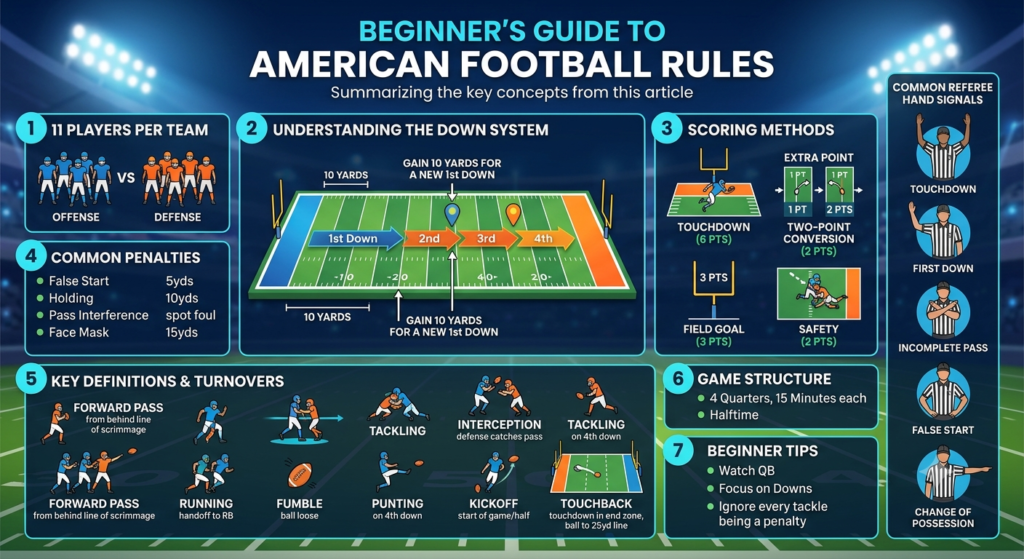
If you’ve ever watched an American football game and wondered why the referee keeps stopping play, what “first and ten” means, or why teams sometimes kick the ball away instead of trying to score, you’re not alone. American football has a reputation for being one of the most strategic sports in the world, but its rules are easier to understand than many people think.
At its core, the game is about gaining territory, protecting the football, and scoring more points than your opponent. Every play follows a clear set of rules, and once you learn those basics, watching a game becomes far more enjoyable.
This beginner’s guide explains the most important American football rules in plain language. Whether you’re watching the NFL, college football, or a local game, these rules will help you follow the action with confidence.
The Basic Objective of the Game
The goal of American football is simple: score more points than the opposing team before the game ends.
Teams score by:
- Carrying the football into the opponent’s end zone.
- Catching the football inside the opponent’s end zone.
- Kicking the football through the goalposts.
- Earning a safety when the opposing team is tackled in its own end zone.
Each team gets turns playing offense and defense throughout the game.
Rule 1: Each Team Has 11 Players on the Field
Only 11 players from each team may be on the field during a play.
Teams can substitute players between plays without any limit, allowing coaches to use different lineups for offense, defense, and special teams.
| Team Unit | Number of Players |
|---|---|
| Offense | 11 |
| Defense | 11 |
| Total Players on the Field | 22 |
If a team has too many players on the field when the ball is snapped, it receives a penalty.
Rule 2: The Game Is Played in Four Quarters
A standard American football game lasts 60 minutes of playing time.
The game is divided into four quarters.
| Period | Length |
|---|---|
| First Quarter | 15 Minutes |
| Second Quarter | 15 Minutes |
| Halftime | 12–20 Minutes |
| Third Quarter | 15 Minutes |
| Fourth Quarter | 15 Minutes |
The game clock stops for incomplete passes, players going out of bounds, penalties, timeouts, scoring plays, and several other situations. This is why games often last more than three hours in real time.
Rule 3: Every Play Starts with a Snap
Before every offensive play, the football is placed on the line of scrimmage.
The center snaps the ball backward to the quarterback to begin the play.
No player is allowed to move across the line of scrimmage before the snap unless the rules permit it.
Rule 4: Understanding the Down System
The down system is one of the most important rules in American football.
The offense receives four downs (attempts) to move the football at least 10 yards.
If they succeed, they earn another set of four downs.
If they fail, the opposing team gains possession.
Example
| Down | Distance Needed |
|---|---|
| 1st Down | 10 Yards |
| 2nd Down | Remaining Distance |
| 3rd Down | Remaining Distance |
| 4th Down | Final Attempt |
For example:
- 1st and 10
- Gain 4 yards
- Now it’s 2nd and 6
- Gain another 7 yards
- New 1st and 10
This process continues until the offense scores or loses possession.
Rule 5: Forward Pass Rules
A team may throw one forward pass during each offensive play.
Important passing rules include:
- The quarterback usually throws the pass.
- The ball must be thrown from behind the line of scrimmage.
- Only eligible receivers may catch the pass.
- If the ball hits the ground before being caught, it is an incomplete pass.
An incomplete pass stops the game clock and counts as one down.
Rule 6: Running the Football
Instead of throwing the ball, the offense may choose to run.
The quarterback hands the football to a running back, who attempts to gain as many yards as possible before being tackled.
There is no limit to the number of running plays a team may call.
Rule 7: Tackling Rules
The defense tries to stop the offense by tackling the player carrying the football.
A play ends when:
- The runner is tackled.
- The runner steps out of bounds.
- The runner scores.
- The referee blows the whistle.
Players cannot tackle opponents by grabbing the face mask or making dangerous hits.
Rule 8: Scoring Rules
There are five ways to score.
| Method | Points |
|---|---|
| Touchdown | 6 |
| Extra Point Kick | 1 |
| Two-Point Conversion | 2 |
| Field Goal | 3 |
| Safety | 2 |
Touchdown
A touchdown is scored when the football crosses the opponent’s goal line while in the possession of an offensive player.
Extra Point
After a touchdown, teams usually kick the football through the goalposts for one additional point.
Two-Point Conversion
Instead of kicking, the offense may run or pass the football into the end zone from the short conversion line.
Field Goal
A successful kick through the uprights during regular play is worth three points.
Safety
A safety occurs when the offense is tackled in its own end zone, giving the defense two points.
Rule 9: Turnovers
A turnover happens whenever possession changes from one team to the other.
Common turnovers include:
| Turnover Type | Description |
|---|---|
| Interception | Defense catches a forward pass |
| Fumble | Ball carrier loses possession |
| Turnover on Downs | Offense fails to gain 10 yards in four downs |
Turnovers often change the momentum of a game and can quickly lead to scoring opportunities for the opposing team.
Rule 10: Punting
On fourth down, teams often choose to punt.
A punt is a kick that sends the football deep into the opponent’s territory instead of risking poor field position after a failed fourth-down attempt.
Punting is considered a strategic decision rather than a scoring playRule 11: Kickoff Rules
Every game starts with a kickoff, and the second half also begins with a kickoff.
During a kickoff:
- The kicking team kicks the ball from its own kicking line.
- The receiving team catches or picks up the ball.
- The returner runs the ball until tackled, goes out of bounds, or scores.
The receiving team’s offense begins from the spot where the return ends.
Kickoff Summary
| Situation | Result |
|---|---|
| Ball returned | Offense starts where runner is tackled |
| Ball goes into end zone and is not returned | Touchback |
| Ball goes out of bounds | Penalty on kicking team |
Rule 12: What Is a Touchback?
A touchback happens when the receiving team does not return the kickoff or catches it in the end zone and chooses not to run.
Instead of returning the ball, the offense starts from its own designated yard line according to the competition’s rules.
A touchback is often the safest option because it avoids the risk of losing yards or fumbling the football.
Rule 13: Fumble Rules
A fumble occurs when a player loses possession of the football before being ruled down.
Once the ball is loose:
- Either team may recover it.
- The team recovering the ball gains possession.
- The play continues until the player is tackled or scores.
Example
A running back is hit while carrying the football.
The ball falls onto the field.
A defensive player picks it up and runs toward the opposite end zone.
The defense has now gained possession.
Rule 14: Interception Rules
An interception happens when a defensive player catches a forward pass intended for an offensive player.
Unlike an incomplete pass, an interception immediately changes possession.
The defender can continue running after making the catch and may even score a touchdown.
Interceptions are among the biggest momentum-changing plays in football.
Rule 15: Common Penalties
Referees use penalties to enforce the rules and maintain fair play.
Here are some of the most common penalties beginners should know.
| Penalty | What It Means | Typical Yard Penalty |
|---|---|---|
| Offside | Defensive player crosses the line before the snap | 5 yards |
| False Start | Offensive player moves before the snap | 5 yards |
| Holding | Illegally grabbing an opponent | 10 yards (offense) |
| Pass Interference | Illegal contact with a receiver before the ball arrives | Spot foul or penalty yards |
| Face Mask | Grabbing an opponent’s face mask | 15 yards |
| Delay of Game | Failing to snap the ball before the play clock expires | 5 yards |
| Unsportsmanlike Conduct | Fighting, taunting, or excessive misconduct | 15 yards |
Penalties can dramatically change field position and sometimes determine the outcome of a close game.
Rule 16: Timeouts
Each team is allowed a limited number of timeouts during each half.
Teams use timeouts to:
- Stop the clock
- Discuss strategy
- Rest tired players
- Avoid delay-of-game penalties
Unused timeouts generally do not carry over to the second half.
Rule 17: The Play Clock
Besides the game clock, football also uses a play clock.
The offense must snap the football before the play clock reaches zero.
If they fail, the referee calls Delay of Game, resulting in a five-yard penalty.
The play clock keeps the game moving and prevents teams from wasting time.
Rule 18: Overtime Rules
If the score is tied after regulation, some competitions play overtime.
Overtime rules vary between professional, college, and high school football.
Generally:
- A winner must be determined.
- Both teams may receive opportunities to score, depending on the league’s rules.
- The first team to gain an advantage under the competition’s overtime format wins.
Rule 19: Player Substitutions
American football allows unlimited substitutions between plays.
This is why teams have separate groups for:
| Unit | Main Responsibility |
|---|---|
| Offense | Score points |
| Defense | Stop the opponent |
| Special Teams | Handle kicks, punts, and returns |
Fresh players help maintain a high level of performance throughout the game.
Rule 20: Instant Replay
Many professional and college games use instant replay.
Officials review video footage to determine whether certain calls were correct.
Replay reviews may be used for:
- Touchdowns
- Turnovers
- Boundary catches
- Goal-line plays
- Player possession
This helps reduce officiating errors in important situations.
Basic Hand Signals Used by Referees
Referees communicate decisions using hand signals.
Some common signals include:
| Signal | Meaning |
|---|---|
| Arms raised overhead | Touchdown |
| One arm raised | First down |
| Arms crossed above head | Incomplete pass |
| Hands on hips | False start |
| Pointing direction | Change of possession |
Learning these signals makes watching games much easier.
Tips for Beginners Watching American Football
If you’re watching football for the first time, these simple tips will help you understand the action.
- Watch the quarterback before the ball is snapped.
- Pay attention to the down and distance shown on the screen.
- Learn how touchdowns, field goals, and safeties are scored.
- Notice how teams change strategy depending on field position.
- Don’t worry about understanding every rule immediately—your knowledge will grow with each game.
Beginner Mistakes to Avoid
New fans often misunderstand a few important rules.
Thinking Every Tackle Is a Penalty
Hard tackles are legal if they follow the rules.
Forgetting About the Down System
Many beginners focus only on the score and overlook how important first downs are.
Ignoring Field Position
Sometimes a team chooses to punt because improving field position is smarter than taking a risky fourth-down attempt.
Confusing Rugby with American Football
Although they share some similarities, American football has different rules, equipment, scoring, and gameplay.
Conclusion
American football may seem complicated at first, but its core rules are straightforward once you understand the basics. The offense works to move the ball down the field, the defense tries to stop them, and every play revolves around the four-down system. Learning how scoring works, recognizing common penalties, and understanding concepts like kickoffs, punts, turnovers, and field position will make every game more enjoyable.
Whether you’re watching the NFL, college football, or a local high school matchup, these beginner-friendly rules provide a solid foundation. As you watch more games, you’ll naturally become familiar with the strategies and terminology that make American football one of the world’s most exciting and tactical sports.
