


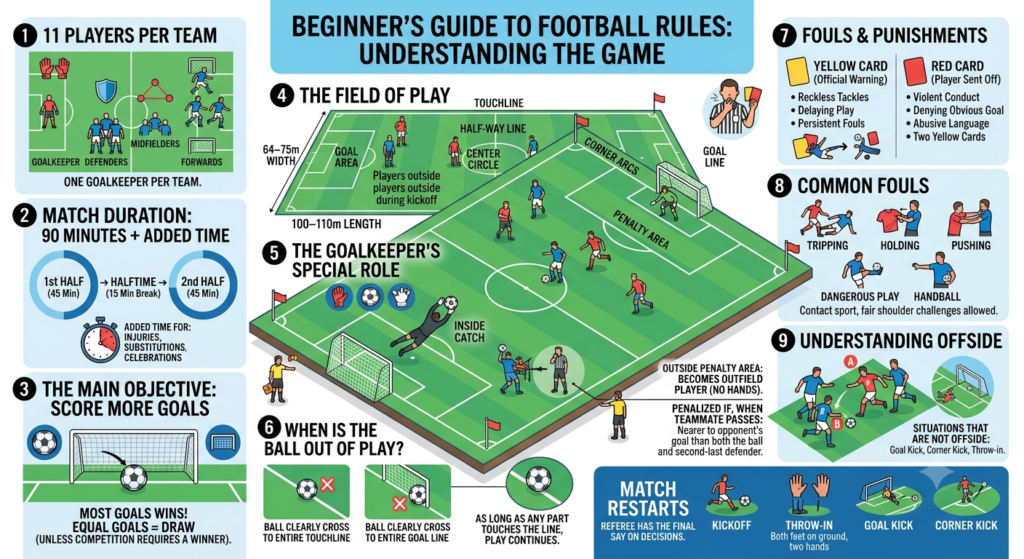
Have you ever watched a football match and wondered why the referee suddenly blew the whistle, raised a yellow card, or stopped play when a player looked perfectly clear on goal? If you’re new to football, you’re certainly not alone. At first glance, the sport appears simple—22 players chasing a ball—but once the match begins, several rules come into play that can confuse first-time viewers.
The good news is that football is actually one of the easiest sports to learn. Once you understand the basic rules, watching matches becomes much more enjoyable. Whether you’re planning to play with friends, follow the Premier League, or simply understand what commentators are talking about, this beginner’s guide covers everything you need to know.
Why Understanding Football Rules Matters
Knowing the rules helps you appreciate the strategy behind every match. Instead of simply watching players pass the ball around, you’ll understand why teams defend in certain ways, why referees stop play, and why coaches celebrate or complain during important moments.
Football is played under a universal set of rules called the Laws of the Game, which are followed almost everywhere in the world. Whether it’s the FIFA World Cup, UEFA Champions League, or your local league, the core rules remain the same.
The Main Objective of Football
The aim is straightforward:
Score more goals than the opposing team before the match ends.
A goal is scored when the entire ball crosses the goal line between the posts and underneath the crossbar, provided no rule has been broken during the attack.
The team with the most goals wins.
If both teams score the same number of goals, the match finishes as a draw unless the competition requires a winner.
Basic Football Rules at a Glance
| Rule | Explanation |
|---|---|
| Players per Team | 11 players including one goalkeeper |
| Match Duration | 90 minutes (two halves of 45 minutes) |
| Ball in Play | The game continues until the ball completely leaves the field or the referee stops play |
| Winning | Team with more goals wins |
| Referee | Has final authority over decisions |
| Goalkeeper | Only player allowed to use hands inside their own penalty area |
How Many Players Are on the Field?
Each team starts with 11 players.
A typical lineup includes:
| Position | Main Responsibility |
|---|---|
| Goalkeeper | Prevent goals |
| Defenders | Stop opposition attacks |
| Midfielders | Connect defense and attack |
| Forwards | Score goals |
Teams usually have substitute players on the bench who can replace teammates during the match.
Starting the Match
Every football game begins with a kickoff.
Before kickoff:
- The referee tosses a coin.
- One captain chooses which side to defend.
- The other team starts with the ball.
- All opposing players remain outside the center circle until the ball is kicked.
The same procedure happens again at the start of the second half.
The Football Field
Football fields can vary slightly in size, but professional matches follow standard measurements.
| Area | Approximate Size |
|---|---|
| Length | 100–110 meters |
| Width | 64–75 meters |
| Goal Width | 7.32 meters |
| Goal Height | 2.44 meters |
| Penalty Area | 16.5 meters from each goal |
Several important markings include:
- Halfway line
- Center circle
- Penalty area
- Goal area
- Corner arcs
- Touchlines
- Goal lines
Each serves a specific purpose during the game.
How Long Does a Football Match Last?
A standard football match consists of:
| Period | Time |
|---|---|
| First Half | 45 minutes |
| Halftime | 15 minutes |
| Second Half | 45 minutes |
| Total Playing Time | 90 minutes |
However, matches usually last around 95–100 minutes because referees add stoppage time for:
- Injuries
- Substitutions
- Goal celebrations
- Time wasting
- VAR reviews
When Is the Ball Out of Play?
The ball is considered out of play only when:
- It completely crosses the touchline.
- It completely crosses the goal line.
- The referee stops the game.
Many beginners mistakenly think the ball is out when it touches the line.
That’s incorrect.
As long as any part of the ball is touching the line, play continues.
The Goalkeeper’s Special Role
The goalkeeper has one unique privilege.
Inside their own penalty area, they may:
- Catch the ball
- Punch the ball
- Throw the ball
- Dive on the ball
Outside the penalty area, they become an ordinary outfield player and cannot deliberately handle the ball.
If they do, the opposing team receives a free kick, and in some situations the goalkeeper may receive a yellow or red card.
Basic Match Flow
A typical football match follows this simple sequence:
- Kickoff begins the game.
- Teams attack and defend.
- Players pass, dribble, and shoot.
- Referee stops play only when necessary.
- Halftime arrives after 45 minutes.
- Second half begins.
- Team with the most goals wins.
Unlike sports with frequent stoppages, football is designed to flow continuously, making it exciting for players and spectators alike.
What Is a Foul?
A foul occurs when a player breaks one of football’s rules while the ball is in play. Most fouls involve unfair physical contact or dangerous play.
Common fouls include:
- Tripping an opponent
- Pushing another player
- Holding a player’s shirt
- Kicking an opponent instead of the ball
- Jumping into an opponent carelessly
- Deliberately handling the ball (except the goalkeeper inside their own penalty area)
The referee decides whether a challenge is fair or unfair based on the speed, force, and intent of the tackle.
Common Fouls Explained
| Foul | Description | Result |
|---|---|---|
| Tripping | Causing an opponent to fall | Free kick |
| Holding | Pulling shirts or arms | Free kick |
| Pushing | Using hands to force an opponent away | Free kick |
| Dangerous Play | High foot or reckless challenge | Free kick |
| Handball | Deliberately touching the ball with the hand or arm | Free kick or penalty |
Not every collision is a foul. Football is a contact sport, and fair shoulder-to-shoulder challenges are allowed.
Direct Free Kick
A direct free kick allows the player to shoot straight at goal.
It is awarded after more serious fouls such as:
- Tripping
- Kicking an opponent
- Holding
- Pushing
- Handball
- Reckless tackles
If the ball goes directly into the goal from a direct free kick, the goal counts.
Indirect Free Kick
An indirect free kick is slightly different.
The ball must touch another player before a goal can be scored.
Indirect free kicks are usually awarded for technical offenses, including:
- Dangerous play without contact
- Goalkeeper holding the ball too long
- Offside offenses
- Preventing the goalkeeper from releasing the ball safely
The referee signals an indirect free kick by raising one arm above their head until another player touches the ball.
Direct vs Indirect Free Kick
| Feature | Direct Free Kick | Indirect Free Kick |
|---|---|---|
| Can score directly? | Yes | No |
| Awarded for | Physical fouls | Technical offenses |
| Referee Signal | Normal whistle | Arm raised |
What Is a Penalty Kick?
A penalty kick is awarded when a defending player commits a direct free kick offense inside their own penalty area.
Examples include:
- Pulling an opponent’s shirt
- Deliberate handball
- Tripping an attacker
- Reckless tackle
The penalty is taken from the penalty spot, located 11 meters (12 yards) from the goal.
Only the goalkeeper stands between the kicker and the goal.
Because of this advantage, penalty kicks have a high success rate in professional football.
Yellow Card
A yellow card serves as an official warning.
Players receive yellow cards for unsporting behavior or repeated rule violations.
Common reasons include:
- Reckless tackles
- Delaying the restart of play
- Dissent toward the referee
- Persistent fouling
- Removing the shirt during a goal celebration
- Entering or leaving the field without permission
A player can continue playing after receiving one yellow card.
Red Card
A red card means the player is immediately sent off.
The team must continue with one fewer player for the rest of the match.
Reasons for a red card include:
- Serious foul play
- Violent conduct
- Deliberately denying an obvious goal with a handball
- Abusive or offensive language
- Receiving two yellow cards in the same match
Playing with ten players often puts a team at a significant disadvantage.
Yellow Card vs Red Card
| Yellow Card | Red Card |
|---|---|
| Official warning | Player sent off |
| Player stays on field | Player leaves immediately |
| Two yellows become one red | Direct red possible for serious offenses |
| Team keeps 11 players | Team continues with fewer players |
Understanding the Offside Rule
The offside rule is one of the most misunderstood parts of football.
Its purpose is simple:
Players cannot wait near the opponent’s goal to gain an unfair advantage.
A player is not automatically offside just because they are ahead of defenders.
They are penalized only if, at the moment a teammate passes the ball:
- They are nearer to the opponent’s goal than both the ball and the second-last defender.
- They are actively involved in the play.
If either condition is missing, play continues.
Situations That Are NOT Offside
A player cannot be offside when receiving the ball directly from:
- A goal kick
- A corner kick
- A throw-in
These exceptions often surprise new fans.
Simple Offside Examples
| Situation | Offside? |
|---|---|
| Player behind defenders when pass is made | No |
| Player ahead of defenders but not involved | No |
| Player ahead of defenders and receives pass | Yes |
| Receives ball from a throw-in | No |
A helpful tip for beginners:
The decision is made the instant the ball is passed—not when it is received.
The Referee’s Role
The referee controls the entire match.
Their responsibilities include:
- Enforcing the Laws of the Game
- Awarding free kicks and penalties
- Showing yellow and red cards
- Keeping time
- Allowing advantage when appropriate
- Ensuring player safety
The referee’s decisions are final during the match, although some can now be reviewed using VAR in competitions where it is available.
Assistant Referees
Each match usually has two assistant referees, often called linesmen.
They help the referee by signaling:
- Offside decisions
- Throw-ins
- Corner kicks
- Goal kicks
- Fouls near the touchline
- Whether the ball has left the field
Their flags provide valuable support, especially during fast-moving attacks.
Match Officials Overview
| Official | Main Responsibility |
|---|---|
| Referee | Controls the match and applies the rules |
| Assistant Referee | Signals offsides and ball out of play |
| Fourth Official | Manages substitutions and added time |
| VAR Team (where used) | Reviews major match-changing incidents |
A throw-in is awarded when the entire ball crosses the touchline (sideline).
The throw-in is taken by the team that did not touch the ball last.
To take a legal throw-in, the player must:
- Keep both feet on or behind the touchline.
- Use both hands.
- Throw the ball from behind and over the head.
- Keep part of each foot touching the ground.
If these requirements are not met, the throw-in is awarded to the opposing team.
Throw-In Rules at a Glance
| Rule | Explanation |
|---|---|
| Ball leaves the touchline | Throw-in awarded |
| Last player to touch ball | Opponent takes the throw |
| Both hands required | Yes |
| Feet on or behind the line | Yes |
| Direct goal allowed | No |
Goal Kicks
A goal kick is awarded when the attacking team last touches the ball before it crosses the defending team’s goal line without resulting in a goal.
The defending team restarts play from inside the goal area.
Goalkeepers usually take goal kicks, but another player can take them as well.
Corner Kicks
A corner kick is awarded when the defending team last touches the ball before it crosses their own goal line without entering the goal.
The attacking team places the ball inside the corner arc and restarts play.
Corner kicks often create excellent scoring opportunities because many players gather in the penalty area.
Goal Kick vs Corner Kick
| Situation | Restart |
|---|---|
| Attacker touches ball last before goal line | Goal Kick |
| Defender touches ball last before goal line | Corner Kick |
Substitutions
Modern football allows teams to replace tired or injured players during a match.
In most major competitions today:
- Teams may use up to five substitutions during normal time.
- These substitutions are usually made during a limited number of stoppages to avoid unnecessary interruptions.
- Introduce fresh players.
- Change tactics.
- Replace injured players.
- Protect players who have received yellow cards.
Added Time
You may notice matches often continue beyond the 45th or 90th minute.
This is called added time (or stoppage time).
The referee adds extra minutes to make up for delays caused by:
- Injuries
- Substitutions
- Goal celebrations
- VAR reviews
- Time wasting
Example
| Half | Scheduled Time | Added Time | Actual End |
|---|---|---|---|
| First Half | 45 minutes | +3 minutes | 48 minutes |
| Second Half | 45 minutes | +6 minutes | 96 minutes |
Extra Time
Some knockout competitions require a winner.
If the score is tied after 90 minutes:
- Two periods of 15 minutes each are played.
- There is a short break between the two extra-time halves.
- If one team scores more goals, that team wins.
Not every competition uses extra time. Some tournaments go directly to a penalty shootout after normal time.
Penalty Shootout
If the score remains level after extra time, many competitions decide the winner with a penalty shootout.
Each team takes five penalties.
If the score is still tied after five kicks each, the shootout continues one kick at a time until one team scores and the other misses in the same round.
Penalty shootouts test both skill and composure under pressure.
Quick Summary of Match Restarts
| Situation | Restart |
|---|---|
| Ball crosses touchline | Throw-in |
| Attacker touches ball last over goal line | Goal Kick |
| Defender touches ball last over goal line | Corner Kick |
| Direct foul | Direct Free Kick |
| Technical offense | Indirect Free Kick |
| Foul inside penalty area | Penalty Kick |
Simple Football Rules Every Beginner Should Remember
If you’re just starting to watch football, these key points will help you follow almost any match:
- Each team has 11 players, including one goalkeeper.
- A standard match lasts 90 minutes, plus added time.
- The team with the most goals wins.
- Only the goalkeeper may handle the ball inside their own penalty area.
- Fouls lead to free kicks or penalties, depending on where they occur.
- Two yellow cards equal one red card.
- A red card means the player is sent off.
- Offside is judged when the pass is played, not when the ball is received.
- The referee has the final say on decisions during the match.
Final Thoughts
Football may seem complicated at first, but once you understand the core rules, it becomes much easier to follow. The game’s simplicity is one of the reasons it has become the world’s most popular sport. Whether you’re watching a local match, the UEFA Champions League, or the FIFA World Cup, the same basic principles apply.
Start by remembering the fundamentals: the objective is to score more goals than your opponent, respect the referee’s decisions, and understand common situations like fouls, offside, throw-ins, and corner kicks. As you watch more matches, these rules will quickly become second nature.
With this beginner’s guide, you now have a solid foundation to enjoy football with confidence, understand match commentary, and appreciate the tactics and excitement that make the sport loved by millions around the world.
