


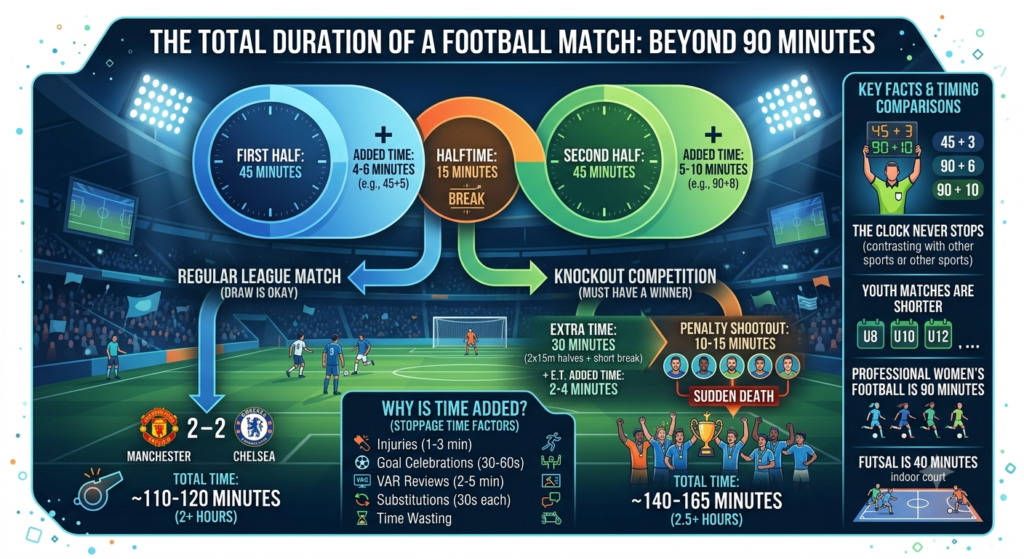
If you’ve ever watched a football match from kickoff to the final whistle, you’ve probably noticed something interesting. The game is supposed to last 90 minutes, yet it often ends at the 95th, 98th, or even the 100th minute. Sometimes, in major tournaments, the action continues for another 30 minutes before ending with a dramatic penalty shootout.
So, how long is a football match actually?
The simple answer is that the official playing time is 90 minutes, split into two halves of 45 minutes each. However, once you include halftime, stoppage time, extra time, and penalties (when required), the total time fans spend watching a match can easily exceed two hours.
Whether you’re new to football or simply curious about how the timing works, this guide explains every stage of a football match in a clear and easy-to-understand way.
The Official Length of a Football Match
According to the Laws of the Game, a standard football match lasts 90 minutes.
The game is divided into two equal halves with a short break in between.
| Match Period | Duration |
|---|---|
| First Half | 45 Minutes |
| Halftime | 15 Minutes |
| Second Half | 45 Minutes |
| Official Playing Time | 90 Minutes |
The referee is responsible for keeping the official time during the match.
Unlike sports such as basketball or American football, the game clock does not stop every time play is interrupted. Instead, lost time is added at the end of each half.
Why Doesn’t a Football Match End Exactly After 90 Minutes?
One of the biggest misconceptions among new football fans is believing that every match finishes exactly after 90 minutes.
In reality, football matches almost never end at precisely 90 minutes because several events interrupt play throughout the game.
Common reasons include:
- Player injuries
- Goal celebrations
- Substitutions
- VAR reviews
- Time wasting
- Fouls requiring treatment
- Red cards
- Crowd interruptions
Rather than stopping the clock each time, the referee simply records the delays and adds them as stoppage time.
Understanding Stoppage Time
Stoppage time is also called:
- Added Time
- Injury Time
At the end of each half, the fourth official displays the minimum number of extra minutes that will be played.
For example:
- 45 + 3
- 45 + 5
- 90 + 6
- 90 + 10
If the board shows 90 + 6, it means at least six additional minutes will be played.
The referee can extend this even further if another delay occurs during stoppage time.
How Is Added Time Calculated?
Although fans often debate the amount of stoppage time, referees follow several factors while making their decision.
Time Lost During Play
| Incident | Estimated Time Lost |
|---|---|
| Goal Celebration | 30–60 Seconds |
| Player Injury | 1–3 Minutes |
| VAR Review | 2–5 Minutes |
| Substitution | 30 Seconds |
| Serious Injury | 5+ Minutes |
| Time Wasting | Depends on Situation |
Every interruption contributes to the total amount of added time.
Example Match Time Calculation
Imagine a football match where the following events occur during the first half.
| Event | Time Lost |
|---|---|
| One Injury | 2 Minutes |
| Goal Celebration | 1 Minute |
| Two Substitutions | 1 Minute |
Calculation
45 Minutes
- 2 Minutes (Injury)
- 1 Minute (Celebration)
- 1 Minute (Substitutions)
= 49 Minutes
Therefore, the referee may end the first half around the 49th minute.
Now let’s look at the second half.
| Event | Time Lost |
|---|---|
| VAR Review | 4 Minutes |
| Three Substitutions | 2 Minutes |
| Time Wasting | 2 Minutes |
Calculation
45 Minutes
- 4 Minutes
- 2 Minutes
- 2 Minutes
= 53 Minutes
Second half finishes around 98 minutes on the match clock.
Complete Match Duration Calculation
Many people assume a football match lasts just one and a half hours.
However, that’s only the official playing time.
Here’s what an average professional match looks like.
| Match Activity | Time |
|---|---|
| First Half | 45 Minutes |
| Added Time | 4 Minutes |
| Halftime Break | 15 Minutes |
| Second Half | 45 Minutes |
| Added Time | 5 Minutes |
Total Time
45 + 4 + 15 + 45 + 5
= 114 Minutes
This means most fans spend almost two hours watching a normal football match from kickoff until the final whistle.
Why Has Stoppage Time Become Longer?
If you’ve watched recent FIFA World Cup or Premier League matches, you’ve probably noticed referees adding 8, 10, or even 12 minutes.
This isn’t because the rules changed dramatically.
Instead, football authorities now encourage referees to calculate wasted time more accurately.
Modern football includes:
- More substitutions
- More VAR reviews
- Longer celebrations
- Better timekeeping
As a result, matches today often have longer periods of added time than they did a decade ago.
What Happens If the Match Ends in a Draw?
The answer depends entirely on the competition.
League Matches
In league competitions, a draw is perfectly acceptable.
For example:
- Premier League
- La Liga
- Bundesliga
- Serie A
- Ligue 1
If both teams are level after 90 minutes plus stoppage time, the match ends immediately.
Each team earns one point.
For example:
Manchester United 2–2 Chelsea
The referee blows the final whistle.
No extra time.
No penalties.
Knockout Competitions
Cup competitions are different because one team must advance to the next round.
Examples include:
- FIFA World Cup
- UEFA Champions League Knockout Stage
- FA Cup
- Copa del Rey
- UEFA European Championship
If the score remains tied after normal time, the match moves into extra time.
How Long Is Extra Time?
Extra time consists of 30 additional minutes.
These are divided into two halves.
| Extra Time Period | Duration |
|---|---|
| First Extra Half | 15 Minutes |
| Short Break | 1 Minute |
| Second Extra Half | 15 Minutes |
| Total Extra Time | 30 Minutes |
Players also switch sides between the two extra-time periods.
The referee may still add stoppage time if delays occur.
Total Time Including Extra Time
Let’s calculate a realistic knockout match.
| Stage | Minutes |
|---|---|
| Regular Time | 90 |
| Added Time | 8 |
| Halftime | 15 |
| Extra Time | 30 |
| Extra-Time Added Time | 4 |
Total
90 + 8 + 15 + 30 + 4
= 147 Minutes
And if penalties are needed, another 10–15 minutes can easily be added.
What Happens If the Score Is Still Level After Extra Time?
If neither team manages to score the winning goal during extra time, the match is decided by a penalty shootout. This is one of the most dramatic moments in football because the pressure shifts from teamwork to individual composure.
Each team selects five players to take one penalty kick each. The teams alternate kicks, and the side with the most successful penalties after five attempts wins the match.
If the score is still tied after both teams have taken five penalties, the shootout moves to sudden death. From that point onward, each team takes one penalty at a time until one team scores and the other misses.
It’s worth noting that penalties only determine the winner of the competition. They do not change the official match score.
For example:
- Argentina 1–1 France (Argentina won 4–2 on penalties)
The official match result remains 1–1, while Argentina advances after winning the shootout.
How Long Does a Penalty Shootout Take?
Unlike the 90-minute match, there is no fixed time limit for a penalty shootout. The duration depends on how many kicks are required.
| Stage | Approximate Time |
|---|---|
| Players Gather | 2–3 Minutes |
| Coin Toss | 1 Minute |
| First Five Penalties | 5–8 Minutes |
| Sudden Death (if needed) | 2–10 Minutes |
Average Duration: 10–15 minutes
Some shootouts finish quickly, while others continue for many rounds before a winner is decided.
How Long Can a Football Match Last in Total?
Many people ask whether a football match can last more than two hours.
The answer is yes.
Let’s calculate a realistic example from a knockout tournament.
| Match Activity | Time |
|---|---|
| First Half | 45 Minutes |
| Added Time | 6 Minutes |
| Halftime | 15 Minutes |
| Second Half | 45 Minutes |
| Added Time | 8 Minutes |
| Extra Time | 30 Minutes |
| Extra-Time Added Time | 4 Minutes |
| Penalty Shootout | 12 Minutes |
Total Match Duration Calculation
45 + 6 + 15 + 45 + 8 + 30 + 4 + 12
= 165 Minutes
That equals approximately 2 hours and 45 minutes from kickoff until the winning team celebrates.
This is why supporters often reserve an entire evening when watching important finals.
Why Doesn’t the Referee Stop the Clock?
Unlike basketball or American football, football uses a running clock.
Instead of stopping the timer after every interruption, the referee allows the clock to continue running and simply adds the lost time at the end of each half.
This system keeps the game flowing naturally and reduces unnecessary delays.
Match Duration in Different Competitions
Although the Laws of the Game remain almost identical worldwide, different competitions may have different rules after a draw.
| Competition | Regular Time | Extra Time | Penalties |
|---|---|---|---|
| Premier League | 90 Minutes | No | No |
| La Liga | 90 Minutes | No | No |
| Bundesliga | 90 Minutes | No | No |
| FIFA World Cup Knockout | 90 Minutes | Yes | Yes |
| UEFA Champions League Knockout | Yes | Yes | Yes |
| FA Cup Final | Yes | Yes | Yes |
League matches normally finish after stoppage time, while knockout tournaments require a winner.
How Long Are Youth Football Matches?
Children do not play the full 90-minute format.
The match length depends on the players’ age.
| Age Group | Match Length |
|---|---|
| Under 8 | 40 Minutes |
| Under 10 | 50 Minutes |
| Under 12 | 60 Minutes |
| Under 14 | 70 Minutes |
| Under 16 | 80 Minutes |
| Adults | 90 Minutes |
These timings help young players develop their skills without becoming overly tired.
Different football associations may make small adjustments to these durations.
How Long Is a Women’s Football Match?
A common misconception is that women’s football has shorter matches.
In reality, professional women’s football follows the same Laws of the Game as men’s football.
A standard women’s match includes:
- First Half – 45 minutes
- Halftime – 15 minutes
- Second Half – 45 minutes
Official playing time is 90 minutes, with added time and extra time used when necessary.
Whether it’s the FIFA Women’s World Cup, UEFA Women’s Champions League, or domestic competitions, the timing rules are essentially the same.
How Long Is a Futsal Match?
Futsal is a faster version of football played indoors on a smaller court.
Its timing system is different from outdoor football.
| Match Type | Duration |
|---|---|
| Outdoor Football | 90 Minutes |
| Futsal | 40 Minutes |
| Indoor Football | 40–60 Minutes |
A futsal match consists of two 20-minute halves, and the clock stops whenever the ball goes out of play, making the timing more precise.
Interesting Facts About Football Match Time
Here are a few facts that many fans don’t know:
- The referee is the only person who decides exactly when the match ends.
- Added time shown by the fourth official is the minimum amount to be played.
- A match can continue beyond the announced added time if another delay occurs.
- Goal celebrations, injuries, and VAR reviews are now major reasons for long stoppage time.
- Some World Cup matches have featured more than 12 minutes of added time in a single half.
