


A cricket team may have talented batters, dangerous bowlers and excellent fielders, but talent alone does not always produce consistent results. Behind many successful teams is a coach who helps players improve their skills, understand their roles and prepare for the challenges of competition.
So, what does a coach in cricket actually do?
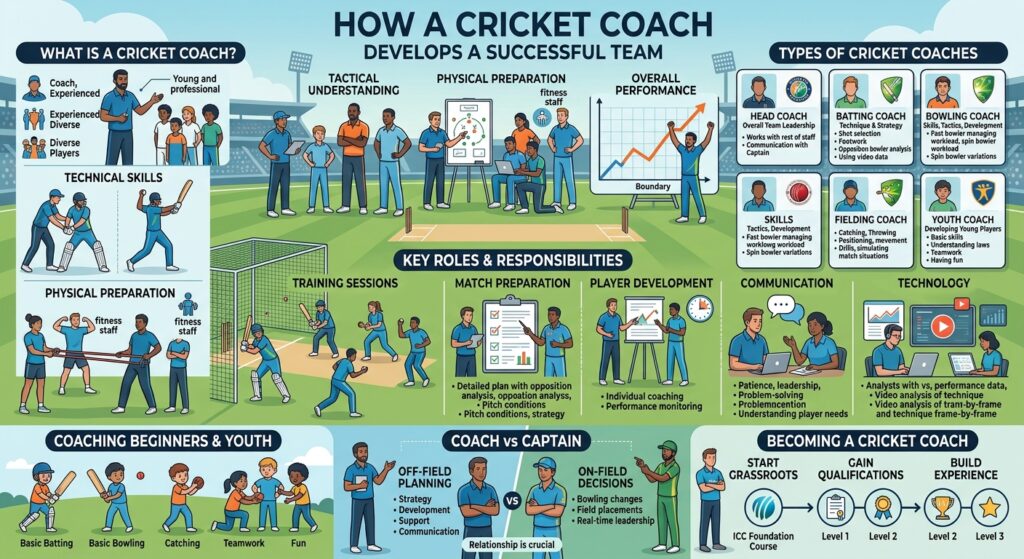
A cricket coach is responsible for helping players and teams improve their technical skills, tactical understanding, physical preparation and overall performance. The job can be very different depending on whether the coach works with beginners, a school team, a domestic side or an international team.
Modern coaching has also become much broader than simply standing beside the nets and giving instructions. Coaches can work with performance analysts, fitness staff, physiotherapists and specialist coaches to create detailed training programs. The ICC‘s current coaching pathway ranges from a foundation course through Levels 1, 2 and 3, with the higher levels designed for player development and high-performance environments.
What Is a Coach in Cricket?
A cricket coach is a person who guides players in learning, practicing and improving the different aspects of cricket.
A coach may help a batter correct a technical problem, show a bowler how to improve their action, teach fielding techniques or help the entire team develop a plan for an upcoming opponent.
At junior level, the coach’s job is often focused on teaching the basics and making sure players enjoy the game. At elite level, the responsibilities become much more detailed.
An international coach may be involved in:
- Training sessions
- Match preparation
- Tactical planning
- Player development
- Opposition analysis
- Team selection discussions
- Performance reviews
- Individual coaching
- Fitness planning
- Communication with support staff
A coach is therefore both a teacher and a leader.
Main Role of a Cricket Coach
The main purpose of a coach is to help players perform better.
This does not mean simply telling a batter to hit the ball harder or asking a bowler to bowl faster. Good coaching involves identifying problems, understanding why they are happening and finding practical ways to solve them.
For example, if a batter is repeatedly dismissed while driving outside the off stump, the coach may study the player’s footwork, balance and shot selection. The training program can then be adjusted to address the specific problem.
The same principle applies to bowling and fielding.
A fast bowler struggling with consistency may work on their run-up, release point and alignment. A fielder who regularly misses difficult catches may spend additional time working on movement, positioning and catching technique.
Different Types of Cricket Coaches
There is no single type of cricket coach. Professional teams often have several coaches, each with a particular responsibility.
| Type of Coach | Main Responsibility |
|---|---|
| Head Coach | Overall team performance and leadership |
| Batting Coach | Batting technique and strategy |
| Bowling Coach | Bowling skills, tactics and development |
| Fielding Coach | Catching, throwing and fielding movement |
| Fast-Bowling Coach | Pace, mechanics and fast-bowling workloads |
| Spin-Bowling Coach | Spin technique and variations |
| Youth Coach | Development of young players |
| High-Performance Coach | Advanced player and team development |
Modern cricket organizations increasingly use specialist coaches. For example, current BCCI coaching roles include dedicated batting, fielding and fast-bowling positions, with responsibilities involving technical coaching, individual player development, training sessions and performance monitoring.
Head Coach in Cricket
The head coach usually has the broadest responsibility.
Rather than concentrating on just one skill, the head coach oversees the team’s overall preparation and works with the rest of the coaching staff.
A head coach may help establish:
- Team playing philosophy
- Training structure
- Match preparation
- Tactical plans
- Player development priorities
- Team culture
- Performance reviews
The head coach also needs to communicate effectively with the captain and players.
One of the most important parts of the job is understanding that every player is different. A strategy that works for one cricketer may not work for another.
Good coaches therefore learn how their players respond to pressure, criticism, encouragement and different training methods.
Batting Coach
A batting coach focuses primarily on the batting department.
The work can include correcting technique, improving shot selection, developing footwork and preparing batters for different types of bowling.
A batting coach may also study opposition bowlers before a match.
For example, if an opposing fast bowler regularly swings the ball into right-handed batters, the coaching staff may prepare batters for that specific challenge during practice.
Modern batting coaching can also involve video and performance data. A player might review footage of their innings to identify patterns that are difficult to notice while playing.
BCCI’s current batting-coach job description includes individual coaching, specialist batting programs, performance objectives, opposition scouting and collaboration with other members of the support team.
Bowling Coach
A bowling coach works with bowlers to improve their technique, accuracy, variations and tactical understanding.
Fast bowlers may work on:
- Run-up
- Bowling action
- Release point
- Seam position
- Swing
- Pace
- Bounce
- Bowling plans
Spin bowlers may focus on:
- Revolutions
- Flight
- Line and length
- Changes of pace
- Different deliveries
- Using the pitch effectively
Bowling coaches also have to think about workloads, especially with fast bowlers. At professional level, managing how much a bowler trains and bowls can be an important part of maintaining performance.
Fielding Coach
Fielding has become one of the most important areas of modern cricket.
A fielding coach works on catching, throwing, ground fielding, movement and positioning.
A small improvement in fielding can save several runs during a match. A good catch can also change the entire course of an innings.
Fielding coaches may create drills that simulate realistic match situations instead of simply asking players to catch balls repeatedly.
Current specialist fielding-coach roles can include designing individual fielding programs, monitoring player objectives and working with strength-and-conditioning staff on movement and biomechanics.
Coaching Young Cricketers
Coaching beginners is different from coaching international players.
Young players are still developing their basic skills, so a coach should not overload them with complicated instructions.
At the introductory level, the focus is often on:
- Basic batting
- Basic bowling
- Catching
- Throwing
- Understanding the law
- Teamwork
- Enjoying the sport
The ICC’s foundation coaching course is designed to introduce aspiring coaches to the fundamentals of cricket and coaching, while Level 1 focuses on coaching beginners.
This shows how coaching can begin with simple teaching before progressing toward advanced performance work.
How Coaches Prepare Players for Matches
Match preparation is one of the most interesting parts of cricket coaching.
Before a game, coaches may study the opposition and consider questions such as:
- Which batters are strongest?
- Which bowlers are likely to create problems?
- How does the pitch normally behave?
- What are the expected conditions?
- Which fielding positions might be important?
- How should the team approach the powerplay?
- How can the middle overs be controlled?
- What is the best plan at the death?
The answers can influence the team’s strategy.
However, cricket is unpredictable. A good coach needs to prepare a plan while also being ready to change it.
The Importance of Communication
Technical knowledge is important, but communication may be just as valuable.
A coach can have excellent cricket knowledge and still struggle if players do not understand the message.
Instructions need to be clear and appropriate for the individual.
Some players respond well to detailed technical explanations. Others may perform better when given one simple thought to focus on.
This is why modern coach education includes communication and player understanding. Advanced ICC coaching education also emphasizes effective communication, observation, review and designing sessions for individuals and teams.
Coaches and Technology
Technology has changed cricket coaching considerably.
Video analysis allows coaches to examine a player’s technique frame by frame. Performance data can provide information about bowling speed, workloads, scoring patterns and other measurements.
Some professional coaching roles now involve athlete-management systems, video content and performance metrics. Current BCCI specialist coaching descriptions specifically mention the use of player-management systems and performance measurements.
Technology does not replace coaching knowledge, though. Data only becomes useful when a coach knows how to interpret it and turn it into practical advice.
Coach and Captain: What Is the Difference?
The coach and captain have different roles.
The coach generally works from outside the playing field and is responsible for preparation, development and support.
The captain is a player who leads the team during the match.
The captain makes decisions on the field, such as bowling changes and field placements, while the coach helps prepare the team and develops the broader strategy.
The two need to work together.
A strong relationship between captain and coach can help the team remain organized when circumstances change during a match.
Qualities of a Good Cricket Coach
A good cricket coach needs more than cricket knowledge.
Some important qualities include:
- Patience
- Communication
- Leadership
- Organization
- Observation
- Technical knowledge
- Tactical understanding
- Adaptability
- Problem-solving
- Emotional intelligence
A coach must also be willing to keep learning.
Cricket changes constantly. New formats, new techniques, new training methods and new analytical tools continue to influence the game.
How to Become a Cricket Coach
Someone interested in coaching can start at grassroots level and gradually gain qualifications and experience.
The exact pathway depends on the country and governing organization. The ICC provides a structured pathway from foundation coaching through Level 1, Level 2 and Level 3.
A beginner coach can start by learning:
- Cricket laws
- Basic techniques
- Coaching principles
- Safety
- Session planning
- Communication
As experience increases, coaches can move toward competitive and high-performance environments.
Level 2, for example, is designed around coaching competitive players and includes areas such as technical analysis, mental skills, biomechanics, physical demands and session planning.
Why Coaches Matter in Cricket
It is easy to notice a batter scoring a century or a bowler taking five wickets. The coach’s contribution is often less visible.
A coach may spend weeks helping a player correct a small technical problem. The improvement might only become obvious when that player performs under pressure during an important match.
Coaches also help create a team environment where players understand their responsibilities.
In international cricket, the coaching role can become especially demanding because teams travel frequently, play multiple formats and face opponents with very different strengths.
Recent coaching appointments also show how important the role remains at national level. In 2026, for example, Gary Kirsten was appointed Sri Lanka men’s head coach with responsibility for preparing the team toward the 2027 Cricket World Cup.
Final Thoughts
A coach in cricket is much more than someone who organizes net practice. Coaches teach skills, develop players, prepare teams, analyze opponents, create strategies and help cricketers deal with the pressures of competition.
At beginner level, coaching may be about learning how to hold a bat or bowl correctly. At international level, it can involve detailed performance analysis, individual development plans, tactical preparation and coordination with a large support team.
The best coaches understand that cricket is played by people, not machines. Technical knowledge matters, but so do communication, patience, trust and the ability to recognize what each player needs.
That combination makes coaching one of the most important parts of modern cricket. Whether the goal is helping a child enjoy their first game or preparing an international team for a major tournament, a good coach can have a lasting influence on a player’s development and a team’s success.
