


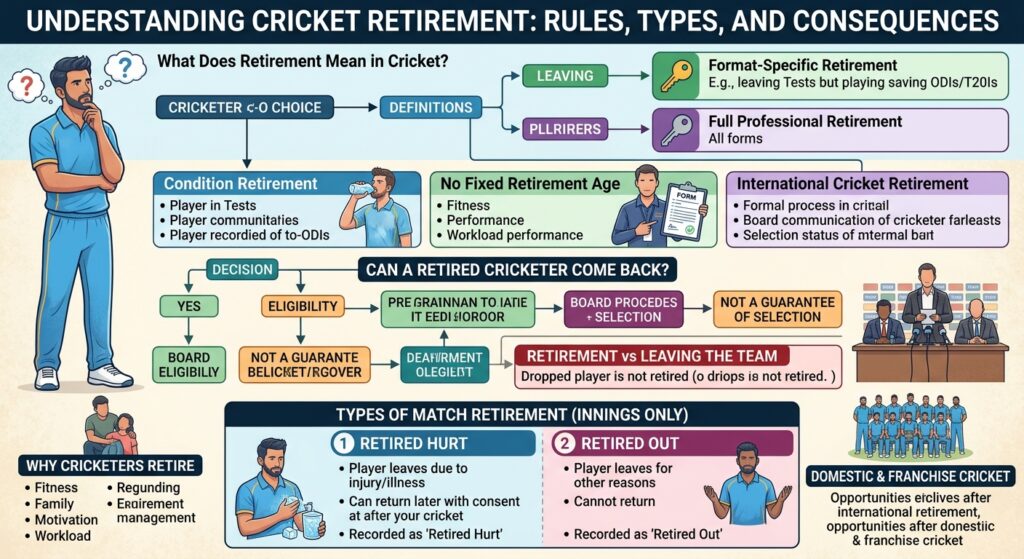
Retirement is a major moment in a cricketer’s career. After spending years playing international matches, domestic competitions, or franchise cricket, a player may decide that it is time to step away. But what exactly happens when a cricketer announces retirement? Are there official rules that determine when a player can retire, or can anyone simply announce that they are finished?
The answer depends on the type of retirement and the level of cricket being played. In most cases, there is no single rule that forces a player to retire at a particular age. A cricketer can generally decide when to end their career, although retirement from international cricket can involve formal communication with the player’s cricket board and, in some circumstances, decisions about returning to the game.
Understanding cricket retirement rules also requires looking at the difference between retiring from a particular format, international cricket, and cricket altogether.
What Does Retirement Mean in Cricket?
Cricket retirement normally means that a player has decided to stop playing at a particular level or in a particular format.
For example, a player may announce retirement from Test cricket but continue playing One Day Internationals (ODIs) and T20 internationals. Another player may leave international cricket while continuing to participate in domestic or franchise leagues.
A retirement announcement therefore does not always mean the end of every cricketing activity.
Players may retire from:
- Test cricket
- ODI cricket
- T20 international cricket
- International cricket altogether
- Domestic cricket
- All forms of professional cricket
The exact consequences depend on what the player announces and the rules of the relevant cricket board or competition.
Is There a Fixed Retirement Age in Cricket?
There is generally no universal retirement age for professional cricketers.
Unlike some professions where a specific retirement age may apply, cricket allows players to continue competing as long as they remain eligible and are selected. A player’s age alone does not automatically end their international career.
Some cricketers retire in their early or mid-30s, while others continue into their late 30s or beyond. The decision can be influenced by fitness, form, workload, family commitments, injuries, selection, and personal priorities.
A player who remains fit and continues performing at a high level may continue playing for many years.
Can a Player Retire From One Format Only?
Yes. Format-specific retirement is common in modern cricket.
A player might decide that the physical demands of Test cricket are no longer suitable while continuing to play limited-overs cricket. Similarly, someone may retire from ODIs but continue playing T20 cricket.
This type of decision allows players to manage their workload while extending their careers.
For example, a player could announce:
“I am retiring from Test cricket but will continue representing my country in white-ball cricket.”
Such an announcement does not necessarily end the player’s international career. The player can remain available for other formats if they meet the relevant selection and eligibility requirements.
Retirement From International Cricket
Retiring from international cricket is a more significant decision.
A player representing a national team normally communicates their decision through the appropriate cricket board or publicly announces their retirement. The player’s board may then update its records and selection status.
Once a player retires from international cricket, they are generally no longer available for selection as an active international player.
However, retirement procedures can differ between cricket boards and governing regulations. There is no single process that is identical for every country.
Can a Retired Cricketer Come Back?
This is one of the most interesting parts of cricket retirement.
A retired player may sometimes return to cricket, but returning to international cricket is not always as simple as changing their mind.
The circumstances depend on the player’s retirement announcement, the relevant cricket board, competition regulations, and the governing rules in effect at that time.
Some players have returned after announcing retirement, while others have remained retired permanently.
A player who wants to make a comeback may need to communicate with their cricket board and become eligible for selection again. Selection itself is still a separate matter. Returning from retirement does not automatically guarantee a place in the national team.
Retirement vs Leaving the National Team
Retirement and being dropped from a team are completely different situations.
A player who is dropped is no longer selected, but they have not necessarily ended their career. They can continue playing domestic cricket and may return to the national side if selected again.
Retirement is a decision by the player to end their participation at a particular level or in a particular format.
This distinction is important because an experienced player can remain outside the national team for a period without officially retiring.
What Happens When a Player Retires During a Match?
The word “retire” has another meaning in cricket that is separate from career retirement.
A batter can retire during an innings. This is known as retiring from the innings rather than retiring from cricket.
Under the Laws of Cricket, a batter who retires for a reason other than illness, injury, or another acceptable circumstance may generally only resume their innings with the opposing captain’s consent. If the batter does not return, they are recorded as retired out.
This is different from a player announcing the end of their professional career.
For example, if a batter leaves the field during a match because of an injury, that does not mean the player has retired from cricket. It is a match-related situation.
What Is Retired Hurt?
“Retired hurt” is another term that often causes confusion.
If a batter becomes injured or ill and leaves the field, they may retire from their innings because they are unable to continue. This is commonly referred to as being retired hurt.
The player may be able to return later in the innings if they recover and the applicable Laws allow it.
Retired hurt has nothing to do with permanently ending a cricket career.
This gives cricket three different situations that should not be confused:
| Situation | Meaning |
|---|---|
| Career retirement | Player ends career or a particular part of it |
| Retired hurt | Batter leaves innings because of injury or illness |
| Retired out | Batter retires for another reason and does not return under the applicable conditions |
Do Players Have to Retire Because of Poor Form?
No.
Poor form does not automatically trigger retirement.
A player can experience a long period without scoring runs or taking wickets and still continue playing if they remain eligible and are selected.
Selection is normally based on several factors, including performance, fitness, team requirements, conditions, and the plans of selectors and team management.
Likewise, a player can retire while still performing well. Retirement is not necessarily a consequence of declining performance.
Why Do Cricketers Retire?
There is no single reason why players retire.
Fitness is one common factor. Professional cricket can involve long tours, frequent matches, training sessions, travel, and significant physical demands.
Other reasons can include:
- Family commitments
- Injuries
- Loss of motivation
- Desire to spend more time away from cricket
- Changes in personal priorities
- Opportunities outside playing cricket
- Workload across different formats
- Age and physical demands
- A desire to finish a particular part of a career
Some players also retire from one format because they want to concentrate on another.
Retirement From Domestic and Franchise Cricket
International retirement does not necessarily prevent a player from participating in other forms of cricket.
A cricketer can retire from international cricket and continue playing domestic competitions or franchise leagues, depending on competition regulations and eligibility.
This has become increasingly relevant because professional cricketers now have opportunities to play in T20 leagues around the world.
A player’s availability may therefore change throughout their career. Someone can stop playing international cricket but remain active in professional domestic or franchise competitions.
Does Retirement Affect a Player’s Records?
Retirement does not erase a player’s career statistics.
Runs, wickets, catches, appearances, centuries, five-wicket hauls, and other achievements remain part of the player’s official record.
If a player retires after playing 100 Test matches, for example, their career record continues to show those 100 appearances.
A later comeback, where permitted, can add further matches to the player’s career statistics.
Retirement and Selection
One important point is that retirement does not create a guaranteed right to return.
Suppose a player announces retirement and later becomes eligible to play again. Even if the relevant board accepts the player’s return, the player still has to be considered for selection.
National teams select players according to their own selection processes.
Therefore, a comeback involves two separate questions:
- Is the player eligible to return?
- Will the selectors choose the player?
Being eligible does not automatically answer the second question.
Final Thoughts on Cricket Retirement Rules
Cricket retirement rules can seem complicated because the word “retirement” is used in several different ways.
A player can retire from one format while continuing in another. They can retire from international cricket while remaining active in domestic or franchise cricket. During a match, a batter can also retire from an innings because of injury or another reason, which is completely different from ending a professional career.
There is also no universal age at which every cricketer must retire. Players generally decide when to finish their careers, while selection, fitness, competition regulations, and cricket-board procedures determine what happens afterward.
For fans, the most important distinction is between career retirement, format retirement, and retirement during an innings. Once these terms are understood, cricket retirement rules become much easier to follow.
