


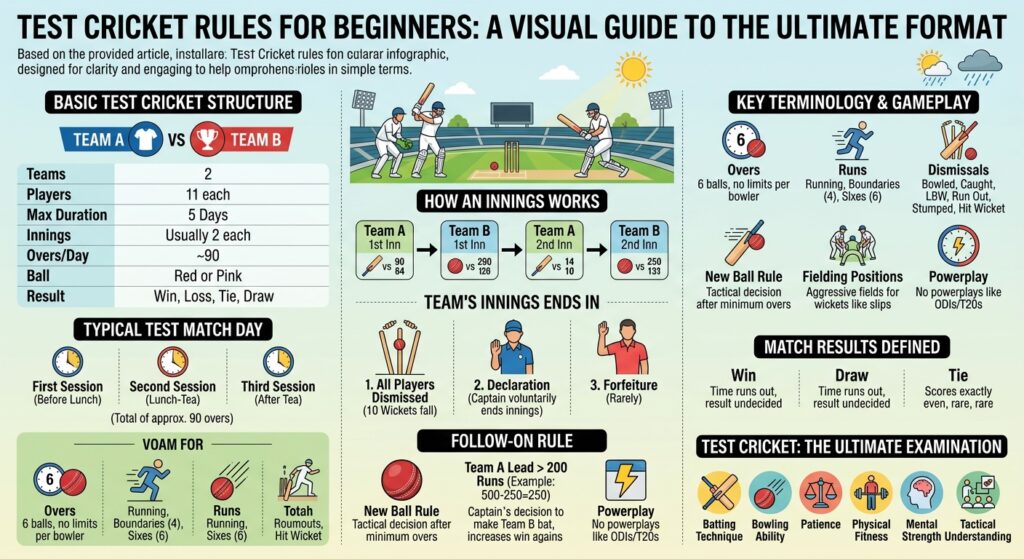
Test cricket is the oldest and most traditional format of the game. While T20 and ODI cricket are fast-paced and usually easier for new fans to understand, Test cricket follows a completely different rhythm. A match can last up to five days, each team gets the opportunity to bat twice, and strategy plays a major role in deciding the result.
For someone watching Test cricket for the first time, the rules can seem confusing. Why does a match sometimes end without a winner? What is a declaration? Why do captains enforce a follow-on? What happens when rain interrupts play?
This beginner’s guide explains the most important Test cricket rules in simple language.
What Is Test Cricket?
Test cricket is the longest format of international cricket. It is played between national teams that have Test status.
Unlike One Day International and T20 cricket, a Test match can last for up to five days. Each team normally has two innings to score runs and attempt to dismiss the opposition.
Test cricket is considered the ultimate examination of a player’s:
- Batting technique
- Bowling ability
- Patience
- Physical fitness
- Mental strength
- Tactical understanding
A player may spend several hours batting, while bowlers may have to deliver long spells over multiple days.
Basic Test Cricket Match Structure
A traditional Test match involves two teams, with eleven players on each side.
The basic structure looks like this:
| Match Element | Test Cricket Rule |
|---|---|
| Teams | 2 |
| Players per Team | 11 |
| Maximum Duration | 5 Days |
| Innings per Team | Usually 2 |
| Overs per Day | Approximately 90 |
| Overs per Innings | No Fixed Limit |
| Ball Used | Red or Pink |
| Result | Win, Loss, Tie, or Draw |
The biggest difference between Test cricket and limited-overs cricket is that there is no fixed limit on the number of overs in an innings.
A team can continue batting until all its wickets fall, the captain declares, or the match situation requires another decision.
How Many Days Does a Test Match Last?
A modern Test match is scheduled for a maximum of five days.
Each day normally contains approximately six hours of cricket, divided into three sessions.
A Typical Test Match Day
| Session | Description |
|---|---|
| First Session | Play before lunch |
| Second Session | Play between lunch and tea |
| Third Session | Play after tea |
| Total | Usually around 90 overs |
There are breaks for lunch and tea between sessions.
However, weather conditions, bad light, injuries, and other interruptions can reduce the amount of play.
If a result is achieved before the fifth day, the match ends early.
For example, one team might bowl out the opposition twice within three days and win the match.
How Does an Innings Work in Test Cricket?
An innings refers to the period when a team is batting.
In Test cricket, each team normally gets two innings.
A simple match structure could look like this:
- Team A bats – First Innings
- Team B bats – First Innings
- Team A bats – Second Innings
- Team B bats – Second Innings
The team that scores more runs and successfully dismisses the opposition can win the match.
Unlike ODI or T20 cricket, there is no requirement to finish an innings within a certain number of overs.
How Does a Team’s Innings End?
A Test innings can end in several ways.
1. All Players Are Dismissed
When ten wickets fall, the innings ends.
There are eleven players in a team, but two batsmen must always be on the field. Therefore, once ten batsmen are out, the team cannot continue batting.
This situation is commonly called being all out.
Example:
England scores 350 runs and loses 10 wickets.
The innings is complete.
2. Declaration
A captain can voluntarily end their team’s innings. This is called a declaration.
The captain usually declares when they believe the team has enough runs and wants additional time to bowl out the opposition.
For example:
- Team A scores 500 runs
- Only two days remain
- Team A’s captain declares the innings
The captain does this to give bowlers enough time to take 20 wickets and win the match.
A declaration is one of the most important strategic elements of Test cricket.
3. Forfeiture
In rare situations, a team may voluntarily forfeit an innings.
This is uncommon in modern cricket but is permitted under the Laws of Cricket.
What Is an Over in Test Cricket?
An over consists of six legal deliveries bowled by one bowler.
For example:
6 balls = 1 over
60 balls = 10 overs
600 balls = 100 overs
However, illegal deliveries such as wides and no-balls do not count as legal balls.
Unlike limited-overs cricket, there is no maximum number of overs for an individual bowler in Test cricket.
A bowler can theoretically bowl as many overs as the captain requires, although fatigue naturally limits long spells.
How Are Runs Scored in Test Cricket?
The basic scoring rules are similar to other cricket formats.
Batsmen can score runs by:
- Running between the wickets
- Hitting boundaries
- Receiving extra runs from illegal deliveries
Common Ways to Score
| Action | Runs |
|---|---|
| Running between wickets | 1 or more |
| Ball reaches boundary after bouncing | 4 |
| Ball crosses boundary without bouncing | 6 |
| No-ball | Extra run |
| Wide | Extra run |
A batsman does not have to score quickly in Test cricket.
This is one of the major differences between Test and T20 cricket.
A player may score 30 runs from 150 balls if the match situation requires defensive batting.
How Does a Batsman Get Out in Test Cricket?
The methods of dismissal are largely the same as other formats.
Bowled
A batsman is bowled when the ball hits the stumps and dislodges the bails.
Caught
A batsman is out caught if a fielder catches the ball before it touches the ground.
LBW
LBW means Leg Before Wicket.
A batsman can be dismissed if the ball hits their body and prevents it from hitting the stumps, subject to specific conditions.
Run Out
A batsman is run out when the fielding team breaks the wicket while the batsman is outside their crease.
Stumped
A batsman can be stumped when they leave their crease while facing a delivery and the wicketkeeper removes the bails.
Hit Wicket
A batsman is out hit wicket if they accidentally break their own wicket with their body or equipment in certain circumstances.
There are other rare methods of dismissal, but these are the most common for beginners to understand.
What Is the Follow-On in Test Cricket?
The follow-on is one of the most unique rules in Test cricket.
After the first innings of both teams, the team that batted first may have a large lead.
If the second team is significantly behind, the captain of the leading team can ask them to bat again immediately.
This means the leading team does not need to bat for a second innings.
In a five-day Test match, the normal follow-on margin is 200 runs.
Example
- Team A scores 500
- Team B scores 250
Team A has a lead of:
500 – 250 = 250 runs
Because the lead is more than 200 runs, Team A can enforce the follow-on.
Team B must bat again.
The main purpose is to save time and increase the chances of winning the match.
What Is a Draw in Test Cricket?
A draw is one of the concepts that often confuses new cricket fans.
A draw does not mean both teams scored the same number of runs.
In Test cricket, a draw happens when the scheduled playing time ends before either team can force a victory.
For example, imagine Team B needs 300 runs to win but only one hour of play remains.
If Team B finishes the day at 150 for 4, the match may end in a draw.
Neither team won or lost because the five days ended without a decisive result.
This makes time an important part of Test cricket strategy.
What Is a Tie in Test Cricket?
A tie is completely different from a draw.
A Test match is tied when both teams complete their innings and finish with exactly the same score.
For example:
- Team A total across required innings: 500
- Team B total across required innings: 500
If the final wicket falls and the scores are level, the match is a tie.
Tied Test matches are extremely rare.
What Happens if Rain Stops Play?
Weather can significantly affect Test cricket.
If rain stops play, the match is paused.
Umpires may also stop the match because of:
- Bad light
- Wet outfield
- Dangerous conditions
- Lightning
Lost playing time can make it harder for either team to achieve a result.
This is one reason why weather-affected Test matches often end in draws.
However, match officials may sometimes extend playing time to help recover lost overs, depending on the playing conditions.
What Is the New Ball Rule in Test Cricket?
The cricket ball becomes softer and older as the match progresses.
In Test cricket, the fielding captain can generally choose to take a new ball after a specified minimum number of overs under the applicable playing conditions.
A new ball is harder and shinier, making it more useful for fast bowlers.
Captains often take a new ball when they believe fresh fast bowlers can generate:
- Swing
- Seam movement
- Extra bounce
- Higher pace
The new-ball decision is an important tactical moment in Test cricket.
Why Are There Fielding Positions Close to the Bat?
Test cricket often features aggressive field placements.
When a fast bowler is swinging the ball, the captain may place several fielders behind the batsman.
Common positions include:
- First slip
- Second slip
- Third slip
- Gully
- Short leg
- Silly point
These positions are designed to catch edges or defensive mistakes.
In limited-overs cricket, fielders are often spread around the boundary to stop runs.
Test cricket, particularly with a new ball, frequently focuses on taking wickets.
Is There a Powerplay in Test Cricket?
No. Test cricket does not use powerplays like ODI or T20 cricket.
There are no mandatory restrictions on where fielders can stand based on overs.
Captains have much greater freedom to create field placements.
This allows for fascinating tactical battles between captains, bowlers, and batsmen.
A captain may use an attacking field when searching for wickets and a defensive field when trying to stop runs.
What Are the Main Rules Beginners Should Remember?
If you are new to Test cricket, remember these key points:
- A Test match can last up to five days.
- Each team usually bats twice.
- There is no fixed number of overs per innings.
- An innings can end when ten wickets fall or when a captain declares.
- Teams need to take 20 opposition wickets to win in most circumstances.
- A follow-on can be enforced when one team has a large first-innings lead.
- A match can end in a win, loss, draw, or rare tie.
- Weather can have a major impact on the result.
- There are no powerplays.
- Strategy and patience are essential.
Why Is Test Cricket Considered the Ultimate Format?
Test cricket tests almost every aspect of a player’s ability.
A batsman must handle different conditions over several days. They may face fast bowlers with a new ball in the morning and spin bowlers on a deteriorating pitch later in the match.
Bowlers must adapt as the pitch and ball change.
Captains must make difficult decisions about:
- Declarations
- Field placements
- Bowling changes
- Follow-ons
- New-ball timing
Unlike shorter formats, there is time for a match to change dramatically.
A team can dominate for three days and still lose because of one exceptional batting performance.
That unpredictability is what makes Test cricket special.
Test Cricket Rules for Beginners: Final Thoughts
Understanding Test cricket rules for beginners becomes much easier once you know the basic structure of the game.
A Test match is a battle that can last up to five days. Each team normally receives two innings, and there is no fixed limit on overs. Teams must combine batting skill, bowling quality, patience, and smart captaincy to create a winning opportunity.
The concepts of declarations, follow-ons, draws, and changing pitch conditions may seem complicated at first, but they are what make Test cricket different from ODI and T20 cricket.
While white-ball cricket offers quick entertainment, Test cricket tells a longer story. Every session can change the direction of the match, and every decision can have consequences days later.
For beginners, the best way to understand Test cricket is simply to watch a match session by session. Once you begin noticing the strategies behind field placements, bowling changes, and batting approaches, the format becomes much easier to enjoy.
Test cricket may take longer than other formats, but its combination of skill, strategy, patience, and drama makes it one of the most fascinating forms of sport in the world.
