


Cricket has a language of its own. Terms such as yorker, bouncer, maiden over, LBW, and hat-trick are familiar to regular fans, but some expressions can sound unusual to beginners. One of the most commonly used terms is the duck.
When a commentator says, “The batter is out for a duck,” it means the player has been dismissed without scoring a single run. While the definition sounds simple, cricket has several interesting types of ducks, including the golden duck, diamond duck, silver duck, pair, and king pair.
A duck is something no batter wants next to their name on the scorecard. It can happen to a beginner or even the greatest player in the world. One good delivery, a brilliant catch, or a simple mistake can end an innings before the batter gets off the mark.
In this article, we explain the complete cricket duck meaning, why it is called a duck, its different types, and some important examples.
What Is a Duck in Cricket?
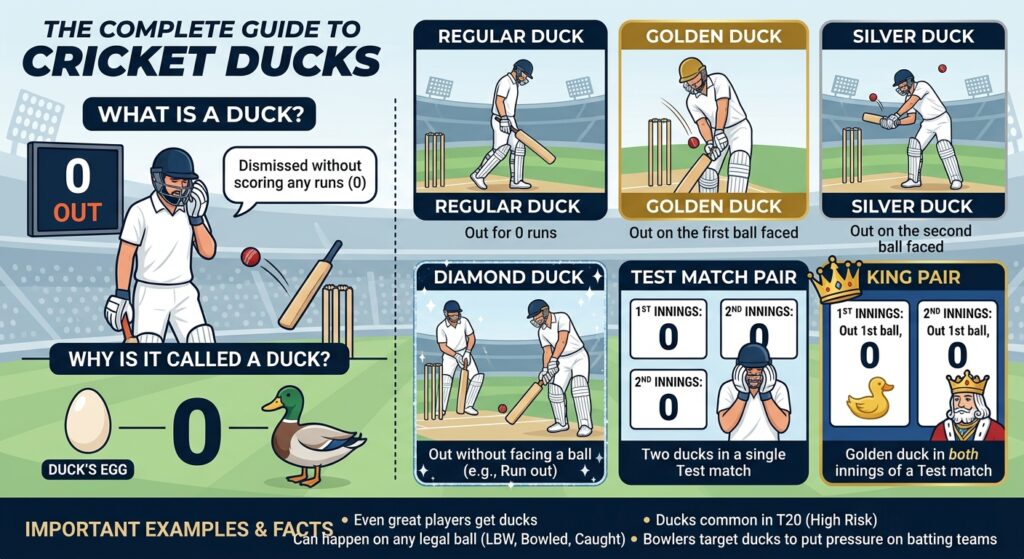
In cricket, a duck means that a batter is dismissed without scoring any runs.
For example:
- Batter faces five balls and scores 0 before getting out = Duck
- Batter faces one ball and gets out = Duck
- Batter gets out without facing a ball in certain circumstances = Can also be classified under a specific type of duck
The most important point is the score.
If a batter is dismissed with 0 runs, they have been dismissed for a duck.
Simple Example
Imagine a batter comes to the crease and faces three deliveries:
- Ball 1: Dot ball
- Ball 2: Dot ball
- Ball 3: Caught by a fielder
Score: 0 runs
The batter has been dismissed for a duck.
Why Is It Called a Duck in Cricket?
The term “duck” is believed to come from the phrase “duck’s egg.”
A duck’s egg has an oval shape similar to the number zero.
Since a batter dismissed without scoring has a score of 0, the expression “duck’s egg” gradually became shortened to simply “duck.”
Today, the word is used throughout the cricket world.
You might hear commentators say:
- “He has gone for a duck.”
- “That is his first duck of the tournament.”
- “The captain is dismissed for a golden duck.”
Although the term sounds humorous, getting a duck can be extremely disappointing for a batter.
Different Types of Ducks in Cricket
Not all ducks are the same. Cricket has developed several names based on how and when the batter gets dismissed.
Here are the most common types.
| Type of Duck | Meaning |
|---|---|
| Regular Duck | Out for 0 runs |
| Golden Duck | Out on the first ball faced |
| Silver Duck | Out on the second ball faced |
| Bronze Duck | Out on the third ball faced |
| Diamond Duck | Out without facing a ball |
| Pair | Two ducks in a Test match |
| King Pair | Golden duck in both innings |
| Golden Pair | Golden ducks in both innings |
Let’s look at each type in more detail.
What Is a Golden Duck?
A golden duck occurs when a batter is dismissed on the very first ball they face without scoring a run.
This is one of the most frustrating dismissals in cricket.
Example
A new batter comes to the crease.
- First ball faced → Bowled
Score: 0
Balls faced: 1
Result: Golden duck
A golden duck can happen in any format of cricket, including Test matches, One Day Internationals, and T20 matches.
It is especially painful for an opening batter who gets dismissed immediately at the start of an innings.
What Is a Silver Duck?
A silver duck occurs when a batter is dismissed for zero after facing two balls.
Example
- First ball: Dot ball
- Second ball: Caught
Score: 0
This is called a silver duck.
The term is less commonly used in professional commentary than “golden duck,” but cricket fans still use it.
What Is a Bronze Duck?
A bronze duck refers to a batter being dismissed for zero after facing three deliveries.
Example
- Ball 1: Dot
- Ball 2: Dot
- Ball 3: LBW
The batter has scored 0 runs from three balls and is dismissed for a bronze duck.
Like the silver duck, this term is mostly informal.
What Is a Diamond Duck?
A diamond duck is one of the more unusual types of ducks in cricket.
It occurs when a batter is dismissed without facing a legal delivery.
For example, a non-striker may be run out before facing a ball.
Example
The striker hits the first ball and calls for a run.
The non-striker is run out while attempting the run.
If that player has not faced a delivery and has scored zero, it can be described as a diamond duck.
Diamond ducks are rare compared with ordinary ducks and golden ducks.
What Is a Pair in Cricket?
A pair happens when a batter scores a duck in both innings of a Test match or another two-innings match.
Example
First Innings: Batter scores 0 and gets out.
Second Innings: Batter scores 0 and gets out again.
This is called a pair.
Getting a pair is particularly disappointing because the player has two opportunities to score but fails to get off the mark in either innings.
What Is a King Pair?
A king pair is an even more unfortunate achievement.
It happens when a batter gets dismissed for a golden duck in both innings of a two-innings match.
Example
| Innings | Result |
|---|---|
| First innings | Out first ball for 0 |
| Second innings | Out first ball for 0 |
This means the batter faced only two balls across both innings and was dismissed each time.
A king pair is extremely rare and is considered one of the worst statistical records a batter can experience.
What Is a Golden Pair?
The term golden pair is also used to describe a batter getting a golden duck in both innings.
In most discussions, golden pair and king pair refer to the same situation.
The terminology may vary depending on cricket writers and regions.
Can a Batter Get a Duck Without Facing a Ball?
Yes.
This can happen in situations involving a run out.
Imagine a batter is standing at the non-striker’s end.
The striker hits the ball and both players attempt a run. The non-striker is run out before facing a delivery during their innings.
The player has:
- Scored 0 runs
- Faced 0 balls
- Been dismissed
This type of dismissal is commonly described as a diamond duck.
It is unusual because the player can be dismissed without actually facing a ball.
Is a Duck Considered a Bad Score?
From a batting perspective, yes.
A duck means the player did not contribute any runs to the team’s total.
However, getting a duck does not always mean the batter played badly.
Sometimes a player can face an excellent delivery and be dismissed immediately.
For example:
- A perfect yorker knocks over the stumps.
- A brilliant inswinger traps the batter LBW.
- A spectacular catch removes the batter.
- A misunderstanding causes a run out.
Cricket is unpredictable, and even the best players occasionally get ducks.
A player’s overall quality should never be judged based on a single innings.
Famous Players Can Also Get Ducks
Even the greatest batters in cricket history have been dismissed for zero.
Sachin Tendulkar, Virat Kohli, and Ricky Ponting have all experienced difficult innings during their careers.
A duck is simply part of cricket.
The difference between a good player and a great player is often their ability to recover mentally and perform in the next innings.
Why Are Ducks Common in T20 Cricket?
Ducks can occur more frequently in aggressive formats such as T20 cricket.
The reason is simple: batters take more risks.
In Test cricket, a batter may spend several deliveries understanding the conditions before playing attacking shots.
In T20 cricket, there is often immediate pressure to score quickly.
A batter may attempt a boundary on the first delivery and get caught.
This can result in a golden duck.
The same aggressive approach that helps players score quick runs can also increase the risk of early dismissal.
Duck vs Dot Ball
A duck and a dot ball are completely different things.
A dot ball is a delivery from which no runs are scored.
A duck is the final score of a dismissed batter who has scored zero runs.
Example
A batter faces:
- Dot ball
- Dot ball
- Single
- Dot ball
The player has not scored a duck because they scored one run.
Even if a batter faces 50 dot balls, they are not considered to have scored a duck unless they are eventually dismissed with zero runs.
How Bowlers Benefit From Ducks
For bowlers, dismissing a batter for a duck can be a major success.
Early wickets put pressure on the batting team.
For example, imagine a team loses two important batters for ducks in the first over.
The score could look like:
Team Score: 2/2
This creates immediate pressure on the remaining batters.
A golden duck can be especially important because it gives the bowling team momentum.
In limited-overs cricket, early wickets can force the batting side to become more cautious.
The Mental Impact of Getting a Duck
Cricket is as much a mental game as a physical one.
Getting dismissed for zero can affect a player’s confidence, particularly if it happens repeatedly.
A batter may begin to:
- Overthink their technique.
- Become nervous at the crease.
- Play too cautiously.
- Take unnecessary risks.
Professional players work hard to move on from poor innings.
One of the most important qualities in cricket is mental resilience.
A batter who gets a duck in one match may score a century in the next.
How Batters Can Avoid Getting a Duck
There is no guaranteed way to avoid a duck, but players can reduce the risk of early dismissal.
1. Take Time to Settle
In longer formats, a batter does not always need to attack immediately.
Watching the first few deliveries can help understand the pitch and bowling conditions.
2. Play According to the Situation
A player should consider the match situation before taking risks.
Sometimes a simple single is more valuable than attempting a difficult boundary.
3. Focus on the Ball
Early in an innings, concentration is extremely important.
A small mistake can end the innings.
4. Stay Mentally Calm
Pressure can cause players to rush their shots.
Remaining calm helps improve decision-making.
Frequently Asked Questions
What does duck mean in cricket?
A duck means a batter has been dismissed without scoring any runs.
Why is zero called a duck?
The term comes from “duck’s egg,” as the shape of an egg resembles the number zero.
What is a golden duck?
A golden duck occurs when a batter is dismissed for zero on the first ball they face.
What is a diamond duck?
A diamond duck generally refers to a batter being dismissed for zero without facing a ball, often through a run out.
What is a pair in cricket?
A pair occurs when a batter gets dismissed for zero in both innings of a two-innings match.
What is a king pair?
A king pair occurs when a batter is dismissed for a golden duck in both innings of a two-innings match.
Can a bowler get a duck?
The term duck applies to any batter who is dismissed without scoring, including a player whose primary role is bowling.
Final Thoughts
The meaning of a duck in cricket is simple: a batter is dismissed without scoring a run. However, cricket has created several interesting variations based on how quickly the dismissal happens.
From a regular duck to a golden duck, diamond duck, pair, and king pair, these terms have become an important part of cricket vocabulary.
Although getting a duck can be disappointing, it is something every cricketer must be prepared for. Even the greatest players have experienced it during their careers.
Cricket is a game of uncertainty. A player can score a century one day and be dismissed for zero the next. That unpredictability is one of the reasons the sport remains so exciting.
For beginners learning cricket terminology, understanding the meaning of a duck is essential. The next time you see a scorecard showing a batter with 0 runs, you will know exactly what commentators mean when they say:
“The batter has gone for a duck.”
