


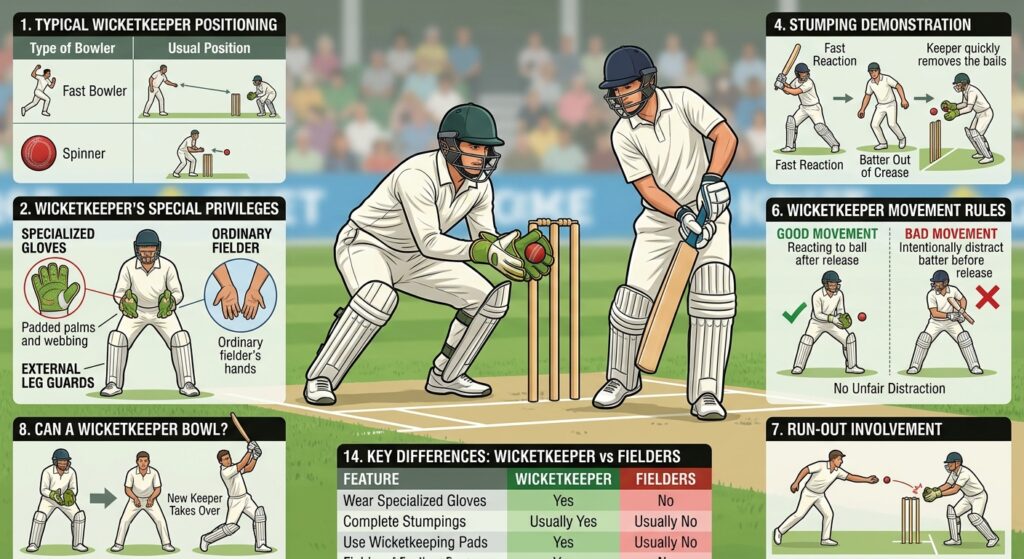
The wicketkeeper is one of the most important players in a cricket team. While batters often receive attention for scoring runs and bowlers are praised for taking wickets, a wicketkeeper quietly influences almost every delivery of an innings.
Standing directly behind the stumps, the wicketkeeper has a unique role that combines concentration, quick reflexes, athletic ability, and a deep understanding of cricket rules. A good wicketkeeper can save valuable runs, take difficult catches, complete stumpings in a fraction of a second, and help the captain make important decisions.
However, wicketkeeping is not simply about catching the ball. The position comes with specific laws and responsibilities. A wicketkeeper must follow certain rules regarding where they stand, when they can move, how dismissals are completed, and how they handle the ball.
This guide explains the most important cricket wicketkeeper rules in simple language.
What Is a Wicketkeeper in Cricket?
A wicketkeeper is the fielding player positioned behind the wicket at the striker’s end.
Their main responsibility is to receive the ball after it passes the batter. Unlike other fielders, the wicketkeeper is allowed to wear specialized gloves and external leg guards while fielding.
The wicketkeeper is involved in several types of dismissals, including:
- Catches
- Stumpings
- Run outs
- Assisting in caught-behind dismissals
The player usually stands close to the stumps when a spin bowler is bowling and moves farther back when facing fast bowlers.
Because the wicketkeeper is involved in almost every ball, concentration is essential.
Basic Cricket Wicketkeeper Rules
A wicketkeeper has special privileges compared with other fielders, but those privileges come with rules.
The main wicketkeeper rules involve:
- Position behind the wicket
- Use of gloves
- Fair catches
- Stumping laws
- Movement before the ball reaches the batter
- Handling the ball
- Run-out involvement
- Fielding responsibilities
Understanding these rules helps players appreciate why wicketkeeping is one of the most demanding positions in cricket.
1. The Wicketkeeper Must Be Positioned Behind the Wicket
The wicketkeeper normally stands behind the stumps at the striker’s end.
Their position changes depending on the type of bowling.
Against a fast bowler, the wicketkeeper may stand several meters behind the stumps because the ball travels at high speed.
Against a spinner, the wicketkeeper usually moves much closer to the stumps. This allows them to react quickly if the batter misses the ball or leaves the crease.
The wicketkeeper must remain ready to receive the ball legally and should not interfere unfairly with the batter.
Positioning is a major part of wicketkeeping. Standing too close to a fast bowler can make catching difficult, while standing too far away against spin can reduce the chance of completing a stumping.
Typical Wicketkeeper Positioning
| Type of Bowler | Usual Wicketkeeper Position |
|---|---|
| Fast Bowler | Several meters behind the stumps |
| Medium Pacer | Moderately behind the stumps |
| Spinner | Close to the stumps |
| Slow Bowler | Very close to the stumps |
There is no single fixed distance for a wicketkeeper. The position depends on bowling speed, bounce, pitch conditions, and the batter’s style.
2. Wicketkeepers Are Allowed to Wear Gloves
One major difference between a wicketkeeper and an ordinary fielder is the use of gloves.
A wicketkeeper is allowed to wear specialized wicketkeeping gloves. These gloves are designed to help catch fast-moving cricket balls and protect the hands.
The gloves have padded palms and webbing between the fingers.
Ordinary fielders generally cannot use wicketkeeping gloves while fielding.
The wicketkeeper may also wear protective equipment such as:
- Leg guards
- Helmet
- Abdominal guard
- Inner gloves
This protective equipment is necessary because wicketkeepers regularly face fast deliveries, unexpected deflections, and powerful edges.
Why Are Wicketkeeping Gloves Different?
A cricket ball can travel at speeds above 140 km/h in v
The wicketkeeper must often catch or stop the ball after it has bounced unpredictably or taken an edge from the bat.
Special gloves provide:
- Better protection
- Improved grip
- Shock absorption
- Greater control
However, simply wearing gloves does not make a catch automatically valid. The wicketkeeper must still complete catches according to the laws of cricket.
3. A Wicketkeeper Can Take Catches Behind the Stumps
One of the most common wicketkeeper dismissals is the caught-behind.
This happens when:
- The bowler delivers the ball.
- The ball touches the batter’s bat or glove connected with the bat.
- The wicketkeeper catches the ball fairly before it touches the ground.
For example, a fast bowler may produce an outside edge, and the wicketkeeper catches the ball behind the stumps.
This is recorded as:
Caught – Wicketkeeper
Wicketkeepers often take some of the most difficult catches in cricket because edges can change direction quickly.
A slight deflection can send the ball to either side, requiring exceptional reflexes.
4. Stumping Rules for Wicketkeepers
Stumping is one of the most specialized dismissals in cricket.
A batter can be stumped when they leave their crease while attempting to play the ball and the wicketkeeper removes the bails before the batter returns safely.
For a stumping to occur:
- The wicketkeeper must receive the ball legally.
- The batter must be out of their ground.
- The ball must not be a no-ball.
- The wicketkeeper must put down the wicket while the batter is outside the crease.
Stumpings are most commonly seen against spin bowling.
Example of a Stumping
Imagine a batter steps forward to attack a spinner.
The batter misses the ball and loses balance.
The wicketkeeper collects the ball and quickly removes the bails before the batter gets their foot back behind the popping crease.
The batter can be given out stumped.
Speed and anticipation are crucial because the entire event may happen in less than a second.
5. Wicketkeeper Movement Rules
A wicketkeeper must be careful about moving before the ball reaches the batter.
In general, unfair movement can lead to a delivery being called illegal under the laws governing unfair play.
For example, a wicketkeeper should not deliberately move in a way that unfairly distracts the batter while the bowler is delivering the ball.
The wicketkeeper’s job is to react to the delivery rather than create an unfair advantage.
Normal movement to adjust for swing, spin, bounce, or deflection is part of legitimate wicketkeeping.
However, deliberate interference with the batter can result in intervention from the umpires.
6. The Wicketkeeper Cannot Interfere with the Batter
The wicketkeeper must not physically obstruct or unfairly distract the batter.
Cricket is a competitive game, but players must be allowed to play their shots without illegal interference.
For example, the wicketkeeper cannot deliberately:
- Push the batter
- Block the batter unfairly
- Prevent a legitimate run through physical obstruction
- Distract the batter illegally
Communication between wicketkeepers and batters is common in cricket. Players may talk, appeal, or encourage teammates, but excessive or deliberate distraction can become an issue.
Sportsmanship remains an important part of the game.
7. Wicketkeeper Run-Out Rules
A wicketkeeper can also play a major role in run outs.
If batters attempt a run, the wicketkeeper may receive a throw from another fielder and break the wicket before the batter reaches the crease.
Example
A batter hits the ball and attempts a quick single.
A fielder picks up the ball and throws it towards the wicketkeeper.
The wicketkeeper catches the throw and removes the bails while the batter is still outside the crease.
If the appeal is successful and the batter has not made their ground, the batter can be given out run out.
Wicketkeepers must have quick hands because direct throws often arrive at high speed.
8. Can a Wicketkeeper Bowl?
Yes, a designated wicketkeeper can bowl during a match, but they cannot perform both roles at exactly the same time during a delivery.
If a wicketkeeper wishes to bowl, another player must take over the wicketkeeping duties.
This replacement arrangement must follow the relevant match regulations.
Similarly, a bowler cannot simply remain behind the stumps and act as the wicketkeeper immediately after delivering the ball.
Cricket positions can change, but the fielding side must always have a properly designated wicketkeeper.
9. Can the Wicketkeeper Field Anywhere?
The wicketkeeper’s primary position is behind the striker’s wicket.
However, teams can change wicketkeepers during a match if necessary, subject to the applicable rules and umpire awareness.
If a player is not acting as the wicketkeeper for a particular period, they can field elsewhere like an ordinary fielder.
When someone is officially performing wicketkeeping duties, they receive the special permission associated with that position, including the use of wicketkeeping gloves and leg guards.
10. Wicketkeeper No-Ball Rules
Wicketkeepers must also understand no-ball situations.
One important point is that a batter generally cannot be dismissed stumped off a no-ball.
For example:
- Bowler oversteps.
- Umpire calls no-ball.
- Batter leaves the crease.
- Wicketkeeper removes the bails.
The stumping dismissal will not stand because the delivery was a no-ball.
However, depending on the circumstances, other forms of dismissal such as a run out may still be possible.
This is why wicketkeepers must remain alert even when they believe the bowler has delivered an illegal ball.
11. Wicketkeeper Responsibilities During Every Delivery
A wicketkeeper has responsibilities that go beyond catching the ball.
During almost every delivery, the wicketkeeper must:
- Watch the bowler’s release.
- Track the movement of the ball.
- Predict swing or spin.
- Maintain balance.
- Prepare for an edge.
- Stop byes.
- Protect the wicket.
- Communicate with fielders.
- Be ready for a stumping or run out.
This makes wicketkeeping physically and mentally demanding.
A batter may be involved in only a portion of the innings. A bowler delivers a limited number of overs in restricted-overs cricket.
The wicketkeeper, however, remains involved throughout the entire opposition innings.
12. Wicketkeeper Rules for Byes and Leg Byes
The wicketkeeper plays an important role in preventing extra runs.
If the batter misses the ball and the ball passes the wicketkeeper, the batting team may run byes.
If the ball touches the batter’s body but not the bat and runs are completed under legal circumstances, those may be recorded as leg byes.
A skilled wicketkeeper can save several runs during an innings by stopping difficult deliveries.
These saved runs can become extremely important in close matches.
Example
Suppose a wicketkeeper prevents:
- 3 byes
- 2 leg-bye opportunities
- 1 overthrow
Saving just a few runs may not seem dramatic, but in a match decided by two or three runs, those stops can change the result.
13. Communication Is an Important Part of Wicketkeeping
Although communication is not a technical dismissal law, it is one of the most important responsibilities of a wicketkeeper.
The wicketkeeper has one of the best views of the field.
From behind the stumps, they can observe:
- Batter positioning
- Field placements
- Bowling line
- Running between wickets
- Potential tactical changes
Many wicketkeepers constantly communicate with:
- Bowlers
- Captain
- Slip fielders
- Close-in fielders
They may suggest field changes or remind bowlers about tactical plans.
This is why experienced wicketkeepers are often considered the eyes and ears of the captain.
14. Key Differences Between a Wicketkeeper and Other Fielders
| Feature | Wicketkeeper | Other Fielders |
|---|---|---|
| Wears specialized gloves | Yes | No |
| Stands behind stumps | Yes | Usually no |
| Can complete stumpings | Yes | Normally no |
| Uses wicketkeeping pads | Yes | No |
| Receives most deliveries | Yes | No |
| Can take catches | Yes | Yes |
| Can assist in run outs | Yes | Yes |
The wicketkeeper has a specialized role, but they are still part of the fielding team and can contribute in multiple ways.
Skills Required to Be a Good Wicketkeeper
Following the rules is important, but becoming a successful wicketkeeper requires many skills.
Quick Reflexes
The ball can change direction after touching the edge of the bat.
Strong Concentration
A wicketkeeper must remain focused for long periods, especially during Test matches.
Good Footwork
Quick movement helps the keeper get into the correct position.
Safe Hands
Catching consistently is one of the most important qualities.
Anticipation
Great wicketkeepers often predict where the ball will go before it reaches them.
Communication
The ability to guide bowlers and support teammates is extremely valuable.
Famous Wicketkeeping Dismissals
Wicketkeepers are responsible for two of cricket’s most exciting forms of dismissal: spectacular catches and lightning-fast stumpings.
A diving catch behind the stumps can completely change the momentum of a match.
Similarly, a quick stumping can dismiss an aggressive batter before they have time to react.
Modern wicketkeeping has become increasingly athletic. Players are expected not only to keep wickets effectively but also, in many teams, contribute significantly with the bat.
The rise of the wicketkeeper-batter has made the position even more important in modern cricket.
Final Thoughts
The wicketkeeper is one of cricket’s most challenging and influential positions. Standing behind the stumps may appear straightforward, but the role requires exceptional concentration, quick reactions, technical skill, and a detailed understanding of cricket rules.
From catching edges and completing stumpings to stopping byes and assisting with run outs, wicketkeepers can influence a match in many different ways.
The basic cricket wicketkeeper rules ensure that the player performs this specialized role fairly. Understanding these rules also makes watching cricket more enjoyable because many crucial moments happen in just a fraction of a second behind the stumps.
A great wicketkeeper is more than just a player who catches the ball. They are a defender, strategist, communicator, and often one of the busiest members of the team. Whether it is a lightning-fast stumping or a spectacular diving catch, the wicketkeeper remains at the center of some of cricket’s most memorable moments.
