


Cricket is a game where a single run can decide the outcome of a match. But what happens when both teams finish with exactly the same score? In many limited-overs matches, the answer is a thrilling tie-breaker known as the Super Over.
A Super Over is one of the most dramatic moments in modern cricket. After an entire match lasting several hours, the result can come down to just six legal deliveries per team. Batters have to attack immediately, bowlers must stay calm under enormous pressure, and captains have to make quick tactical decisions.
Super Overs are now a familiar part of T20 cricket and are also used in other limited-overs competitions when tournament playing conditions require a winner. However, the rules behind a Super Over are not always understood by casual fans.
This guide explains the Cricket Super Over rules, how a Super Over works, who can bat and bowl, what happens if the Super Over is tied, and why this tie-breaking method has become such an important part of modern cricket.
What Is a Super Over in Cricket?
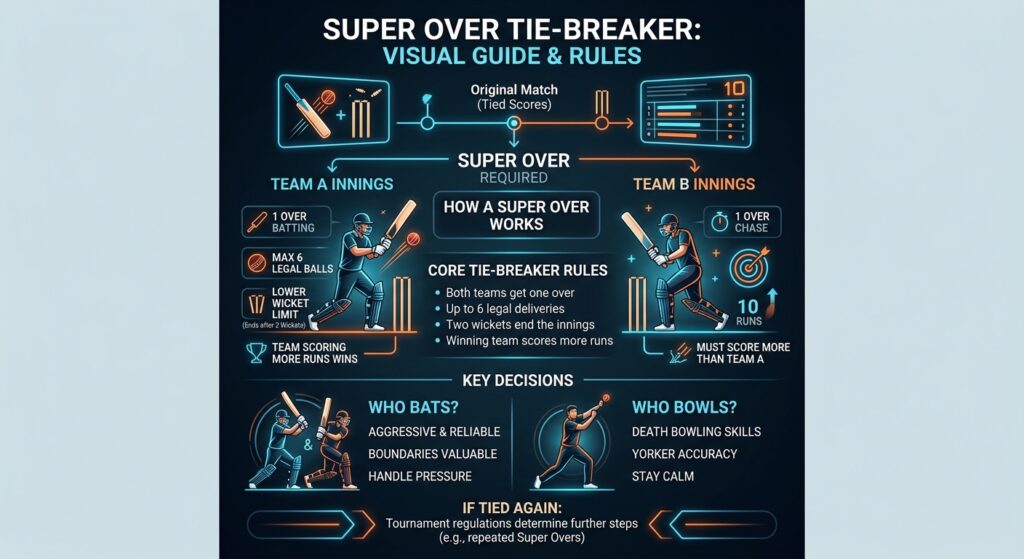
A Super Over is a tie-breaking method used in limited-overs cricket when two teams finish a match with the same score and competition rules require one team to win.
Each team gets one over, consisting of up to six legal balls, to score as many runs as possible.
The team batting second in the Super Over must score more runs than the first team to win the match.
For example:
- Team A scores 12 runs in its Super Over.
- Team B needs 13 runs to win.
- If Team B scores 13 or more, it wins.
- If Team B scores fewer than 12, Team A wins.
- If both teams finish on the same Super Over score, the competition’s playing conditions determine the next step.
Although it sounds simple, the Super Over creates an entirely different type of cricket. There is no time for a batter to settle or for a bowler to gradually understand the conditions. Every ball can potentially decide the match.
When Is a Super Over Used?
A Super Over is generally used in limited-overs cricket when a match ends in a tie and the competition requires a clear winner.
It is most commonly associated with:
- T20 Internationals
- Domestic T20 leagues
- Franchise cricket
- Major ICC limited-overs tournaments
- Certain One Day competitions
Not every tied cricket match automatically requires a Super Over. The exact rules depend on the playing conditions of the particular tournament.
For example, a group-stage match in one competition may officially remain a tie, while a knockout match may require a Super Over to decide which team progresses.
This is why tournament regulations are important. The basic concept of the Super Over is widely recognized, but the procedures surrounding it can vary between competitions.
Basic Cricket Super Over Rules
The central rules of a Super Over are straightforward.
| Rule | How It Works |
|---|---|
| Overs per team | 1 over |
| Legal deliveries | Up to 6 balls |
| Batting teams | Both teams get a chance to bat |
| Wickets | Innings ends after two wickets |
| Winner | Team scoring more runs wins |
| Tie | Further tie-breaking procedures may apply |
Each team gets one over to score as many runs as possible.
However, the batting side can lose only two wickets before its Super Over innings ends. In practical terms, the team is considered all out after losing two wickets because only three batters are available for that one-over contest.
This rule makes wicket-taking incredibly valuable.
A bowler who dismisses two batters can end the opposition’s Super Over before all six legal deliveries are completed.
How Many Balls Are in a Super Over?
Each team receives one over of up to six legal deliveries.
However, wides and no-balls do not count as legal deliveries.
This means a Super Over can contain more than six actual deliveries if the bowler bowls illegal balls.
For example:
- Ball 1: Legal delivery
- Ball 2: Wide
- Ball 2 again: Legal delivery
- Ball 3: No-ball
- Free-hit delivery follows if applicable
- Remaining legal deliveries continue
A bowler who loses control can therefore give the batting team additional scoring opportunities.
In a normal innings, one wide may not seem like a major problem. During a Super Over, however, one extra run and one extra ball can completely change the result.
How Many Wickets Are Allowed in a Super Over?
The batting team can lose a maximum of two wickets during a Super Over.
Once the second wicket falls, the innings is over.
Consider this example:
Team A is batting in a Super Over.
- First ball: 2 runs
- Second ball: Wicket
- Third ball: 4 runs
- Fourth ball: Wicket
The innings immediately ends after the second wicket.
Even though only four deliveries have been completed, Team A cannot continue batting.
This rule makes the Super Over a high-risk situation. Batters need to score quickly, but they cannot afford careless dismissals.
Who Can Bat in the Super Over?
The batting team selects eligible players from its playing XI according to the match regulations.
Usually, teams choose their most aggressive and reliable batters for a Super Over. Captains often prefer players who can score boundaries immediately rather than players who need time to build an innings.
A typical Super Over batting pair might include:
- A powerful opening batter
- An experienced finisher
- A player known for handling pressure
The choice is not always obvious.
A batter who is technically excellent may not necessarily be the best Super Over player. In this situation, the ability to hit boundaries from the first ball is extremely valuable.
Teams also consider match-ups.
For example, if the opposition is likely to use a right-arm fast bowler, a captain may select a batter who performs particularly well against pace bowling.
Who Can Bowl the Super Over?
The bowling team selects one bowler to deliver the entire Super Over.
This decision can be one of the most important tactical moments of the match.
Captains usually consider:
- Death bowling ability
- Yorker accuracy
- Experience under pressure
- Ability to bowl slower deliveries
- Match-ups against specific batters
- Confidence and recent performance
A bowler who has taken several wickets earlier in the match may seem like the obvious choice, but Super Over bowling requires a different mindset.
The bowler cannot simply rely on taking wickets. One poor delivery can disappear for six.
This is why many teams prefer specialist death bowlers who are comfortable defending small targets in the final over of a match.
Can the Same Bowler Bowl Another Super Over?
If additional Super Overs are required, the specific tournament playing conditions determine bowler eligibility and restrictions.
In modern professional cricket, competition rules may limit the reuse of players in repeated Super Overs. The regulations are designed to maintain fairness and prevent teams from relying endlessly on the same specialist.
Because playing conditions can differ between tournaments, fans should check the regulations governing that particular competition.
The important point is that a repeated Super Over is not simply treated as an ordinary extra over added to the match. It follows specific tie-break procedures established by the competition.
What Happens If the Super Over Is Also Tied?
This is one of the most interesting questions about Super Over rules.
If both teams score the same number of runs in the Super Over, the result depends on the tournament’s playing conditions.
Modern cricket generally favors repeating the Super Over until a winner is determined when conditions and time allow.
However, practical limitations can sometimes affect what is possible. Weather, venue restrictions, tournament scheduling, or other competition-specific regulations may influence the final procedure.
Older cricket fans may remember alternative tie-breaking methods that were previously used. Modern rules have increasingly moved toward deciding close matches through further play rather than using statistical measures from the original match.
How Is the Batting Order Decided?
The order of batting in a Super Over is determined by the match regulations, but generally both teams get one opportunity to bat.
The toss does not automatically decide the winner of a tied match.
The teams must perform again under the pressure of the tie-breaker.
The captain’s decision about which batters to send becomes extremely important. Unlike a normal innings, there is no opportunity to recover from a slow start.
Imagine a team sending a cautious batter who scores:
- Dot ball
- Single
- Dot ball
Half the Super Over is already gone, and the pressure has increased dramatically.
This is why teams usually prioritize attacking players.
Why Is the Super Over So Exciting?
The Super Over compresses the drama of an entire cricket match into just a few minutes.
Every ball has significance.
A six can change the target instantly. A wicket can end an innings. A wide can become a crucial extra run. A brilliant yorker can save a match.
The pressure is also unusually intense because players know there is almost no room for recovery.
In a normal 20-over innings, a batter can survive a difficult over and accelerate later.
During a Super Over, there is no “later.”
Every delivery is important.
Super Over Strategy for Batters
Batting in a Super Over requires a balance between aggression and intelligence.
The goal is to score quickly, but simply swinging at every ball is not always the best strategy.
Experienced batters often look for:
1. Boundary Opportunities
A boundary significantly increases the scoring rate.
2. Strong Match-Ups
A batter may target a bowler’s weaker length or preferred side.
3. Quick Running
A well-placed shot can produce two or three runs.
4. Avoiding Early Wickets
Losing wickets is especially dangerous because the innings ends after two dismissals.
A successful Super Over batter usually has a clear plan before facing the first delivery.
Super Over Strategy for Bowlers
Bowling a Super Over is one of cricket’s toughest challenges.
The bowler has only six legal deliveries and knows the batter will attack.
Common bowling strategies include:
- Yorker at the stumps
- Wide yorker outside off stump
- Slower ball
- Off-cutter
- Back-of-a-length delivery
- Surprise bouncer where conditions allow
The biggest mistake is becoming predictable.
If a batter knows a yorker is coming every ball, they can prepare for it.
The best Super Over bowlers combine accuracy with variation.
A Simple Super Over Example
Imagine a T20 match finishes with both teams scoring 160 runs.
The match is tied, so a Super Over is required.
Team A’s Super Over
| Ball | Result |
|---|---|
| 1 | 4 runs |
| 2 | 2 runs |
| 3 | Wide |
| 3 | 6 runs |
| 4 | 1 run |
| 5 | Wicket |
| 6 | 3 runs |
Total: 17 runs
Team B now needs 18 runs to win.
Team B’s Chase
| Ball | Result |
|---|---|
| 1 | 6 runs |
| 2 | 4 runs |
| 3 | 2 runs |
| 4 | 1 run |
| 5 | 4 runs |
| 6 | 1 run |
Total: 18 runs
Team B wins the Super Over by successfully scoring more than Team A.
This example shows how quickly momentum can change. After one six, the pressure on the bowling team increases immediately.
The Difference Between a Tie and a Super Over
A tie means both teams finish their original innings with exactly the same score.
A Super Over is the method used to break that tie when a winner is required.
For example:
- Team A: 175/6
- Team B: 175/8
The match is tied.
If the competition requires a winner, a Super Over may follow.
It is important not to confuse the two terms.
The tie is the result of the main match, while the Super Over is the tie-breaking contest.
Final Thoughts
The Cricket Super Over is one of the most exciting innovations in limited-overs cricket. It provides a dramatic way to separate two teams when a match finishes level.
The basic idea is simple: each team gets one over to score as many runs as possible. But the pressure involved makes it anything but simple.
Batters must attack immediately. Bowlers need exceptional accuracy. Captains have to choose the right players, and every decision can influence the result.
With only six legal deliveries available, there is almost no margin for error. A single wide, missed yorker, brilliant catch, or powerful six can decide a match that may have been evenly contested for hours.
For cricket fans, the Super Over represents everything that makes limited-overs cricket thrilling: pressure, strategy, skill, unpredictability, and unforgettable finishes.
The next time a match ends in a tie, watching the Super Over with an understanding of the rules will make every delivery even more exciting.
