


Cricket is a game filled with tactical decisions, and one of the most important tactical periods in limited-overs cricket is the powerplay. Whether you watch One Day Internationals (ODIs), T20 Internationals, or domestic franchise cricket, the powerplay often has a major influence on the direction of the match.
For new fans, the term can initially sound confusing. What exactly is a powerplay? Why do fielding restrictions exist? How many overs are included? And why do teams sometimes attack aggressively during these overs while others play cautiously?
The answer lies in understanding how cricket’s fielding rules change during different stages of an innings.
This guide explains cricket powerplay rules, including how powerplays work in ODI and T20 cricket, fielding restrictions, batting strategies, bowling tactics, and the importance of this exciting phase of the game.
What Is a Powerplay in Cricket?
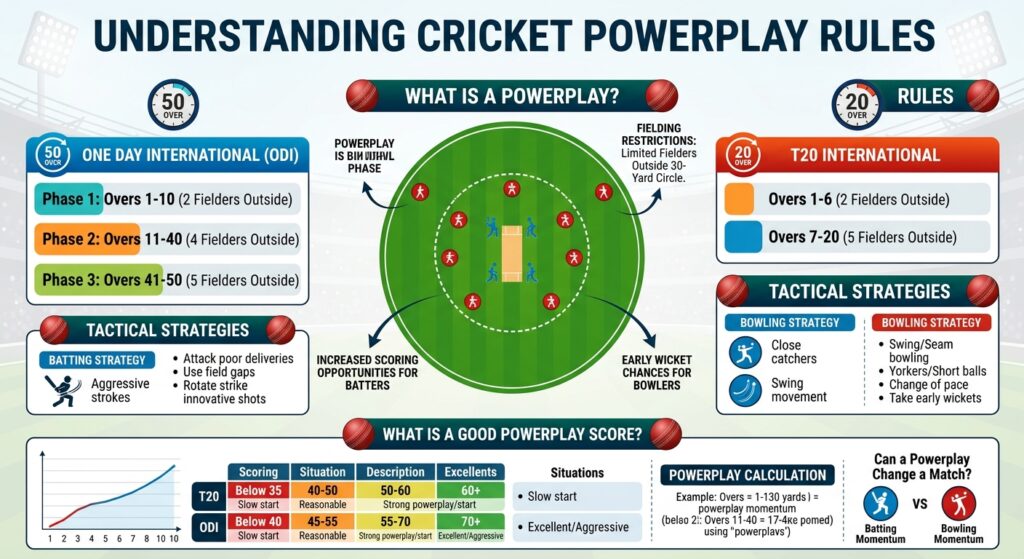
A powerplay is a specific period during a limited-overs cricket match when restrictions are placed on the number of fielders allowed outside the 30-yard circle.
The main purpose of the powerplay is to encourage attacking cricket and increase scoring opportunities. Since fewer fielders can be positioned near the boundary, batters often have more gaps to target.
Powerplays are mainly used in:
- One Day International (ODI) cricket
- T20 International cricket
- Domestic one-day competitions
- Franchise T20 leagues
Test cricket does not use powerplay rules because Test matches do not have the same fixed-over format as limited-overs cricket.
During a powerplay, the fielding captain cannot place all fielders near the boundary. This creates opportunities for the batting team, but it also allows bowlers to attack with the new ball and potentially take early wickets.
That balance makes the powerplay one of the most exciting phases of a cricket match.
Why Was the Powerplay Introduced?
Cricket authorities introduced fielding restrictions to make limited-overs cricket more entertaining and balanced.
Before strict fielding restrictions became common, captains could place many fielders near the boundary. This sometimes made scoring difficult and encouraged defensive v.
Powerplay rules changed this approach.
By limiting the number of fielders outside the circle, the batting side receives an opportunity to score quickly. At the same time, bowlers can use the new ball when it is harder, faster, and more likely to swing or seam.
As a result, powerplays create a fascinating contest between bat and ball.
A successful powerplay can completely change the momentum of a match.
Cricket Powerplay Rules in ODI Matches
In modern One Day International cricket, each innings consists of 50 overs. The innings is divided into three fielding phases.
These phases determine how many fielders can stand outside the 30-yard circle.
| Phase | Overs | Maximum Fielders Outside Circle |
|---|---|---|
| Powerplay 1 | Overs 1–10 | 2 fielders |
| Middle Overs | Overs 11–40 | 4 fielders |
| Final Overs | Overs 41–50 | 5 fielders |
The first 10 overs are commonly called the mandatory powerplay.
During these opening overs, only two fielders are allowed outside the 30-yard circle.
This means the boundary has fewer protected areas, giving batters opportunities to score through aggressive shots.
However, attacking too early can also be risky.
The new ball often moves through the air or off the pitch, meaning opening batters must balance aggression with careful shot selection.
ODI Powerplay: Overs 1 to 10
The first 10 overs are among the most important in an ODI innings.
Fielding restrictions mean that only two players can be positioned outside the circle. The remaining fielders must stay inside or close to the inner fielding area.
This usually encourages teams to:
- Play attacking shots
- Take advantage of gaps
- Score boundaries
- Rotate the strike quickly
- Put pressure on new-ball bowlers
At the same time, bowling teams often attack with slip fielders.
A captain may position:
- One or two slips
- A gully
- Point
- Cover
- Mid-off
- Mid-on
- Fine leg
- Third man depending on field restrictions
The exact field changes depending on whether the batter is right-handed or left-handed and whether the bowler is a fast bowler or spinner.
T20 Cricket Powerplay Rules
T20 cricket has a shorter powerplay because an innings contains only 20 overs.
The standard T20 powerplay lasts for the first six overs of the innings.
During these six overs, only two fielders are allowed outside the 30-yard circle.
The basic structure looks like this:
| Match Format | Total Overs | Powerplay Overs |
|---|---|---|
| ODI | 50 | First 10 overs |
| T20 | 20 | First 6 overs |
The T20 powerplay is usually extremely aggressive because teams have limited time to score runs.
Batters often attempt:
- Lofted drives
- Pull shots
- Cut shots
- Inside-out shots
- Aggressive running between wickets
A team scoring 50 or 60 runs without losing wickets during the powerplay can establish a strong platform.
However, losing three or four wickets early can create serious problems.
How Many Fielders Are Allowed Outside the Circle?
The number of fielders outside the circle depends on the stage of the innings.
In a standard T20 match, the restrictions generally work as follows:
| Overs | Maximum Fielders Outside the Circle |
|---|---|
| 1–6 | 2 |
| 7–20 | 5 |
This simple rule has a huge impact on batting strategy.
Imagine a powerful batter facing a fast bowler. During the powerplay, only two fielders can protect the boundary. If the batter finds a gap, there is a greater chance of scoring a boundary.
After the powerplay ends, more fielders can move to the boundary, making attacking shots riskier.
What Is the 30-Yard Circle?
The 30-yard circle is a marked fielding circle around the pitch.
During restricted overs, a certain number of fielders must remain inside this area.
The circle plays an important role in limited-overs cricket because it determines where fielders may positioned.
During a powerplay:
- Most fielders must remain inside the circle.
- Only a limited number can stand outside it.
- Captains cannot simply place defensive boundary fielders everywhere.
This creates more scoring opportunities for the batting team.
Powerplay Rules and Batting Strategy
The powerplay is not simply about hitting every ball for six.
Successful teams usually combine aggression with intelligent cricket.
A good opening partnership understands when to attack and when to defend.
For example, if a fast bowler is swinging the new ball significantly, blindly attacking may result in early wickets. Instead, experienced batters might wait for loose deliveries while taking calculated risks against weaker balls.
Common batting strategies during the powerplay include:
- Attacking poor deliveries
- Using the gaps in the field
- Rotating strike
- Running aggressively between wickets
- Targeting a weaker bowler
- Using innovative shots when appropriate
- Preserving wickets while maintaining a healthy scoring rate
The ideal powerplay depends on the pitch and conditions.
On a flat batting surface, teams may aim for a very high score.
On a difficult pitch, surviving the new-ball spell without losing wickets may be equally valuable.
Bowling Strategy During the Powerplay
Although fielding restrictions favor the batting side, bowlers also have opportunities during the powerplay.
The new cricket ball is generally harder and can move more than an older ball.
Fast bowlers may use:
- Swing bowling
- Seam movement
- Yorkers
- Short balls
- Changes of pace
Captains often attack with close-catching fielders because early wickets can put the batting team under immediate pressure.
For example, a captain might place slips behind the wicket when conditions favor swing.
Taking two wickets in the first few overs can be more valuable than simply preventing runs.
This is why powerplay bowling requires courage.
A defensive approach may stop some boundaries, but an attacking bowler who takes wickets can change the entire match.
The Importance of Wickets During the Powerplay
Runs are important, but wickets are equally important.
Consider two T20 powerplay scores:
| Team | Score After 6 Overs |
|---|---|
| Team A | 55/0 |
| Team B | 60/4 |
At first glance, Team B appears to be ahead because it has scored more runs.
However, Team A is often in the stronger position because all its major batters are still available.
A team at 55/0 can accelerate later in the innings.
A team at 60/4 may need to rebuild.
This shows why teams cannot judge a powerplay purely by the number of runs scored.
The combination of runs, wickets, pitch conditions, and batting depth matters.
What Is a Good Powerplay Score?
There is no single answer because conditions vary.
However, approximate scoring ranges can provide a general idea.
In T20 Cricket
| Powerplay Score | General Situation |
|---|---|
| Below 35 | Slow or difficult start |
| 40–50 | Reasonable |
| 50–60 | Strong powerplay |
| 60+ | Excellent and aggressive start |
In ODI Cricket
| Score After 10 Overs | General Situation |
|---|---|
| Below 40 | Slow start |
| 45–55 | Balanced start |
| 55–70 | Strong start |
| 70+ | Highly aggressive powerplay |
These figures are not official rule.
A score of 40 may be excellent on a difficult bowling pitch, while 60 might be considered average on a flat batting wicket.
Powerplay Calculation Example
Let’s take a simple T20 example.
Suppose a team scores:
- Over 1: 8 runs
- Over 2: 10 runs
- Over 3: 7 runs
- Over 4: 12 runs
- Over 5: 9 runs
- Over 6: 11 runs
The total powerplay score is:
8 + 10 + 7 + 12 + 9 + 11 = 57 runs
The team has scored 57 runs in 6 overs.
To calculate the run rate:
Run Rate = Total Runs ÷ Overs
57 ÷ 6 = 9.50
Therefore, the batting team’s powerplay run rate is 9.50 runs per over.
A strong scoring rate during the powerplay can reduce pressure during the middle overs.
Can a Powerplay Change a Match?
Absolutely.
A dominant powerplay can influence the rest of the innings.
Imagine a T20 team scoring 65 runs in the first six overs without losing a wicket. The middle-order batters can then play with freedom because the team already has a strong foundation.
On the other hand, if the bowling team takes three early wickets and restricts the opposition to 35 runs, the batting side may struggle to recover.
Powerplays can therefore create momentum in two different ways:
Batting Momentum
A high scoring rate gives confidence to the batting team.
Bowling Momentum
Early wickets create pressure and force new batters to rebuild.
The psychological impact can be just as important as the score itself.
Powerplay in Rain-Affected Matches
Rain can affect powerplay rules in shortened matches.
When the number of overs is reduced, the number of powerplay overs may also be adjusted according to the playing regulations.
For example, a match reduced from 20 overs to a shorter format cannot necessarily use the full six-over powerplay.
The exact calculation depends on the official playing conditions for that competition.
This ensures that fielding restrictions remain fair even when a match is shortened.
Common Mistakes Teams Make During the Powerplay
Teams sometimes misunderstand the purpose of the powerplay.
One common mistake is trying to attack every delivery.
Aggressive cricket does not mean careless cricket.
A smart batting team identifies:
- Which bowler is easiest to attack
- Which side of the field has gaps
- Whether the pitch supports bowling
- How much movement the new ball has
Similarly, bowling teams sometimes become too defensive.
Simply trying to avoid boundaries can allow batters to settle comfortably.
The best teams combine planning with flexibility.
Powerplay vs Middle Overs
The contrast between powerplay and middle overs is important.
During the powerplay, field restrictions encourage aggressive batting.
During the middle overs, additional boundary fielders make scoring more difficult.
This is why many teams change their approach after the powerplay.
Powerplay Approach
- Higher risk
- More attacking shots
- Fewer boundary fielders
- New-ball bowling
- Greater opportunity for quick runs
Middle Overs Approach
- More fielders outside
- Greater importance of singles
- Spinners often become more involved
- Batters must rotate strike
- Boundaries can be harder to find
The best batting teams adapt quickly instead of using the same strategy throughout the innings.
Final Thoughts
Understanding cricket powerplay rules is essential for anyone learning limited-overs cricket.
The powerplay is a period when fielding restrictions create opportunities for batters while also giving bowlers a chance to take wickets with the new ball. In ODI cricket, the first 10 overs are played under the strictest field restrictions, while in T20 cricket the powerplay covers the first six overs.
However, the powerplay is about more than simply scoring fast.
Teams must balance aggression with wicket preservation. A successful batting side uses the field restrictions intelligently, while a strong bowling side attacks and looks for breakthroughs.
This combination of strategy, pressure, and attacking cricket is what makes the powerplay one of the most important phases of any limited-overs match.
Whether you are a beginner trying to understand the rules or a regular cricket fan studying match tactics, watching how teams approach the powerplay can help you understand why a cricket match changes direction so quickly. One excellent over, one early wicket, or one aggressive partnership can transform the momentum of an entire game.
