


When people first start watching or playing cricket, they usually pay attention to the bat, the stumps, or the size of the ground. The cricket ball often gets less attention. Yet its weight is one of the most important things about the game. A few grams can change how a ball feels in a bowler’s hand, how quickly it travels through the air, and how difficult it is for a batter to control a shot.
So, how much does a cricket ball weigh?
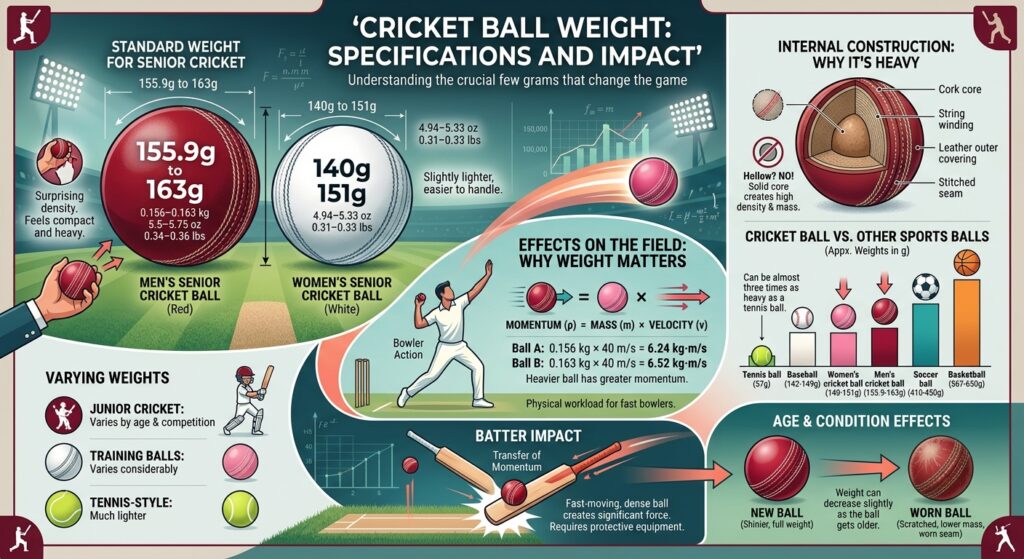
For senior men’s cricket, a standard cricket ball weighs between 155.9 grams and 163 grams. Senior women’s cricket uses a slightly lighter ball, generally between 140 grams and 151 grams. Junior cricket can use smaller and lighter balls depending on the age group and competition.
The weight is not simply a number written in the rules. It is connected to the construction, balance, bounce, swing, seam movement, and overall character of the ball. Understanding cricket ball weight therefore gives players a better idea of why different balls behave differently on the field.
What Is the Standard Weight of a Cricket Ball?
The official weight of a cricket ball for men’s senior cricket is:
155.9 g to 163 g
That is approximately:
- 0.156 to 0.163 kilograms
- 5.5 to 5.75 ounces
- Around 0.34 to 0.36 pounds
There is a small permitted range rather than one exact weight. This allows manufacturers to produce balls that meet the playing regulations while still having normal manufacturing variations.
| Type of Cricket Ball | Approximate Official Weight |
|---|---|
| Men’s senior cricket | 155.9–163 g |
| Women’s senior cricket | 140–151 g |
| Junior cricket | Varies by age and competition |
| Training balls | Varies considerably |
| Tennis-style practice balls | Much lighter |
The exact specifications can depend on the governing body, competition, and age category, so players should always check the rules of the competition they are playing in.
Why Does Cricket Ball Weight Matter?
Ball weight affects almost every part of a delivery.
A heavier ball carries more momentum when it leaves the bowler’s hand. If two balls travel at the same speed but one has greater mass, the heavier ball has greater momentum.
The basic calculation is:
Momentum = Mass × Velocity
For example, imagine a cricket ball with a mass of 0.160 kg being bowled at 35 m/s.
Momentum = 0.160 × 35
Momentum = 5.6 kg·m/s
This is only a simplified example, because a real cricket delivery involves air resistance, rotation, friction and other forces. Still, it shows why the ball’s mass matters.
A heavier ball can also feel more demanding during long spells of bowling. Fast bowlers repeatedly accelerate the ball, and that movement is part of the physical workload involved in bowling.
How Heavy Is a Men’s Cricket Ball?
A men’s senior cricket ball normally falls within the 155.9 to 163 gram range.
Most people can easily hold a cricket ball in one hand, but its compact construction makes it surprisingly dense. A cricket ball is not an empty shell. Inside it is a solid core, usually made from layers of cork and wound string, with a leather outer covering.
The compact construction gives the ball its familiar hardness.
For comparison, a typical tennis ball weighs roughly 57 grams. That means a regulation men’s cricket ball can be almost three times as heavy as a tennis ball.
This difference becomes obvious when someone who has only played tennis picks up a hard cricket ball for the first time.
How Heavy Is a Women’s Cricket Ball?
Women’s senior cricket generally uses a slightly lighter ball than men’s cricket.
The usual weight range is:
140 to 151 grams
This difference may look small, but it can make the ball easier to handle, particularly during repeated bowling and fielding.
The lighter specification is part of the equipment standards used for women’s cricket. It does not mean the ball is soft or harmless. A leather cricket ball remains a hard object and can travel at high speeds.
The difference in weight also means players should not automatically compare bowling speeds, throwing distances, or other measurements between men’s and women’s cricket without considering the equipment being used.
What Is a Cricket Ball Made Of?
Understanding the weight becomes easier when you look at how a cricket ball is constructed.
A traditional cricket ball has several major components:
- Cork core
- String winding
- Leather outer covering
- Stitched seam
The cork core forms the center. Layers of string are wound tightly around the core. The leather covering is then fitted around the internal structure.
The stitching creates the raised seam that bowlers use to influence the ball’s movement.
The combination of these materials gives the ball its weight, hardness and durability.
Unlike a hollow ball, a cricket ball has a dense internal structure. That is why it can maintain considerable momentum after being bowled.
Does Cricket Ball Weight Affect Bowling Speed?
Weight can influence bowling, although it is not the only factor that determines speed.
A bowler’s speed depends on many things, including:
- Run-up speed
- Bowling action
- Arm speed
- Release point
- Strength
- Technique
- Body position
- Wrist movement
- Ball condition
- Pitch conditions
Suppose two bowlers deliver balls at exactly the same speed, but one ball is heavier. The heavier ball has greater momentum.
For example:
Ball A: 0.156 kg × 40 m/s = 6.24 kg·m/s
Ball B: 0.163 kg × 40 m/s = 6.52 kg·m/s
The difference is:
6.52 − 6.24 = 0.28 kg·m/s
This is a simplified physics example rather than a prediction of what will happen during an actual match.
Does a Heavier Ball Bounce Differently?
Ball weight can influence how the ball interacts with the pitch, but bounce is not determined by weight alone.
The pitch surface is extremely important.
A cricket ball landing on a hard, dry surface may behave very differently from one landing on a softer or greener pitch. The ball’s speed, angle, seam position, spin and condition also affect what happens after pitching.
The construction of the ball matters too.
A well-made cricket ball has enough hardness and structure to maintain its shape when it strikes the ground repeatedly.
This is one reason professional players pay close attention to the condition of the ball during a match.
Cricket Ball Weight and Fast Bowling
Fast bowlers rely on speed, accuracy and movement. The ball’s standard weight provides a consistent piece of equipment for them to work with.
A bowler does not simply throw the ball forward. The delivery involves a carefully coordinated movement of the legs, hips, shoulders, arm and wrist.
At professional level, a fast bowler may deliver hundreds of balls during a match and train with the ball regularly.
Because the ball is hard and relatively heavy compared with many other sports balls, proper technique is essential.
A bowler who tries to generate speed using only the arm can place unnecessary strain on the body. Efficient bowling uses the entire kinetic chain.
Cricket Ball Weight and Spin Bowling
Spin bowlers may not bowl at the same speeds as fast bowlers, but ball weight remains important.
Spinners focus on:
- Revolutions per minute
- Finger or wrist position
- Release angle
- Flight
- Dip
- Bounce
- Turn
- Drift
The ball’s mass contributes to its momentum as it travels toward the batter.
A spinner also needs enough control to place the ball accurately. The grip must be comfortable, and the ball must sit naturally in the fingers.
Different spinners develop different grips depending on whether they bowl off-spin, leg-spin, left-arm orthodox spin or another variation.
Why Does the Ball Have a Seam?
The seam is one of the most recognizable features of a cricket ball.
It is created by stitching together sections of the leather covering. Bowlers can use the seam position to influence movement.
For example, a fast bowler may attempt to keep the seam upright. If the ball lands on the seam, it can deviate from its original path.
Swing bowling is also affected by the condition and orientation of the ball.
The weight itself does not create swing, but it is part of the complete physical characteristics of the ball.
Does the Weight Change as the Ball Gets Older?
The ball can change during a match.
A cricket ball is repeatedly:
- Bowled
- Struck by the bat
- Thrown by fielders
- Rubbed against clothing
- Hit against the pitch
- Exposed to weather conditions
Over time, the leather can become worn. The seam can become less prominent, and the surface can become scratched or rough.
The ball’s physical condition can therefore change considerably during a long innings.
However, players do not normally try to alter the ball by adding foreign substances. Cricket has strict rules regarding ball tampering.
Fielders are permitted to polish the ball using normal methods allowed by the playing conditions, which helps maintain one side of the ball and can support conventional swing bowling.
Red Ball vs White Ball Weight
Red and white cricket balls used in professional cricket are designed to meet the relevant playing specifications.
The major difference people notice is not necessarily weight but the ball’s color, finish and the conditions in which it is used.
Red balls are strongly associated with Test cricket and first-class cricket.
White balls are commonly used in limited-overs cricket because they remain easier to see under floodlights and against certain backgrounds.
Although the appearance and performance characteristics differ, both are carefully manufactured pieces of sporting equipment.
What About Pink Cricket Balls?
Pink cricket balls are used in day-night Test matches.
They were developed to provide better visibility under changing light conditions than a traditional red ball.
The pink ball has its own construction and finishing requirements, but it remains within the appropriate regulations for the format.
The use of pink balls demonstrates that cricket ball design is not simply about making a ball that weighs a particular amount. Visibility, durability, surface condition and performance are all important.
How Much Does a Cricket Ball Weigh Compared With Other Sports Balls?
A simple comparison makes the cricket ball’s weight easier to understand.
| Sports Ball | Approximate Weight |
| Cricket ball, men’s | 155.9–163 g |
| Cricket ball, women’s | 140–151 g |
| Tennis ball | About 57 g |
| Baseball | About 142–149 g |
| Football (soccer) | About 410–450 g |
| Basketball | About 567–650 g |
These figures are approximate because official specifications vary between sports and categories.
A men’s cricket ball is therefore considerably heavier than a tennis ball but much lighter than a soccer ball or basketball.
Its compact size makes it particularly dense for its dimensions.
How Many Ounces Is a Cricket Ball?
Converting grams into ounces is straightforward.
One ounce is approximately 28.35 grams.
If a men’s cricket ball weighs 160 grams:
160 ÷ 28.35 = 5.64 ounces
So a typical men’s cricket ball is roughly 5.6 ounces.
This is another useful way to understand its weight, particularly for readers who are more familiar with imperial measurements.
How Is Cricket Ball Weight Checked?
Manufacturers have to produce balls that meet the relevant specifications.
A ball can be weighed using a precision scale.
For example, if the permitted range for a men’s senior ball is 155.9 to 163 grams, a manufacturer can check the finished product before it is supplied for competition.
The measurement is not something players normally calculate during a match. Instead, the equipment is manufactured and approved according to the regulations of the competition or governing organization.
Why Can’t Cricket Balls Be Any Heavier?
There are practical reasons for having a standardized weight.
If every player could choose any ball weight, the game would become inconsistent.
Imagine one team using a 140-gram ball while another used a 180-gram ball. The difference could affect bowling, batting, fielding and player safety.
Standardization ensures that the equipment is broadly comparable from one match to another.
It also allows players to develop skills around predictable equipment specifications.
Does Cricket Ball Weight Affect Batting?
Yes, although the effect is connected with speed and impact rather than weight alone.
When a fast-moving cricket ball hits a bat, a transfer of momentum occurs.
A simplified momentum calculation is:
Momentum = mass × velocity
If the ball is moving quickly, even its relatively modest mass produces significant momentum.
This is why batters wear protective equipment, especially when facing fast bowling.
Helmets, gloves, pads and other protective equipment are important parts of cricket at competitive levels.
Cricket Ball Weight for Beginners
Beginners do not always need to start with a regulation hard cricket ball.
Coaches often use softer training balls, tennis balls or other modified equipment when teaching young players.
The appropriate ball depends on:
- Player age
- Skill level
- Coaching environment
- Competition rules
- Safety considerations
Young players should use equipment recommended by their coach or competition rather than simply choosing a full-weight senior cricket ball.
Learning correct catching, throwing, batting and bowling technique is more important than immediately using professional-level equipment.
Final Thoughts
Cricket ball weight may seem like a small technical detail, but it plays an important role in the sport. A standard men’s cricket ball weighs between 155.9 and 163 grams, while the senior women’s specification is lighter at around 140 to 151 grams.
That weight works together with the ball’s construction, seam, leather covering and internal core to produce the characteristics players experience on the field.
For bowlers, the ball is the tool through which pace, swing and spin are created. For batters, its speed and mass determine the force they have to deal with. For fielders, its weight and hardness make catching and throwing skills essential.
The next time you watch a cricket match, it is worth remembering that the small leather ball moving between the bowler and batter has been carefully designed to meet specific standards. Its weight is only one part of the equation, but it is a crucial one.
