


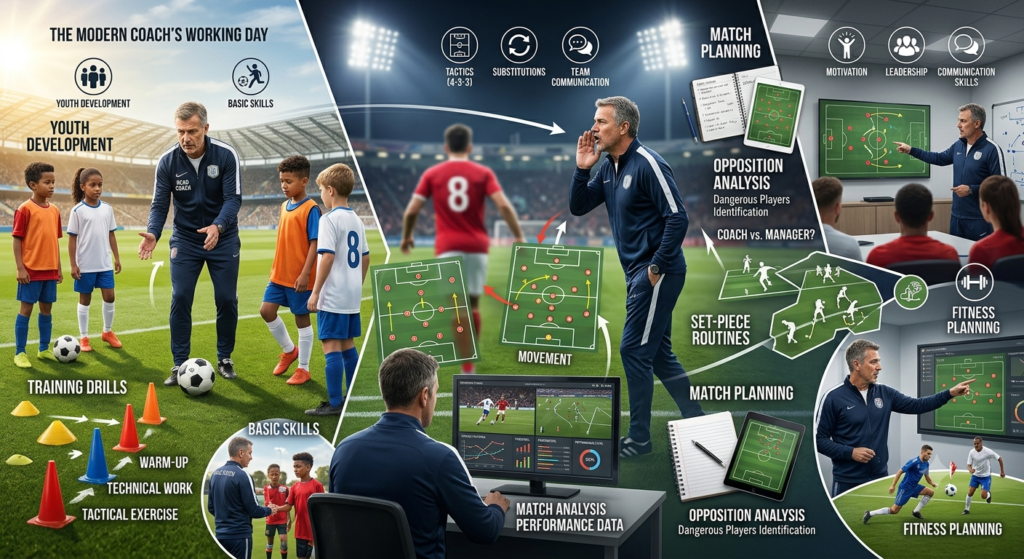
A football match may look like it is decided by the players on the pitch, but there is usually another person influencing almost every important moment from the sideline. That person is the football coach.
A coach is responsible for much more than selecting eleven players and telling them where to stand. Modern football coaching involves tactics, training, player development, match preparation, communication, fitness, psychology, analysis, and decision-making. When a team is winning, the coach may receive plenty of praise. When results go badly, the same coach is often the first person questioned.
The job can be demanding, but it is also one of the most influential positions in the sport.
Whether working with children at a local club or managing a professional team, a football coach has one central objective: help players and the team perform better.
What Is a Football Coach?
A football coach is a person who trains, organizes, develops, and guides football players.
The exact responsibilities depend on the level of football. A youth coach may concentrate heavily on basic skills and enjoyment, while a professional head coach may spend hours studying opponents, preparing tactical plans, managing staff, and analyzing match data.
A coach can influence areas such as:
- Training sessions
- Team selection
- Formation
- Tactical approach
- Player development
- Set pieces
- Match preparation
- Opposition analysis
- Fitness planning
- Team communication
- Motivation
- Substitutions
- Post-match analysis
At amateur level, one coach may handle many of these responsibilities alone. At professional level, there can be an entire coaching department working together.
The Difference Between a Coach and a Manager
The words “coach” and “manager” are sometimes used interchangeably, but they can describe different responsibilities.
A coach is generally focused on improving players and preparing the team for matches. A manager may have a wider role that includes recruitment, transfers, staff management, club strategy, media responsibilities, and other decisions.
However, the distinction depends on the country and club.
In some football systems, the head coach controls the team while sporting directors and recruitment departments handle transfers. In other environments, the manager has much greater control.
| Role | Typical Responsibilities |
|---|---|
| Head Coach | Tactics, training, team selection and match decisions |
| Assistant Coach | Supports training and tactical preparation |
| Goalkeeper Coach | Develops goalkeeper technique and decision-making |
| Fitness Coach | Physical conditioning and recovery |
| Analyst | Studies matches, opponents and performance data |
| Youth Coach | Develops young players |
| Manager | May combine coaching with broader club responsibilities |
What Does a Football Coach Do?
A coach’s working day can look very different from what fans see during a 90-minute match.
The match is only one part of the job.
Before a game, the coaching staff may spend hours examining the opponent. They might identify how the opposing team builds attacks, where it leaves space, which players are dangerous, and how it behaves when possession is lost.
The coach then develops a plan.
That plan has to be communicated clearly because complicated instructions are useless if players cannot understand them.
During training, the coach creates exercises that prepare players for situations they may encounter during a match.
For example, a coach working on defending against counterattacks might organize a small-sided exercise in which defenders must react quickly after losing possession.
Tactical Planning
Tactics are one of the most important parts of modern coaching.
A coach has to decide how the team should attack, defend, press, build from the back, and react when the opponent changes its approach.
Some common formations include:
- 4-3-3
- 4-4-2
- 4-2-3-1
- 3-5-2
- 3-4-3
- 5-3-2
However, a formation written on paper does not tell the whole story.
A team listed as 4-3-3 may defend in a 4-5-1 shape. It may attack with one full-back moving into midfield and effectively create a different structure.
This is why football coaching requires an understanding of movement rather than simply memorizing formations.
Training Players
Training is where many of a coach’s ideas are developed.
A good session usually has a clear purpose. Instead of simply making players run around, the coach should know what skill or tactical behavior each exercise is designed to improve.
A typical session might include:
- Warm-up
- Technical work
- Tactical exercise
- Small-sided game
- Set-piece practice
- Cool-down
The exact structure changes depending on the age, fitness level and competition schedule.
For younger players, training should generally emphasize technical development and enjoyment. Professional players may spend more time on tactical details, recovery and match-specific preparation.
Player Development
One of the most important responsibilities of a football coach is helping players improve.
A talented youngster may have excellent dribbling ability but struggle with decision-making. Another player might understand the game extremely well but need to improve speed or strength.
A coach has to identify these weaknesses and create opportunities for improvement.
Player development can involve:
- Passing
- First touch
- Shooting
- Dribbling
- Crossing
- Heading
- Positioning
- Decision-making
- Defensive awareness
- Communication
- Physical preparation
Development is rarely instant. A player may need months or even years of consistent work before a weakness becomes a strength.
Communication Skills
A coach can have excellent tactical knowledge and still struggle if communication is poor.
Players need instructions that are clear and practical.
Instead of giving a long explanation in the middle of a fast training exercise, a coach may use short phrases that players quickly understand.
Communication also means listening.
Players may have concerns about their position, fitness, role, or confidence. A good coach does not necessarily agree with every player, but understanding the player’s perspective can help build trust.
Motivation and Leadership
Football is full of pressure.
Players can lose confidence after mistakes. Teams can struggle after several defeats. Young players may become frustrated when they do not receive playing time.
The coach has to manage these situations.
Leadership does not always mean shouting. Sometimes the most effective approach is calm communication. Other situations may require strong discipline.
The best coaches understand that different players respond to different forms of leadership.
One player may need encouragement, while another may need to be challenged more directly.
Match-Day Decisions
A coach’s decisions during a match can change the outcome.
Substitutions are one obvious example.
Suppose a team is losing 1-0 with 20 minutes remaining. The coach could introduce another attacking player, change the formation, or push a midfielder higher up the pitch.
But every attacking change creates a potential defensive risk.
This is where coaching becomes a balancing act.
A coach must constantly consider questions such as:
- Should the team press higher?
- Should the defensive line drop?
- Is a player tired?
- Does the formation need changing?
- Is the opponent creating problems down one side?
- Should a substitution be made?
- Is the team protecting a lead or chasing the game?
There is rarely enough time to consider every possibility.
Football Coach and Match Analysis
Technology has changed coaching significantly.
Modern coaching teams can use video footage and performance data to study matches in considerable detail.
They can examine:
- Passing patterns
- Possession
- Shots
- Expected goals
- Pressing actions
- Defensive positioning
- Set pieces
- Ball recoveries
- Player movement
Video analysis can reveal details that are easy to miss while watching a match live.
For example, a coach may notice that a winger repeatedly moves inside when the team builds an attack. That movement might create space for the full-back.
These small details can become important tactical advantages.
Set-Piece Coaching
Free kicks, corners and other dead-ball situations can have a major influence on football matches.
A coach may create different routines for attacking and defending set pieces.
An attacking corner might involve:
- Near-post movement
- Far-post runs
- Blocking movements
- Short corners
- Players arriving late
Defensively, the team may use zonal marking, man marking, or a combination of both.
Because set pieces can be rehearsed repeatedly, they provide coaches with an opportunity to prepare specific situations before match day.
Qualities of a Good Football Coach
There is no single personality type that guarantees success.
However, several qualities are valuable.
1. Football Knowledge
A coach needs to understand the technical and tactical aspects of the game.
2. Leadership
Players need someone capable of setting standards and taking responsibility.
3. Patience
Player development does not happen overnight.
4. Adaptability
A successful coach must be willing to change when circumstances change.
5. Communication
Ideas need to be explained clearly.
6. Organization
Training, analysis and match preparation require careful planning.
7. Observation
Small details can have a major impact on performance.
8. Emotional Control
Football can become highly stressful. A coach must remain capable of making decisions under pressure.
Common Coaching Styles
Different coaches have different philosophies.
| Coaching Style | Main Characteristics |
|---|---|
| Possession-based | Focuses on keeping the ball and controlling tempo |
| Counter-attacking | Looks to exploit space quickly after winning possession |
| High pressing | Attempts to regain the ball close to the opponent’s goal |
| Defensive | Prioritizes organization and limiting chances |
| Development-focused | Concentrates strongly on improving young players |
| Flexible | Changes approach depending on the opponent |
No style is automatically perfect.
A coach needs players capable of executing the chosen approach.
For example, a high-pressing system requires players who can cover ground, coordinate movements and react quickly. A possession-based system requires technical quality and intelligent positioning.
How to Become a Football Coach
People enter coaching through different routes.
A former professional player may move into coaching after retirement, while another person may begin by volunteering with a local youth team.
A common pathway involves:
Playing or volunteering → coaching courses → practical experience → youth or amateur football → higher-level qualifications → professional opportunities
Coaching education is important because enthusiasm alone is not enough.
Courses can teach areas such as:
- Coaching methodology
- Laws of the game
- Player development
- Match analysis
- Sports science
- Safeguarding
- Leadership
- Tactical planning
The specific qualifications required depend on the country and the level at which someone wants to work.
Football Coaches at Youth Level
Youth coaching deserves special attention.
A youth coach is not simply a smaller version of a professional coach.
Young players need age-appropriate training. The emphasis should usually be on learning rather than winning every match.
A coach should help children develop confidence, coordination, technical ability and an understanding of teamwork.
It is also important to create an environment where players are comfortable making mistakes.
A young player who is afraid to lose the ball may stop trying creative things. A coach who allows players to experiment can help them develop more naturally.
Why Football Coaches Matter
The influence of a football coach extends beyond tactics.
A good coach can change how players think about the game. They can help an inexperienced player understand positioning, encourage a struggling player to regain confidence, or give a talented youngster the opportunity to compete at a higher level.
At professional level, coaching can also determine how an expensive squad functions as a unit.
Having eleven talented players does not automatically create a great team.
Football requires cooperation.
Players have to understand where teammates will move, when to press, when to pass, when to defend and when to take risks. The coach helps create that shared understanding.
Final Thoughts
A football coach is much more than someone standing on the touchline giving instructions.
The modern coach is part teacher, part strategist, part leader and part problem-solver. From planning training sessions to studying opponents and making substitutions, coaching involves countless decisions that supporters may never see.
The most successful coaches are often those who understand that football is constantly changing. Tactics evolve, players develop different strengths, and opponents find new ways to cause problems.
A great coach therefore needs more than a favorite formation or a collection of clever drills. They need curiosity, adaptability, communication and the ability to bring different personalities together.
Ultimately, football remains a team sport. The coach cannot score a goal or make a tackle from the sideline. What a coach can do is create the conditions in which players have the best possible chance to succeed.
That is what makes coaching such an important part of the beautiful game.
