


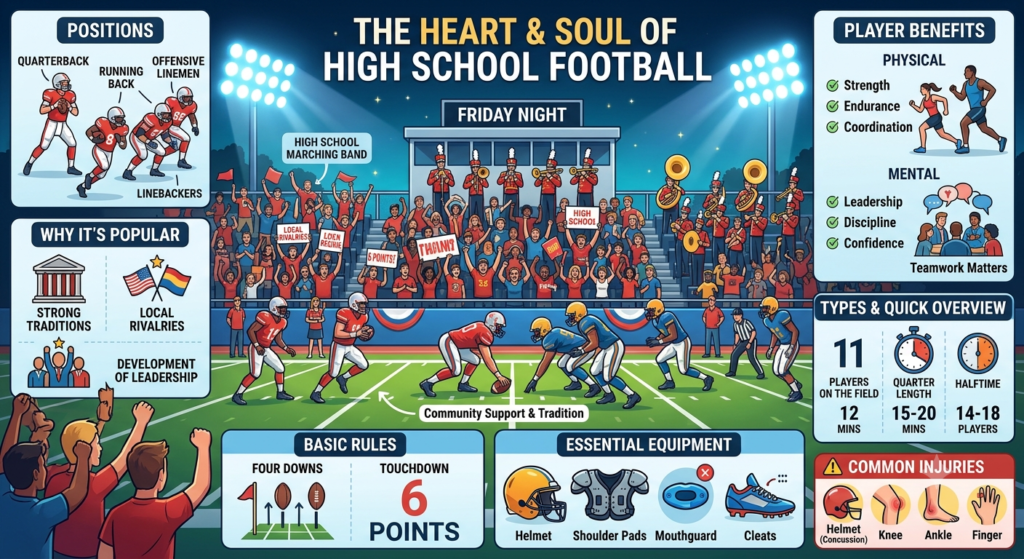
High school football is much more than a sport. For millions of students, parents, teachers, and fans, it is a tradition that brings communities together every fall. Friday night games, cheering crowds, marching bands, and school spirit create memories that last a lifetime. While only a small percentage of players continue to college or professional football, the lessons learned on the field often stay with them forever.
From learning teamwork and discipline to building confidence and leadership, high school football plays an important role in the development of young athletes. Whether you are a student considering joining the team, a parent wanting to understand the game, or simply a football fan, this guide explains everything you need to know about high school football.
What Is High School Football?
High school football is a competitive version of American football played by students enrolled in secondary schools, typically between the ages of 14 and 18. Schools compete against others within their district, conference, or state, following rules established by state athletic associations.
Although the basic rules are similar to college and professional football, there are some differences in game length, overtime rules, and player safety regulations.
Quick Overview
| Feature | High School Football |
|---|---|
| Players on the Field | 11 per team |
| Player Age | Usually 14–18 years |
| Quarter Length | 12 minutes |
| Halftime | 15–20 minutes |
| Total Regulation Time | 48 minutes |
| Season | Fall (August–November in most states) |
The History of High School Football
Football became popular in American schools during the late 1800s. As the sport grew, schools began organizing official teams and local competitions. By the early 20th century, state athletic associations had been established to standardize rules and improve player safety.
Today, thousands of high schools across the United States participate in organized football leagues, with many games attracting crowds of several thousand spectators.
Why High School Football Is So Popular
High school football has become one of the most followed school sports because it combines athletic competition with community pride.
Some reasons for its popularity include:
- Strong school traditions
- Local rivalries
- Community support
- Exciting Friday night games
- Opportunities for college scholarships
- Development of leadership skills
Many towns treat football games as major weekly events during the season.
Positions in High School Football
Every player has a specific role on the team.
| Offensive Positions | Defensive Positions |
|---|---|
| Quarterback | Defensive End |
| Running Back | Defensive Tackle |
| Wide Receiver | Linebacker |
| Tight End | Cornerback |
| Offensive Line | Safety |
Quarterback
The quarterback leads the offense by throwing passes, handing the ball to running backs, and making quick decisions.
Running Back
Running backs carry the football and are responsible for gaining rushing yards.
Wide Receiver
Receivers catch passes and try to score touchdowns.
Offensive Linemen
Their primary job is protecting the quarterback and creating running lanes.
Defensive Players
The defense works to stop the opposing team’s offense by tackling players, forcing turnovers, and preventing touchdowns.
Basic Rules of High School Football
Understanding a few basic rules makes watching the game much more enjoyable.
Four Downs
A team has four attempts (downs) to gain at least 10 yards.
If successful, they receive another set of four downs.
If not, possession goes to the other team.
Touchdown
A touchdown is worth 6 points.
After scoring, teams can attempt:
- Extra Point Kick (1 point)
- Two-Point Conversion (2 points)
Field Goal
A successful field goal earns 3 points.
Safety
A safety occurs when the offense is tackled inside its own end zone.
The defense receives 2 points.
Scoring System
| Method | Points |
|---|---|
| Touchdown | 6 |
| Extra Point Kick | 1 |
| Two-Point Conversion | 2 |
| Field Goal | 3 |
| Safety | 2 |
Equipment Used in High School Football
Player safety depends heavily on proper equipment.
Essential gear includes:
| Equipment | Purpose |
|---|---|
| Helmet | Protects the head |
| Shoulder Pads | Absorb impact |
| Mouthguard | Protects teeth |
| Cleats | Improve grip |
| Gloves | Better catching ability |
| Hip Pads | Reduce injuries |
| Knee Pads | Protect knees |
| Jersey and Pants | Team uniform |
Modern helmets are designed to reduce impact, although no helmet can completely eliminate the risk of concussion.
Practice Schedule
A typical high school football team practices several times each week.
Example weekly schedule:
| Day | Activity |
|---|---|
| Monday | Film review and conditioning |
| Tuesday | Offensive practice |
| Wednesday | Defensive practice |
| Thursday | Special teams and walkthrough |
| Friday | Game Day |
| Saturday | Recovery |
| Sunday | Rest |
Physical Benefits
Playing football provides many health benefits.
These include:
- Improved strength
- Better cardiovascular fitness
- Faster reaction time
- Increased endurance
- Enhanced coordination
- Greater flexibility
Football combines speed, power, balance, and agility into one sport.
Mental Benefits
Football challenges players mentally as much as physically.
Athletes develop:
- Leadership
- Confidence
- Decision-making
- Discipline
- Time management
- Communication skills
Learning how to perform under pressure is one of football’s greatest lessons.
Teamwork Matters
Football is often described as the ultimate team sport.
Unlike individual sports, success depends on every player performing their assignment correctly.
A quarterback cannot complete a pass without protection.
A running back cannot find space without blockers.
The defense cannot stop opponents without coordinated teamwork.
This teaches responsibility and trust.
High School Football and College Scholarships
Many student-athletes dream of earning college scholarships.
College coaches evaluate players based on:
- Athletic ability
- Academic performance
- Leadership
- Character
- Work ethic
Strong grades are just as important as athletic talent because colleges have academic eligibility requirements.
Common Injuries
Like any contact sport, football carries some injury risk.
Common injuries include:
| Injury | Description |
|---|---|
| Sprained Ankle | Ligament injury |
| Knee Injury | ACL or MCL damage |
| Shoulder Injury | Dislocations or strains |
| Concussion | Head injury |
| Hamstring Strain | Muscle injury |
| Finger Fracture | Broken fingers |
Proper coaching, conditioning, and safety equipment help reduce these risks.
Tips for New Players
If you are thinking about joining your school’s football team, consider these tips:
- Attend every practice.
- Stay physically active throughout the year.
- Listen carefully to coaches.
- Learn the playbook.
- Eat a balanced diet.
- Stay hydrated.
- Get enough sleep.
- Be a supportive teammate.
Improvement comes through consistency rather than overnight success.
How Fans Can Support the Team
Fans are an important part of the high school football experience.
Support can include:
- Attending games
- Respecting officials
- Encouraging players
- Supporting fundraising events
- Celebrating good sportsmanship
Positive community involvement creates a better environment for everyone.
High School Football vs College Football
| Feature | High School | College |
|---|---|---|
| Quarter Length | 12 Minutes | 15 Minutes |
| Regulation Time | 48 Minutes | 60 Minutes |
| Player Age | 14–18 | 18–23 |
| Scholarships | No | Yes |
| Game Speed | Moderate | Faster |
| Attendance | Hundreds to Thousands | Thousands to Over 100,000 |
Challenges Facing High School Football
Although the sport remains popular, schools continue to address several challenges:
- Improving player safety
- Managing equipment costs
- Preventing heat-related illnesses
- Recruiting qualified coaches
- Balancing academics and athletics
Many programs now use improved training methods and stricter safety protocols to protect athletes.
The Future of High School Football
Technology is changing how high school football is coached and played. Teams increasingly use video analysis, wearable fitness trackers, and digital playbooks to improve performance. Safety equipment continues to evolve, and greater awareness of injury prevention is helping create a safer environment for young athletes.
As participation grows in many areas, high school football remains a cornerstone of school culture and community pride.
Final Thoughts
High school football is more than a game played under bright stadium lights. It teaches discipline, resilience, teamwork, and leadership while creating lifelong friendships and unforgettable memories. Whether a player hopes to earn a college scholarship or simply enjoys representing their school, the experience offers valuable lessons that extend far beyond the football field.
For students, parents, coaches, and fans alike, high school football continues to be one of the most meaningful and exciting traditions in American sports. With its combination of competition, community spirit, and personal growth, it remains an important part of the high school experience and a foundation for future success both on and off the field.
