


If you’ve ever watched a football match, you’ve probably noticed that every player wears a number on the back of their jersey. Some players proudly wear the famous No. 7, while others are known for the legendary No. 10 or reliable No. 1. These numbers aren’t just random—they have a rich history and often reflect a player’s position, responsibilities, and even their legacy.
Although modern football allows players to choose almost any squad number, traditional jersey numbers still carry significant meaning. Fans often associate certain numbers with iconic players and playing styles.
In this guide, you’ll learn the history of football jersey numbers, what each traditional number represents, and why some numbers have become legendary in world football.
What Are Football Jersey Numbers?
Football jersey numbers are unique numbers assigned to players to identify them during matches. They help referees, coaches, commentators, and supporters recognize players on the pitch.
Originally, jersey numbers were directly linked to playing positions. Today, while many teams still follow these traditions, players often choose numbers for personal reasons, superstitions, or as a tribute to their idols.
Why Do Football Players Wear Numbers?
Football jersey numbers serve several important purposes.
- Identify players during matches
- Help referees record goals, bookings, and substitutions
- Allow fans to recognize their favorite players
- Represent traditional playing positions
- Build a player’s personal brand
Without jersey numbers, managing a football match would be much more difficult.
History of Football Jersey Numbers
Jersey numbers were not part of football when the sport first began.
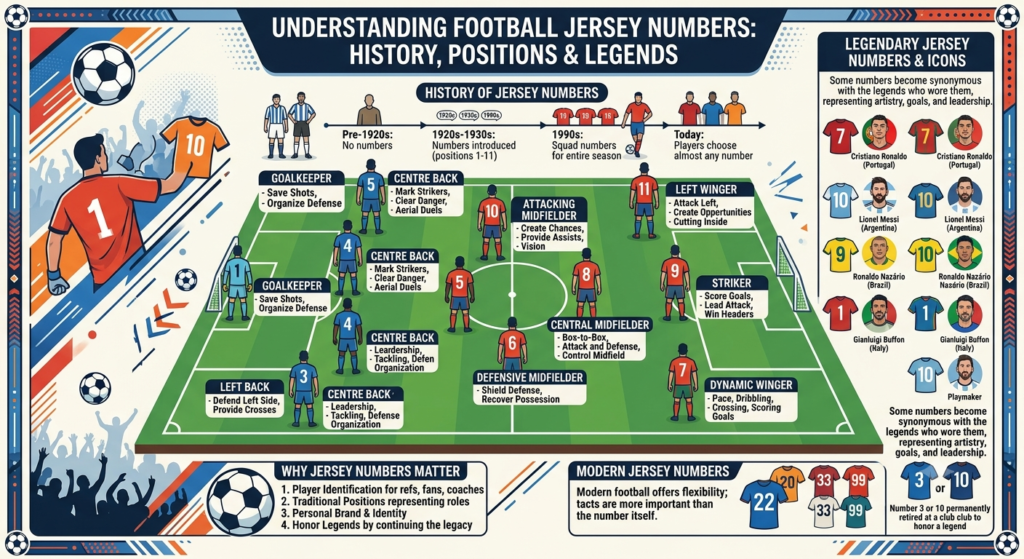
In the early years, players wore identical shirts without any numbers. As football became more organized in the 1920s and 1930s, teams started adding numbers to help spectators identify players.
The traditional numbering system assigned numbers based on position.
Evolution of Jersey Numbers
| Period | Development |
|---|---|
| Before 1928 | No shirt numbers |
| Late 1920s | Numbers introduced in some matches |
| 1930s | Traditional 1–11 system became common |
| 1990s | Squad numbers used for entire seasons |
| Today | Players may choose almost any number |
Modern football no longer requires players to wear numbers according to their position, but the traditional meanings remain widely recognized.
Traditional Football Jersey Numbers Explained
For many decades, the starting eleven wore numbers 1 through 11, with each number representing a specific role on the field.
Traditional Position Numbers
| Jersey Number | Position | Primary Role |
|---|---|---|
| 1 | Goalkeeper | Protect the goal |
| 2 | Right Back | Defend the right side |
| 3 | Left Back | Defend the left side |
| 4 | Centre Back / Defensive Midfielder | Defensive leader |
| 5 | Centre Back | Central defender |
| 6 | Defensive Midfielder / Centre Back | Break up attacks |
| 7 | Right Winger | Create chances and score |
| 8 | Central Midfielder | Box-to-box playmaker |
| 9 | Striker | Main goal scorer |
| 10 | Attacking Midfielder | Creative playmaker |
| 11 | Left Winger | Attack from the left |
Although formations have evolved, these numbers still carry historical significance.
Number 1 – The Goalkeeper
The number 1 jersey is traditionally reserved for the team’s first-choice goalkeeper.
Goalkeepers are responsible for:
- Saving shots
- Organizing the defense
- Catching crosses
- Starting attacks with accurate distribution
Because they are the only players allowed to use their hands inside the penalty area, goalkeepers have always been assigned the No. 1 shirt.
Famous Number 1 Players
| Player | Country |
|---|---|
| Gianluigi Buffon | Italy |
| Iker Casillas | Spain |
| Manuel Neuer | Germany |
| Peter Schmeichel | Denmark |
Number 2 – Right Back
Traditionally, the No. 2 shirt belongs to the right back.
Their responsibilities include:
- Stopping opposing wingers
- Supporting attacks
- Delivering crosses
- Winning one-on-one duels
Modern full-backs are expected to contribute both defensively and offensively.
Number 3 – Left Back
The No. 3 jersey mirrors the role of the right back but on the opposite side.
A left back must:
- Defend the left flank
- Support attacking moves
- Cross the ball into the penalty area
- Track opposing wingers
Many legendary defenders have proudly worn the No. 3 shirt throughout football history.
Number 4 – Defensive Leader
The No. 4 shirt is commonly worn by:
- Centre backs
- Defensive midfielders
This player often acts as the team’s organizer, reading the game and protecting the defense.
Typical qualities include:
- Strength
- Leadership
- Positioning
- Tackling ability
Number 5 – Centre Back
The No. 5 jersey traditionally belongs to another central defender.
Centre backs wearing No. 5 are responsible for:
- Winning aerial duels
- Blocking shots
- Clearing crosses
- Marking opposing strikers
Many team captains have worn this number because central defenders often lead the back line.
Number 6 – Defensive Midfielder
The No. 6 shirt is often associated with the holding midfielder.
This player sits in front of the defense and helps maintain balance throughout the match.
Main responsibilities include:
- Breaking up attacks
- Winning possession
- Short passing
- Protecting defenders
- Controlling the tempo
In some teams, the No. 6 also plays as a centre back.
Traditional Defensive Numbers Summary
| Number | Position | Main Responsibility |
|---|---|---|
| 1 | Goalkeeper | Save shots |
| 2 | Right Back | Defend right side |
| 3 | Left Back | Defend left side |
| 4 | Centre Back / DM | Organize defense |
| 5 | Centre Back | Stop attackers |
| 6 | Defensive Midfielder | Shield defense |
Why Do Some Players Keep the Same Number?
Many footballers keep the same jersey number throughout their careers because it becomes part of their identity.
Fans often associate certain numbers with legendary players. A jersey number can become just as recognizable as the player’s name.
For example:
- A striker may always wear No. 9.
- A creative playmaker often prefers No. 10.
- A winger may choose No. 7 because of famous players who wore it before.
Some players even refuse to change their number after transferring to a new club if it’s available.
Number 7 – The Dynamic Winger
The No. 7 shirt is one of the most iconic jersey numbers in football.
Traditionally, it belongs to the right winger, a player known for pace, creativity, and goal-scoring ability.
Main Responsibilities
- Dribble past defenders
- Deliver crosses
- Create scoring chances
- Score goals
- Support the striker
Today, many attacking midfielders and forwards also wear the No. 7 shirt because of its legendary status.
Famous Number 7 Players
| Player | Country | Known For |
|---|---|---|
| Cristiano Ronaldo | Portugal | Goals, speed, leadership |
| David Beckham | England | Crossing and free kicks |
| George Best | Northern Ireland | Dribbling |
| Eric Cantona | France | Creativity |
Number 8 – The Box-to-Box Midfielder
The No. 8 shirt usually belongs to a midfielder who contributes in both attack and defense.
These players cover large areas of the pitch and often become the engine of the team.
Responsibilities
- Passing
- Tackling
- Creating attacks
- Supporting defenders
- Joining attacks
Famous Number 8 Players
| Player | Country |
|---|---|
| Steven Gerrard | England |
| Frank Lampard | England |
| Andrés Iniesta | Spain |
| Toni Kroos | Germany |
Number 9 – The Striker
The No. 9 jersey is traditionally worn by the team’s main goal scorer.
A classic No. 9 spends most of the match inside or around the penalty area, waiting for scoring opportunities.
Main Duties
- Score goals
- Finish crosses
- Hold up the ball
- Win headers
- Lead the attack
Famous Number 9 Players
| Player | Country |
|---|---|
| Ronaldo Nazário | Brazil |
| Robert Lewandowski | Poland |
| Alan Shearer | England |
| Karim Benzema | France |
The phrase “natural number nine” is often used to describe a traditional striker.
Number 10 – The Playmaker
No jersey carries more prestige than the No. 10.
Traditionally worn by the team’s most creative player, the No. 10 links midfield and attack.
These players are known for:
- Vision
- Passing
- Dribbling
- Creativity
- Match-winning moments
Many of football’s greatest legends have worn this number.
Famous Number 10 Players
| Player | Country |
|---|---|
| Lionel Messi | Argentina |
| Pelé | Brazil |
| Diego Maradona | Argentina |
| Ronaldinho | Brazil |
For many fans, the No. 10 shirt symbolizes football artistry.
Number 11 – The Left Winger
The No. 11 shirt traditionally belongs to the left winger.
Responsibilities include:
- Attacking from the left side
- Cutting inside
- Crossing
- Creating chances
- Scoring goals
Famous Number 11 Players
| Player | Country |
|---|---|
| Ryan Giggs | Wales |
| Neymar Jr. | Brazil |
| Mohamed Salah* | Egypt |
| Romário | Brazil |
*While Mohamed Salah has worn different numbers during his career, he has also played with No. 11 at club level.
Traditional Attacking Numbers Summary
| Jersey Number | Position | Main Role |
|---|---|---|
| 7 | Right Winger | Speed and creativity |
| 8 | Central Midfielder | Attack and defense |
| 9 | Striker | Score goals |
| 10 | Attacking Midfielder | Playmaker |
| 11 | Left Winger | Create and finish attacks |
Modern Football Jersey Numbers
Today’s football is much more flexible than it was decades ago.
Players are no longer required to wear numbers based on their positions. Many choose numbers because of:
- Personal preference
- Lucky numbers
- Childhood idols
- Family reasons
- Marketing and branding
For example, a defender may wear No. 10, while a striker could wear No. 99.
High Squad Numbers
Many clubs assign numbers beyond 30, especially to academy players and new signings.
Examples include:
| Number Range | Common Use |
|---|---|
| 1–11 | Traditional starters |
| 12–25 | First-team squad |
| 26–40 | Reserve players |
| 41+ | Academy or youth players |
Some leagues have no upper limit, allowing players to wear numbers such as 77, 88, or 99.
Retired Jersey Numbers
Some football clubs permanently retire jersey numbers to honor legendary players or commemorate special events.
When a number is retired, no future player at that club wears it.
Reasons for Retiring a Number
- Club legend
- Memorial tribute
- Exceptional achievements
- Emotional significance
Not every league allows retired numbers, but many clubs have chosen this way to recognize players who made a lasting impact.
Can Two Players Wear the Same Number?
No.
During an official competition, every player in the squad must have a unique jersey number.
For example:
| Player | Jersey Number |
|---|---|
| Goalkeeper | 1 |
| Defender | 5 |
| Midfielder | 8 |
| Forward | 9 |
Two players cannot wear the same number in the same match.
How Jersey Numbers Help Fans
Jersey numbers make football easier to follow.
Supporters often identify players by their numbers, and many buy replica shirts featuring the numbers of their favorite stars.
Over time, some numbers become closely associated with legendary players, making them instantly recognizable around the world.
Complete Football Jersey Numbers (1–11)
The table below summarizes the traditional jersey numbers used in football and the positions they are commonly associated with.
| Jersey Number | Traditional Position | Main Responsibilities |
|---|---|---|
| 1 | Goalkeeper | Save shots, organize defense, distribute the ball |
| 2 | Right Back | Defend the right side, support attacks |
| 3 | Left Back | Defend the left side, provide crosses |
| 4 | Centre Back / Defensive Midfielder | Leadership, tackling, defensive organization |
| 5 | Centre Back | Mark strikers, clear danger, win aerial duels |
| 6 | Defensive Midfielder | Protect the defense, recover possession |
| 7 | Right Winger | Pace, dribbling, crossing, scoring |
| 8 | Central Midfielder | Link defense and attack, control the midfield |
| 9 | Striker | Score goals and lead the attack |
| 10 | Attacking Midfielder | Create chances, provide assists, score goals |
| 11 | Left Winger | Attack from the left, create opportunities |
Interesting Facts About Football Jersey Numbers
- The No. 10 shirt is often considered the most prestigious number in football because it has been worn by many of the game’s greatest playmakers.
- The No. 9 is traditionally reserved for the team’s primary goal scorer.
- Goalkeepers almost always wear No. 1, although some modern keepers choose different numbers.
- Squad numbers became permanent in many leagues during the 1990s, allowing players to keep the same number throughout the season.
- Some players wear unusual numbers, such as 45, 66, 77, or 99, to honor personal milestones or because their preferred numbers are unavailable.
- Fans often associate a player’s jersey number with their identity, making it one of the most recognizable aspects of their career.
Do Jersey Numbers Always Match Positions?
Not anymore.
While the traditional numbering system is still widely understood, modern football gives players much more freedom in choosing their squad numbers.
For example:
- A winger may wear No. 11, 7, or even 17.
- A striker could wear 9, 19, or 99.
- A midfielder might choose 6, 8, or 24.
The tactical role of a player is now more important than the number on the back of the shirt.
Why Some Jersey Numbers Become Legendary
Certain jersey numbers gain legendary status because of the players who wore them.
| Jersey Number | Common Reputation |
|---|---|
| 1 | Reliable goalkeeper |
| 7 | Skillful winger and superstar |
| 9 | Clinical goal scorer |
| 10 | Creative genius and playmaker |
These numbers often carry expectations. Fans may expect a player wearing the No. 10 shirt to provide creativity or a No. 9 to score goals regularly.
Conclusion
Football jersey numbers have evolved from a simple method of identifying players into symbols of position, tradition, and identity. While modern football allows greater flexibility in squad numbering, the classic numbers from 1 to 11 continue to represent specific roles on the pitch and remain deeply connected to the history of the game.
Whether it’s the dependable No. 1, the prolific No. 9, or the legendary No. 10, each shirt tells a story. For players, a jersey number can become part of their legacy, while for fans, it often represents unforgettable moments and iconic careers.
Understanding football jersey numbers not only makes watching matches more enjoyable but also provides a deeper appreciation of the sport’s traditions and tactical evolution.
