


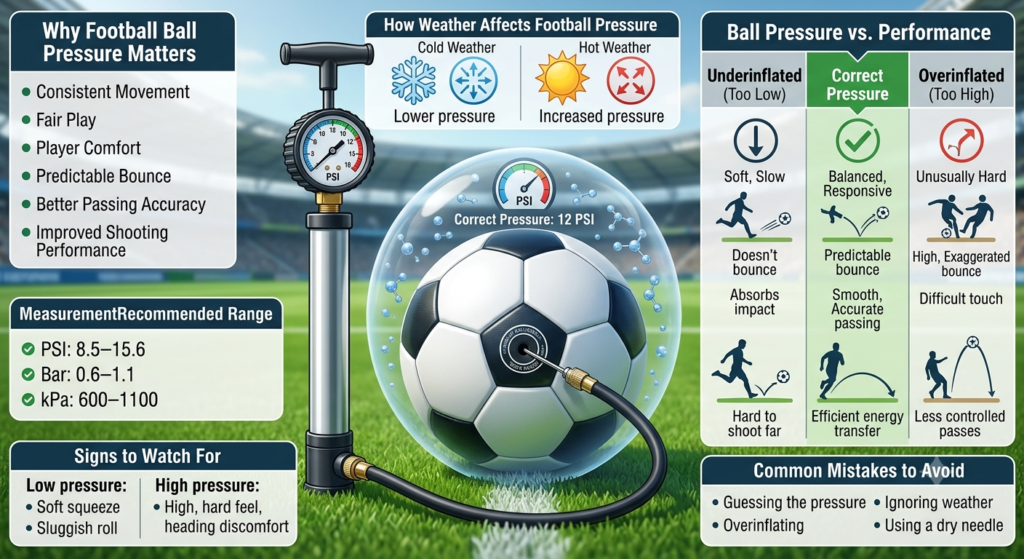
A football may look simple from the outside, but one of the most important factors affecting its performance is something you can’t see—air pressure. Whether you’re playing a casual game in the park, training with your local club, or competing in a professional match, the amount of air inside the ball influences how it bounces, travels, and feels when kicked.
Many players focus on choosing the right football boots or the correct ball size, yet overlook ball pressure. An underinflated football can feel soft and slow, while an overinflated ball becomes hard to control and uncomfortable to strike. Maintaining the correct pressure not only improves performance but also extends the life of the football.
In this guide, you’ll learn the recommended football pressure, how to measure it, how weather affects inflation, common mistakes to avoid, and practical tips for keeping your football match-ready.
Why Football Ball Pressure Matters
Football is designed to perform within a specific pressure range. The correct pressure helps ensure consistent movement, fair play, and player comfort.
A properly inflated football provides:
- Predictable bounce
- Better passing accuracy
- Improved shooting performance
- Comfortable first touch
- Longer ball lifespan
- More consistent flight
Even a small change in pressure can noticeably affect the way the ball behaves during a match.
Recommended Football Pressure
According to the Laws of the Game, a standard match football should be inflated to between 0.6 and 1.1 bar, which equals approximately 8.5 to 15.6 psi (pounds per square inch) at sea level.
| Measurement | Recommended Range |
|---|---|
| PSI | 8.5–15.6 |
| Bar | 0.6–1.1 |
| kPa | 600–1100 |
Most professional match balls perform best around 11–13 psi, although always check the manufacturer’s recommendation printed near the valve.
What Is PSI?
PSI stands for Pounds per Square Inch, a unit used to measure air pressure.
It tells you how much force the air inside the football exerts on its inner surface. The correct PSI helps the ball maintain its shape and deliver consistent performance throughout the game.
How Correct Pressure Affects Performance
1. Ball Control
When the pressure is correct, the ball feels balanced and responsive.
Benefits include:
- Softer first touch
- Better dribbling control
- Improved passing accuracy
- Easier trapping
2. Shooting Power
A properly inflated football transfers energy more efficiently.
Players often notice:
- Cleaner strikes
- Faster shots
- More predictable flight
- Better long-range accuracy
3. Passing Accuracy
Incorrect pressure can affect how the ball rolls and travels through the air.
| Pressure | Effect on Passing |
|---|---|
| Too Low | Slow and inconsistent |
| Correct | Smooth and accurate |
| Too High | Faster but harder to control |
Signs Your Football Is Underinflated
An underinflated football is one of the most common problems at amateur level.
Symptoms include:
- Feels soft when squeezed
- Doesn’t bounce properly
- Rolls slowly
- Absorbs more impact
- Difficult to shoot long distances
- Loses shape during play
Besides affecting performance, playing with too little air can place extra stress on the ball’s stitching and outer cover.
Signs Your Football Is Overinflated
Adding too much air creates a very different set of problems.
Watch for these signs:
- Ball feels unusually hard
- High, exaggerated bounce
- Difficult first touch
- Faster but less controlled passes
- Increased discomfort when heading the ball
- Greater stress on seams and bladder
An overinflated football can also wear out more quickly because the internal bladder and outer panels remain under constant tension.
How to Check Football Pressure
The most accurate way to measure pressure is with a pressure gauge.
Steps:
- Apply a small amount of lubricant or water to the valve.
- Insert the gauge carefully.
- Read the PSI value.
- Add or release air if needed.
- Recheck before use.
Many modern hand pumps include a built-in pressure gauge, making it easy to maintain the correct inflation.
How to Inflate a Football Correctly
Follow these simple steps:
- Use a football pump with a suitable needle.
- Moisten the needle before inserting it into the valve to avoid damage.
- Inflate the ball gradually.
- Check the pressure frequently.
- Stop once the recommended PSI is reached.
- Remove the needle carefully.
Avoid forcing the needle into the valve, as this can cause leaks over time.
Ball Pressure by Football Size
Although manufacturers may vary slightly, the recommended pressure is generally similar across standard football sizes.
| Ball Size | Age Group | Recommended Pressure |
|---|---|---|
| Size 3 | Under 8 | 8.5–12 PSI |
| Size 4 | Ages 8–12 | 8.5–13 PSI |
| Size 5 | Ages 13+ and Adults | 8.5–15.6 PSI |
Always refer to the markings on the ball for the exact recommended range.
How Weather Affects Football Pressure
Temperature plays a significant role in air pressure.
Cold Weather
Cold air causes the air inside the football to contract.
Effects include:
- Lower pressure
- Softer feel
- Reduced bounce
Hot Weather
Warm air expands.
Effects include:
- Increased pressure
- Harder feel
- Higher bounce
If you’re moving between very different temperatures, it’s a good idea to check the ball’s pressure before play.
Indoor vs Outdoor Football Pressure
Different types of footballs may require different inflation levels.
| Ball Type | Typical Pressure |
|---|---|
| Outdoor Match Ball | 8.5–15.6 PSI |
| Training Ball | Manufacturer recommendation |
| Futsal Ball | Lower than a standard football for reduced bounce |
| Indoor Football | Varies depending on the playing surface |
Always follow the manufacturer’s guidance, especially for futsal and indoor balls.
Common Mistakes to Avoid
Many players unknowingly shorten the lifespan of their football by making simple mistakes.
| Mistake | Better Practice |
|---|---|
| Guessing the pressure | Use a pressure gauge |
| Overinflating | Stay within the recommended PSI |
| Ignoring weather | Recheck pressure when temperatures change |
| Using a dry pump needle | Lubricate the needle before insertion |
| Leaving the ball in direct sunlight | Store it in a cool, dry place |
Tips for Maintaining Proper Ball Pressure
To keep your football in excellent condition:
- Check the pressure every week if you play regularly.
- Inspect the valve for signs of damage or leaks.
- Store the ball away from excessive heat and cold.
- Avoid sitting or standing on the football.
- Clean the ball after muddy games.
- Use a quality hand pump with a pressure gauge.
Regular maintenance not only improves performance but also extends the ball’s lifespan.
Final Thoughts
Maintaining the correct football ball pressure is one of the simplest ways to improve your game. A properly inflated ball offers better control, more consistent passing, accurate shooting, and predictable bounce, while also protecting the ball from unnecessary wear. Whether you’re training, coaching, or playing competitively, taking a few minutes to check the pressure before each session can make a noticeable difference.
Remember that factors such as temperature, storage conditions, and regular use can all affect inflation. By using a pressure gauge, following the recommended PSI, and caring for your football properly, you’ll enjoy better performance and a longer-lasting ball.
