


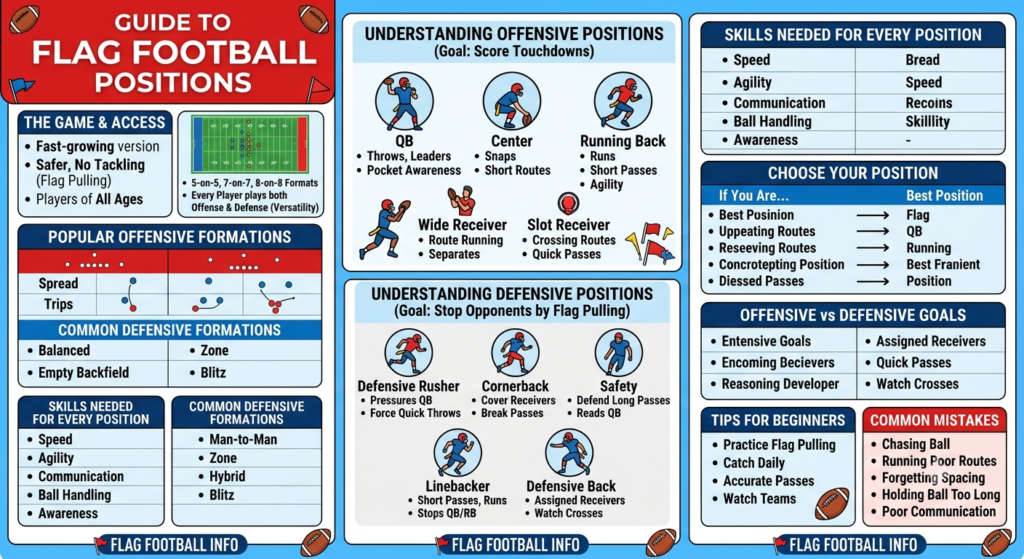
Flag football has become one of the fastest-growing versions of football around the world. It offers all the excitement of traditional football while replacing tackling with flag pulling, making the game safer and more accessible for players of all ages. Whether you’re joining a recreational league, coaching a youth team, or simply trying to understand the game better, learning the different flag football positions is an excellent place to start.
Unlike tackle football, where teams often have 11 players on the field, flag football typically features 5-on-5, 7-on-7, or 8-on-8 formats. Because there are fewer players, each position becomes even more important. Every player usually contributes on both offense and defense, making versatility one of the biggest strengths in flag football.
In this guide, you’ll learn the responsibilities of each position, how teams line up, and what skills are needed to succeed.
Understanding Flag Football Positions
Each player on the field has a specific job. On offense, the goal is to move the ball down the field and score touchdowns. On defense, the objective is to stop the opposing team by pulling the ball carrier’s flag before they reach the end zone.
Although leagues may have slightly different rules, most flag football positions remain similar across all formats.
Offensive Flag Football Positions
The offense usually consists of five key positions. Depending on the league, some players may perform multiple roles during the same game.
| Position | Main Responsibility | Key Skills |
|---|---|---|
| Quarterback (QB) | Throws or hands off the ball | Passing, leadership, decision-making |
| Center (C) | Snaps the ball and blocks | Accuracy, awareness |
| Running Back (RB) | Runs or catches short passes | Speed, agility |
| Wide Receiver (WR) | Catches passes | Route running, hands, quickness |
| Slot Receiver | Short and intermediate routes | Agility, football IQ |
Quarterback (QB)
The quarterback is often considered the leader of the offense. Every play begins with the ball being snapped to the quarterback by the center.
Main Responsibilities
- Read the defense before the snap
- Throw accurate passes
- Hand the ball to a running back when needed
- Decide where to move the ball
- Communicate plays to teammates
A successful quarterback doesn’t always have the strongest arm. Good decision-making, timing, and accuracy are often more important than throwing power in flag football.
Essential Skills
- Quick thinking
- Leadership
- Strong communication
- Passing accuracy
- Pocket awareness
Center (C)
The center starts every offensive play by snapping the ball to the quarterback. In many flag football leagues, the center is also eligible to catch passes after completing the snap.
Responsibilities
- Deliver accurate snaps
- Protect the quarterback
- Run short passing routes
- Help create space for teammates
An experienced center can become one of the quarterback’s favorite targets because defenses sometimes overlook this position.
Running Back (RB)
The running back brings versatility to the offense. Depending on the play design, this player may run with the football, block for teammates, or catch passes out of the backfield.
Responsibilities
- Carry the football
- Catch short passes
- Protect the quarterback
- Create yards after the catch
Key Skills
- Explosive speed
- Balance
- Agility
- Vision
- Quick acceleration
Running backs often become playmakers because of their ability to change direction quickly in open space.
Wide Receiver (WR)
Wide receivers stretch the defense by running routes and catching passes. They line up near the sidelines and use speed to create separation from defenders.
Common Routes
- Slant
- Go route
- Curl
- Out route
- Post
- Corner
A great receiver understands how to find open areas rather than relying solely on speed.
Important Skills
- Reliable hands
- Route running
- Body control
- Acceleration
- Awareness
Slot Receiver
The slot receiver lines up between the center and the outside receiver.
This position is common in 5-on-5 and 7-on-7 leagues because it creates additional passing options.
Responsibilities
- Catch quick passes
- Run crossing routes
- Create mismatches
- Gain yards after the catch
Players in this role must react quickly since the ball often arrives within a few seconds of the snap.
Defensive Flag Football Positions
Defense is just as important as offense in flag football. Since tackling isn’t allowed, defenders must rely on positioning, speed, and timing to pull flags effectively.
The most common defensive positions include:
| Position | Main Job |
|---|---|
| Defensive Rusher | Pressure the quarterback |
| Cornerback | Cover wide receivers |
| Safety | Protect deep passes |
| Linebacker | Stop short passes and runs |
| Defender | Pull flags and cover zones |
Each defender must communicate well because offenses often use motion and quick passing plays to create confusion.
Defensive Rusher
The defensive rusher attacks the quarterback after the snap. Unlike tackle football, many leagues require the rusher to begin several yards behind the line of scrimmage before rushing.
Responsibilities
- Pressure the quarterback
- Force quick throws
- Prevent scrambling
- Pull the quarterback’s flag
Speed and timing are essential. Arriving too early may result in a penalty, while arriving too late gives the quarterback extra time to find an open receiver.
Cornerback
Cornerbacks defend the outside receivers and try to prevent completed passes.
Responsibilities
- Cover receivers
- Break up passes
- Pull flags after catches
- Watch the quarterback’s eyes
Good cornerbacks remain patient rather than chasing every fake move.
Safety
The safety usually plays farther back than the other defenders.
Their role is to stop deep passes and provide support if another defender misses a flag pull.
Responsibilities
- Defend long passes
- Read the quarterback
- Help teammates
- Prevent touchdowns
A smart safety can change the momentum of a game by anticipating throws and making timely interceptions.
Linebacker
The linebacker is one of the busiest players on the defensive side of the ball. This position combines speed, awareness, and quick decision-making. Depending on the play, a linebacker may defend against a short pass, stop a running play, or help cover a receiver crossing the middle of the field.
Main Responsibilities
- Cover short passing routes
- Stop running plays
- Pull the ball carrier’s flag
- Communicate with teammates
- Help defend the middle of the field
A good linebacker is always watching the quarterback while keeping an eye on nearby receivers. Reacting quickly is often the difference between stopping a play for a short gain or allowing a long touchdown.
Defensive Back
Some leagues simply refer to additional defenders as defensive backs. Their primary responsibility is to cover receivers and prevent easy completions.
Responsibilities
- Stay close to assigned receivers
- Watch for crossing routes
- Contest passes
- Pull flags immediately after a catch
Because flag football relies heavily on passing, defensive backs spend much of the game moving, changing direction, and reading offensive patterns.
Popular Flag Football Formations
Every team develops formations based on its players’ strengths. Here are a few of the most common offensive setups.
| Formation | Description | Best Used For |
|---|---|---|
| Spread Formation | Receivers line up across the field | Passing plays |
| Trips Formation | Three receivers on one side | Creating mismatches |
| Balanced Formation | Even receivers on both sides | Balanced offense |
| Empty Backfield | No running back | Quick passing game |
A well-designed formation forces the defense to spread out, creating more room for receivers to find open space.
Common Defensive Formations
Defensive formations are designed to limit passing lanes and prevent big plays.
| Formation | Purpose |
|---|---|
| Man-to-Man | Each defender covers one player |
| Zone Defense | Defenders protect specific areas |
| Hybrid Defense | Mix of man and zone coverage |
| Blitz Package | Extra pressure on the quarterback |
Most beginner teams start with zone defense because it encourages teamwork and reduces coverage mistakes.
How to Choose the Right Flag Football Position
Not every player is suited for the same role. Your athletic abilities, experience, and playing style can help determine the best position.
| If You Are… | Best Position |
|---|---|
| Fast and agile | Wide Receiver |
| Strong leader | Quarterback |
| Quick with good hands | Slot Receiver |
| Excellent at reading plays | Safety |
| Aggressive and fast | Defensive Rusher |
| Good all-around athlete | Linebacker |
| Reliable and consistent | Center |
Remember, many recreational leagues rotate players through different positions, helping everyone develop a complete understanding of the game.
Skills Needed for Every Position
Although each role has unique responsibilities, several skills benefit every flag football player.
Speed
Quick acceleration helps both offensive and defensive players create or close space.
Agility
Sharp cuts and rapid direction changes are essential since there is no tackling.
Communication
Calling out routes, defensive assignments, and adjustments keeps the team organized.
Ball Handling
Whether throwing, catching, or carrying the football, secure ball control reduces turnovers.
Awareness
Good players constantly scan the field and anticipate what will happen next instead of simply reacting.
Offensive vs Defensive Positions
The table below highlights the primary differences.
| Offensive Position | Primary Goal | Defensive Counterpart | Primary Goal |
|---|---|---|---|
| Quarterback | Complete passes | Defensive Rusher | Pressure the quarterback |
| Running Back | Gain rushing yards | Linebacker | Stop runs and short passes |
| Wide Receiver | Catch passes | Cornerback | Defend receivers |
| Slot Receiver | Find open space | Safety | Protect deep areas |
| Center | Snap and receive | Defensive Back | Cover receivers |
Understanding how these positions match up helps players recognize strategies during games.
Tips for Beginners
If you’re new to flag football, focus on mastering the basics before learning advanced plays.
- Learn one position at a time.
- Practice pulling flags cleanly instead of grabbing clothing.
- Improve your catching with daily drills.
- Work on short, accurate passes.
- Stay in constant communication with teammates.
- Watch experienced teams to understand spacing and movement.
- Learn the rules of your specific league, as they can vary.
Consistent practice will improve both confidence and performance.
Common Mistakes New Players Make
Many beginners repeat the same errors during their first few games.
Chasing the Ball
Defenders sometimes abandon their assignments to chase the quarterback or ball carrier, leaving receivers wide open.
Running Poor Routes
Receivers who round off routes instead of making sharp cuts are easier to defend.
Forgetting Spacing
Offensive players standing too close together make it easier for defenders to cover multiple receivers.
Holding the Ball Too Long
Quarterbacks should make quick decisions. Waiting too long often results in pressure or incomplete passes.
Poor Communication
Simple calls before the snap can prevent confusion and improve teamwork.
Avoiding these common mistakes can dramatically improve a team’s overall performance.
Why Position Versatility Matters
One of the unique aspects of flag football is that many players contribute on both offense and defense. A receiver may become a cornerback after a change of possession, while the quarterback might defend as a safety.
This versatility develops a wider range of football skills and gives every player a better understanding of the game.
Teams with adaptable players are often more successful because they can adjust to injuries, substitutions, and different opponents without losing effectiveness.
Conclusion
Understanding flag football positions is the first step toward becoming a smarter and more confident player. Each position—whether it’s the quarterback directing the offense, the receiver creating separation, the linebacker covering the middle, or the safety protecting against deep passes—plays a valuable role in the team’s success.
As you gain experience, don’t hesitate to try multiple positions. Learning different responsibilities improves your football IQ, makes you a more versatile teammate, and helps you appreciate how every player contributes to the game. With regular practice, solid communication, and a willingness to learn, you’ll be well prepared to enjoy everything flag football has to offer.
