


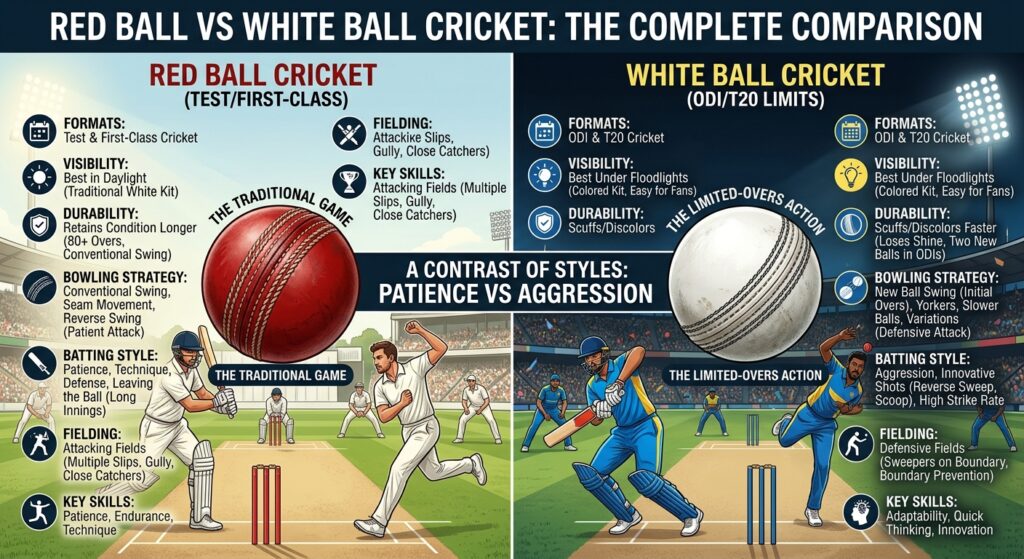
Cricket may be played with the same basic bat, wickets, and eleven players on each side, but the type of ball used can completely change the character of a match. One of the most interesting comparisons in the sport is red ball vs white ball cricket.
For many cricket fans, the difference may appear simple: Test cricket uses a red ball, while limited-overs cricket uses a white ball. However, there is much more to it. The color of the ball affects visibility, swing, seam movement, durability, batting conditions, bowling strategies, field settings, and even the skills required from players.
Red-ball cricket is often associated with patience, technique, and endurance. White-ball cricket, on the other hand, is known for aggressive batting, innovative shots, and fast-paced action.
Understanding the difference between these two balls can help beginners appreciate why some players excel in Test cricket while others become specialists in ODI and T20 formats.
This guide explains everything you need to know about red ball vs white ball cricket.
What Is a Red Cricket Ball?
A red cricket ball is traditionally used in Test matches and first-class cricket. It has been part of the game for generations and remains strongly associated with traditional cricket.
The ball is made from a cork core wrapped in layers of tightly wound string and covered with leather. A raised seam runs around the middle, allowing bowlers to generate movement through the air and off the pitch.
Red balls are especially effective in longer matches because they retain their condition for extended periods.
In Test cricket, the same ball can be used for many overs, which creates an interesting battle between bat and ball. A new red ball may swing significantly, while an older ball can help bowlers generate reverse swing.
This changing nature of the ball is one of the reasons Test cricket is considered the ultimate examination of a player’s skills.
What Is a White Cricket Ball?
A white cricket ball is primarily used in One Day Internationals (ODIs), T20 cricket, and other limited-overs formats.
White balls were introduced because red balls are difficult to see under floodlights. As day-night cricket became popular, players and spectators needed a ball that remained visible against the darker background.
The white ball has a similar basic construction to the red ball, but its outer surface and finishing process differ.
White balls are designed to remain visible during matches played under artificial lights. However, they can become dirty and lose their shine faster than red balls.
This creates a unique challenge for bowlers and captains in limited-overs cricket.
Red Ball vs White Ball Cricket: Quick Comparison
| Feature | Red Ball | White Ball |
|---|---|---|
| Main Formats | Test and First-Class Cricket | ODI and T20 Cricket |
| Visibility | Best in daylight | Best under floodlights |
| Swing | Can swing for longer periods | Usually swings more when new |
| Durability | Generally retains condition longer | Can become dirty faster |
| Match Length | Long-format cricket | Limited-overs cricket |
| Batting Style | Patient and defensive | Aggressive and attacking |
| Reverse Swing | Common with older ball | Less predictable |
| Typical Use | Day matches and traditional cricket | Day-night and night matches |
Although both balls serve the same purpose, their behavior during a match can be very different.
Why Is a Red Ball Used in Test Cricket?
The red ball is ideal for traditional cricket because it remains effective over a long period.
Test matches can last up to five days, and the ball must go through different stages during an innings.
At the beginning of an innings, the ball is hard and shiny. Fast bowlers can use this condition to generate conventional swing.
As the ball becomes older, the shine gradually disappears. The surface becomes rougher, and bowlers may begin using different techniques.
Later in the innings, experienced fast bowlers can attempt reverse swing.
This natural evolution creates multiple phases within a Test match.
For example:
- New ball: More swing and seam movement
- Slightly older ball: Better batting conditions
- Old ball: Reverse swing becomes possible
- Very old ball: Spin bowlers may become more influential
This constant change makes red-ball cricket highly tactical.
Why Is a White Ball Used in Limited-Overs Cricket?
The biggest reason is visibility.
When cricket began experimenting with colored clothing and night matches, the traditional red ball became difficult to see.
A white ball provided a clear solution.
Under stadium floodlights, the white ball is much easier for:
- Batsmen to pick up
- Fielders to track
- Umpires to observe
- Television viewers to follow
However, using a white ball created new challenges.
A white cricket ball can become dirty quickly. It may also lose its shine and become difficult to see later in a long ODI match.
For this reason, modern ODI cricket often uses two new balls, one from each end.
This means each ball is generally used for fewer overs compared with the single-ball system traditionally associated with longer formats.
Difference in Swing
Swing is one of the biggest differences between red and white ball cricket.
A cricket ball swings when air moves differently around its two sides.
The condition of the ball, seam position, bowling speed, and atmospheric conditions all influence swing.
Red Ball Swing
The red ball is famous for producing swing, particularly in helpful conditions.
In countries with cooler and cloudier weather, fast bowlers can use the red ball to great effect.
A new red ball can move in both directions.
A right-arm fast bowler, for example, may produce:
- Outswing
- Inswing
- Seam movement
- Later reverse swing
Because the red ball can maintain its condition for a longer time, bowlers often have more opportunities to use different types of movement.
White Ball Swing
The white ball can also swing significantly, particularly when new.
In fact, the early overs of an ODI or T20 match can be extremely difficult for batsmen.
However, the white ball usually loses its shine relatively quickly.
Once this happens, conventional swing may reduce.
Because limited-overs cricket is shorter, bowlers must make the most of the new-ball phase.
This is why teams often attack aggressively with fast bowlers during the opening overs.
Seam Movement and Bowling
Both red and white balls have a raised seam, but their use in different formats creates different bowling strategies.
In red-ball cricket, bowlers can afford to be patient.
A fast bowler might bowl several overs outside the off stump, trying to create uncertainty for the batsman.
The goal is often to force a mistake.
In white-ball cricket, bowlers face a different challenge.
Batsmen are more aggressive and frequently attack from the first few overs.
Therefore, bowlers need to combine traditional skills with defensive tactics.
Common white-ball bowling strategies include:
- Yorkers
- Slower balls
- Bouncers
- Wide yorkers
- Cutters
- Knuckleballs
This difference highlights the changing nature of modern cricket.
A bowler who dominates in Test cricket may need additional skills to succeed in T20 cricket.
Batting Differences Between Red and White Ball Cricket
The approach to batting changes dramatically depending on the color of the ball and format of the game.
Red-Ball Batting
Red-ball batting requires patience.
A Test batsman may leave dozens of deliveries outside the off stump before playing an attacking shot.
The primary goal is survival combined with scoring runs.
Players must understand:
- Their off-stump position
- When to leave the ball
- How to defend
- How to play swing
- How to manage long innings
A batsman can spend several hours at the crease in a Test match.
Mental concentration becomes just as important as technical ability.
White-Ball Batting
White-ball cricket rewards aggression.
The limited number of overs means batsmen cannot always wait for loose deliveries.
Players often use innovative shots to score quickly.
These include:
- Reverse sweeps
- Switch hits
- Scoop shots
- Ramp shots
- Inside-out shots
Modern white-ball cricket requires excellent hand-eye coordination and the ability to score in every part of the ground.
Strike rates are particularly important in T20 cricket.
A player scoring 40 runs from 20 balls can sometimes have a greater impact than someone scoring 70 from 70 deliveries.
Fielding Strategies
Fielding tactics also differ between red-ball and white-ball cricket.
In Test cricket, captains often use attacking fields.
For example, when a fast bowler is swinging the new ball, the captain may place:
- Slip fielders
- Gully
- Short leg
- Silly point
The objective is to take wickets.
In white-ball cricket, field placements are often designed to prevent boundaries.
Captains must think about scoring areas and batsmen’s preferred shots.
A deep fielder may be placed specifically to stop a six or catch a mistimed big shot.
Because every run matters in limited-overs cricket, defensive field settings are much more common.
Durability of Red Ball vs White Ball
Durability is another important difference.
A red ball is generally better suited to longer periods of play.
It gradually changes condition, creating different challenges throughout an innings.
The white ball can become discolored because of:
- Contact with the pitch
- Grass stains
- Dirt
- Moisture
- Repeated impact
Once a white ball loses its brightness, visibility can become a concern.
This is particularly important during long ODI matches.
The introduction of two new balls in ODI cricket helped address this issue.
Red Ball Cricket Requires Patience
One of the biggest differences is the mindset required.
Red-ball cricket is often compared to a long chess match.
Players need to think several overs ahead.
A batsman cannot simply attack every delivery.
Similarly, a bowler must build pressure over time.
For example, a fast bowler might repeatedly bowl in the same channel outside off stump.
After several defensive shots, the batsman may become frustrated and attempt an aggressive stroke.
That is when the bowler gets an opportunity.
This patience is one of the defining characteristics of Test cricket.
White Ball Cricket Requires Adaptability
White-ball cricket moves much faster.
A player may only have a few deliveries to make an impact.
A batsman entering during the final overs of a T20 match cannot spend time settling in.
They must immediately understand:
- Field positions
- Required run rate
- Bowler’s strengths
- Boundary dimensions
- Match situation
Similarly, bowlers must constantly adapt.
A bowler who delivers the same type of ball repeatedly can quickly become predictable.
This makes white-ball cricket highly demanding from a tactical perspective.
Which Ball Is Harder to Play?
There is no simple answer because both formats present different challenges.
However, many players consider the red ball more difficult because of the longer duration of matches and the greater importance of technique.
A red-ball batsman must survive against:
- Swinging new balls
- Seam movement
- Fast bowlers using short-pitch tactics
- Spin bowlers attacking rough areas
- Reverse swing with an old ball
The mental challenge is enormous.
White-ball cricket, however, creates pressure in a different way.
Batsmen must score quickly while taking calculated risks.
A small mistake can end a team’s momentum.
Therefore, both balls test different aspects of cricketing ability.
Can Players Be Good at Both Formats?
Yes, many great cricketers have succeeded in both red-ball and white-ball cricket.
However, transitioning between formats can be challenging.
A Test batsman may need to become more aggressive in T20 cricket.
A T20 specialist may need to improve their defensive technique for Test matches.
The best all-format players are able to adjust their mindset and technique.
They understand when to defend, when to attack, and how the ball behaves under different conditions.
This adaptability is one of the greatest skills in modern cricket.
Red Ball vs White Ball: Which Is Better?
Neither ball is better because they serve different purposes.
The red ball represents the traditional side of cricket. It rewards patience, technique, endurance, and strategic thinking.
The white ball represents the faster and more entertaining side of modern cricket. It encourages attacking play, innovation, and quick decision-making.
Both formats have contributed to cricket’s global popularity.
Some fans love the slow-building drama of a five-day Test match.
Others enjoy the excitement of a high-scoring T20 contest.
Fortunately, modern cricket offers both.
Final Thoughts
The debate over red ball vs white ball cricket is really a comparison between two different styles of the same sport.
The red ball is closely connected with Test cricket, long innings, swing bowling, patience, and traditional techniques. Its behavior changes gradually, creating a long tactical contest between batsman and bowler.
The white ball is designed for limited-overs cricket and performs best under lights. It encourages faster scoring, aggressive batting, innovative shots, and constantly changing strategies.
Neither format is superior to the other. Instead, they showcase different skills.
A complete cricketer should ideally understand both worlds. They should know how to leave a swinging red ball outside off stump and also how to attack a white ball in the final over of a T20 match.
That contrast is one of the reasons cricket remains such a fascinating sport. From the traditional red ball of Test cricket to the fast-paced excitement of white-ball matches, every format brings something unique to the game.
In simple terms: red-ball cricket tests patience and technique, while white-ball cricket tests aggression and adaptability.
