


Cricket is a game played on large grounds, but the most important action takes place in a surprisingly small area: the cricket pitch. Every ball bowled, every run scored, and almost every dismissal begins around this central strip.
For beginners, the dimensions of a cricket pitch can seem confusing. How long is a cricket pitch? What is the distance between the wickets? How wide is the pitch? Where exactly are the bowling and popping creases?
Understanding cricket pitch dimensions is useful not only for players but also for fans who want to understand the game better. The measurements of a cricket pitch are carefully standardized, particularly in professional cricket, to ensure fairness between batters and bowlers.
This guide explains everything you need to know about cricket pitch dimensions, including the official length, width, crease measurements, wicket distance, and the difference between the pitch and the wider cricket field.
What Is a Cricket Pitch?
A cricket pitch is the rectangular strip located in the center of a cricket ground where most of the game takes place. It is the area between the two sets of wickets.
The bowler runs towards one end of the pitch and delivers the ball to the batter standing at the opposite end. After hitting the ball, batters run between the wickets to score runs.
The condition of the pitch can have a major influence on a cricket match. Some pitches help fast bowlers, while others provide more assistance to spin bowlers. A flat pitch may make batting easier and lead to high-scoring matches.
Although cricket grounds can vary greatly in size, the central pitch follows specific measurements.
Official Cricket Pitch Dimensions
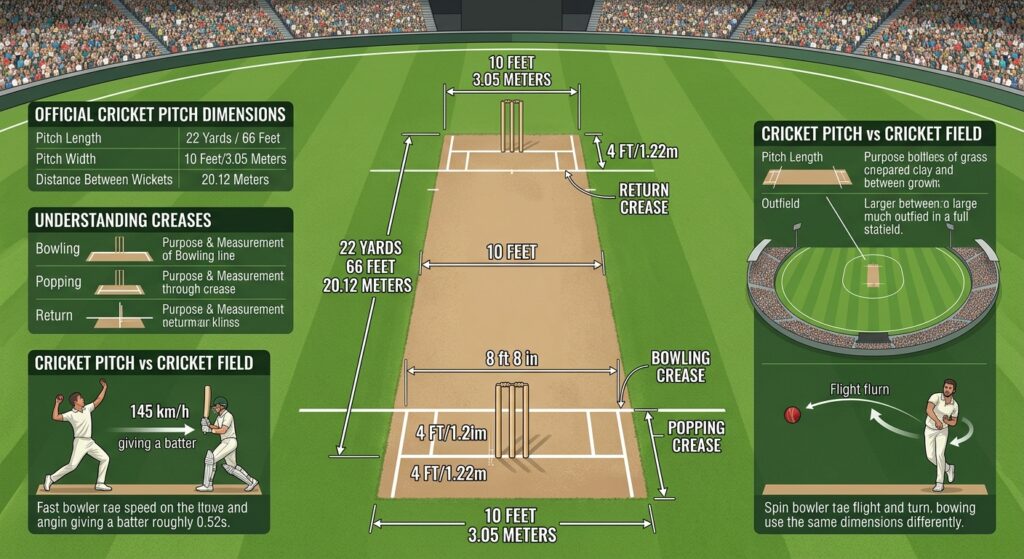
The standard cricket pitch has a length of 22 yards, which is equal to 66 feet or 20.12 meters.
The width of the pitch is 10 feet, which equals approximately 3.05 meters.
Here is a simple breakdown:
| Cricket Pitch Measurement | Size in Yards | Size in Feet | Size in Meters |
|---|---|---|---|
| Pitch Length | 22 yards | 66 feet | 20.12 meters |
| Pitch Width | 3.33 yards | 10 feet | 3.05 meters |
| Distance Between Wickets | 22 yards | 66 feet | 20.12 meters |
The 22-yard measurement is one of the most recognizable standards in cricket. Whether the match is Test cricket, ODI cricket, T20, or a local club game, the basic distance between the two wickets remains the same.
Why Is a Cricket Pitch 22 Yards Long?
The origin of the 22-yard cricket pitch goes back hundreds of years.
One popular explanation is connected to an old measuring chain used in England. A chain traditionally measured 22 yards, and this measurement eventually became associated with the distance between the wickets in cricket.
Over time, the 22-yard distance became an established standard of the game.
Today, cricket has changed dramatically. Players are fitter, bats are more powerful, and bowling speeds are higher than ever. However, the basic length of the cricket pitch remains unchanged.
That consistency creates an interesting connection between modern cricket and the early history of the sport.
Cricket Pitch Length Explained
The length of the pitch is measured from one wicket to the other.
Simple Calculation
1 yard = 3 feet
Therefore:
22 yards × 3 = 66 feet
To convert yards into meters:
22 yards × 0.9144 = 20.1168 meters
Rounded off, this gives:
22 yards = 20.12 meters
This distance is extremely important because it determines the amount of time a batter has to react to the ball.
For example, a fast bowler delivering at 145 km/h gives the batter very little time to judge line, length, swing, and bounce.
On the other hand, spin bowlers use the same 22-yard distance differently. Instead of relying mainly on speed, they attempt to deceive the batter through flight, turn, drift, and variation.
How Wide Is a Cricket Pitch?
A standard cricket pitch is 10 feet wide, or approximately 3.05 meters.
This rectangular area contains the main playing surface between the wickets. The actual prepared section is important because its condition can change throughout a match.
In longer formats, especially Test cricket, the surface may gradually deteriorate. Footmarks created by bowlers can become rough, cracks may appear, and spin can increase as the match progresses.
The width of the pitch provides enough space for bowlers to land safely during their delivery stride while maintaining a consistent playing area.
Distance Between the Two Wickets
The two wickets are placed at opposite ends of the cricket pitch.
The distance between them is:
22 yards (20.12 meters)
Each wicket consists of three stumps and two bails.
When batters run between the wickets, they must make their ground safely at the opposite end. This is why speed between the wickets is such an important skill in cricket.
A quick single might look simple, but players must cover approximately 20 meters before reaching the opposite crease.
Running Calculation
If a batter completes one run:
- Distance from one wicket to the other = approximately 20.12 meters
For two runs:
- 20.12 × 2 = 40.24 meters
For three runs:
- 20.12 × 3 = 60.36 meters
For a boundary inside the ground, batters do not need to run, but when the ball stays in play, fitness and running speed become essential.
Understanding Cricket Pitch Creases
Creases are white lines marked on the pitch. They help determine whether a batter is safe from being run out or stumped and whether a bowler has delivered a legal ball.
There are several important crease markings.
1. Bowling Crease
The bowling crease is marked through the center of the stumps at each end.
This line is approximately 8 feet 8 inches long.
The stumps are positioned along this crease.
For bowlers, this crease acts as an important reference point when delivering the ball.
2. Popping Crease
The popping crease is one of the most important lines on the cricket pitch.
It is positioned 4 feet (1.22 meters) in front of the bowling crease.
A batter must usually have some part of their bat or body grounded behind this line to be considered safely in their ground.
The popping crease is also important for bowlers. If a bowler’s front foot lands beyond the allowed area during delivery, the umpire can call a no-ball.
3. Return Crease
The return creases run perpendicular to the bowling crease.
They help define the area from which the bowler must deliver the ball.
A bowler must remain within the permitted crease area while bowling. Stepping outside the return crease can result in an illegal delivery.
Cricket Pitch Markings at a Glance
| Marking | Purpose | Measurement |
|---|---|---|
| Pitch Length | Distance between wickets | 22 yards / 20.12 m |
| Pitch Width | Width of playing strip | 10 feet / 3.05 m |
| Popping Crease | Batter’s safety line | 4 feet in front of bowling crease |
| Bowling Crease | Line where stumps are positioned | 8 ft 8 in long |
| Return Crease | Defines bowler’s delivery area | Runs perpendicular to bowling crease |
These lines may appear simple, but they play a major role in the laws of cricket.
The Cricket Pitch vs the Cricket Field
Many people confuse the cricket pitch with the entire cricket field.
They are not the same thing.
The pitch is the narrow rectangular strip in the center of the ground.
The field, often called the outfield or playing area, is the much larger space surrounding the pitch.
Unlike the pitch, there is no single universal measurement for the size of every cricket ground.
Some stadiums have large boundaries, while others have relatively short boundaries.
For example, a batter playing at a large international stadium may need significantly more power to hit a six than at a smaller ground.
However, regardless of the size of the stadium, the central pitch remains approximately the same standard length.
Different Types of Cricket Pitches
Although the dimensions remain consistent, the surface of cricket pitches can be very different.
Green Pitch
A green pitch has a noticeable amount of grass.
These conditions often assist fast bowlers because the ball can seam and move after pitching.
Batsmen may find it difficult to play freely, particularly against quality swing bowling.
Dry Pitch
Dry pitches usually offer more assistance to spin bowlers.
As the surface becomes rough, the ball can grip and turn sharply.
These pitches are often associated with matches where spin bowling plays a major role.
Flat Pitch
A flat pitch generally provides a consistent bounce and less movement.
Batters often enjoy playing on flat surfaces because the ball comes onto the bat more predictably.
High-scoring matches are common on good batting pitches.
Dusty Pitch
Dusty surfaces can break up during a match.
They may provide uneven bounce and significant spin, particularly in longer games.
The condition of such a pitch can change dramatically from the first day of a Test match to the final day.
Why Pitch Dimensions Matter in Cricket
The standardized dimensions of a cricket pitch create a fair balance between bat and ball.
Imagine if one cricket ground had a 20-yard pitch while another had a 25-yard pitch. Fast bowlers would have different advantages, batters would have different reaction times, and the basic nature of the game would change.
The 22-yard pitch ensures that players compete under a consistent central measurement.
However, other conditions can still vary.
These include:
- Pitch hardness
- Grass coverage
- Moisture
- Weather
- Cracks in the surface
- Bounce
- Spin
- Seam movement
This is one reason cricket remains such a fascinating sport. The dimensions stay the same, but the behavior of the surface can make every match feel different.
How Pitch Length Affects Fast Bowlers
The 22-yard distance is particularly important for fast bowlers.
A bowler delivering the ball at high speed gives the batter limited reaction time.
Consider a delivery traveling at approximately 140 km/h.
First, convert the speed:
140 km/h = approximately 38.9 meters per second
The pitch distance is approximately 20.12 meters.
Ignoring factors such as the release point and bounce, the approximate travel time would be:
20.12 ÷ 38.9 = 0.52 seconds
That means the batter has roughly half a second to observe the delivery and decide how to respond.
This calculation demonstrates why facing fast bowling can be incredibly difficult.
How Pitch Dimensions Affect Spin Bowlers
Spin bowlers use the 22-yard distance in a completely different way.
Rather than trying to overwhelm the batter with speed, they use:
- Flight
- Turn
- Drift
- Bounce
- Variations in pace
The distance allows the ball enough time to dip and deceive the batter.
A well-flighted delivery may encourage a batter to play forward, only for the ball to turn sharply after bouncing.
This is why the pitch condition becomes particularly important for spin bowlers.
Are Cricket Pitch Dimensions Different in T20, ODI and Test Cricket?
No. The standard dimensions of the central cricket pitch remain essentially the same across major formats.
Whether it is:
- Test cricket
- One Day International cricket
- T20 cricket
- Domestic cricket
- Club cricket
The distance between the wickets remains 22 yards.
What changes between formats is the style of play.
Test cricket requires patience and endurance. ODI cricket combines careful batting with aggressive scoring. T20 cricket focuses heavily on fast scoring and attacking cricket.
Despite these differences, every format is played on the same fundamental 22-yard stage.
Maintaining a Cricket Pitch
Preparing a cricket pitch requires considerable expertise.
Ground staff carefully manage:
- Grass length
- Moisture levels
- Rolling
- Surface hardness
- Repairs
- Covers during rain
Rolling helps create a firm and even surface.
Moisture can affect how much the ball moves after bouncing. Grass may help seam bowlers, while dry surfaces can encourage spin.
In professional cricket, pitch preparation often becomes a major talking point before an important match.
Teams may prefer conditions that suit their strongest players. A side with excellent fast bowlers may prefer a lively surface, while a team with strong spin options might benefit from a dry turning pitch.
Final Thoughts
The cricket pitch may occupy only a small part of the entire cricket ground, but it is undoubtedly the heart of the game. Its standard length of 22 yards has remained one of cricket’s defining measurements for generations.
From a fast bowler charging in at full pace to a spinner carefully setting up a batter, everything revolves around this central strip. The dimensions remain consistent, but the surface itself can completely change the character of a match.
A green pitch can produce a battle between fast bowlers and batters. A dry, cracked surface can bring spin into the game. A flat wicket can create an environment where records and huge scores become possible.
For anyone learning cricket, understanding pitch dimensions is an excellent place to start. Once you know the length, width, crease markings, and distance between wickets, many parts of the game become easier to understand.
The next time you watch a cricket match, remember that some of the most dramatic moments in the sport happen within a rectangular strip measuring just 22 yards long and 10 feet wide.
