


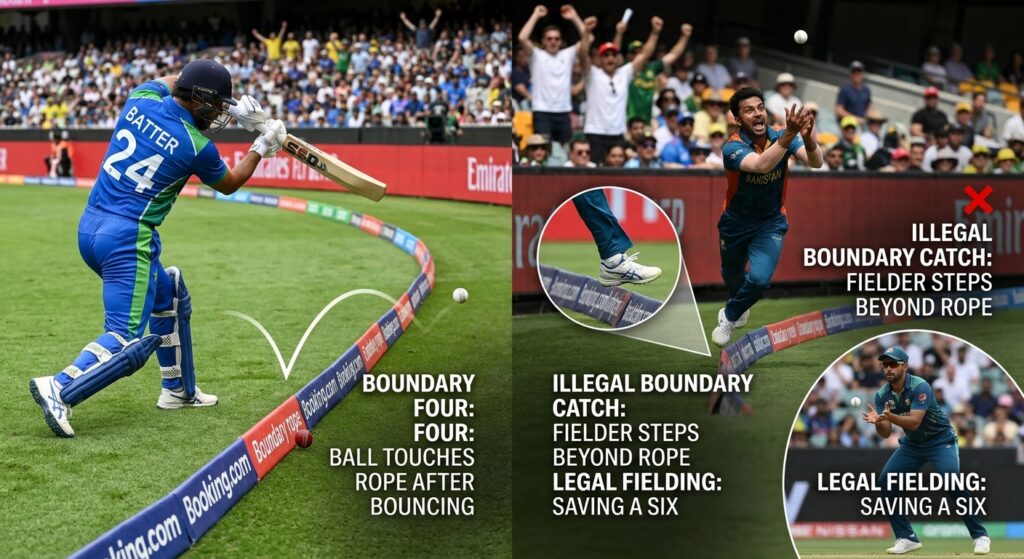
Cricket is a sport full of rules, strategies, and scoring methods, but few moments excite fans more than watching a batter hit the ball to the boundary. A perfectly timed cover drive racing across the outfield or a powerful shot sailing over the ropes can completely change the momentum of a match.
For beginners, however, cricket boundary rules can sometimes be confusing. What happens when the ball touches the boundary rope? Is it always four runs? What if a fielder touches the ball while standing outside the boundary? Can a batter score six runs if the ball bounces before crossing the rope?
Understanding cricket boundary rules is important because boundaries play a major role in scoring. A four or six can increase the run rate, put pressure on bowlers, and dramatically change the outcome of a match.
This guide explains the main boundary rules in cricket, including how fours and sixes are scored, what happens when fielders touch the ball near the boundary, and other situations that players and fans should understand.
What Is a Boundary in Cricket?
A boundary is the edge of the playing area that separates the main field of play from the area outside it.
In most professional cricket stadiums, the boundary is marked using a rope, advertising cushion, fence, or another clear marker. The size of a cricket field can vary depending on the stadium and level of cricket.
When the ball reaches or crosses the boundary under specific conditions, runs are automatically awarded to the batting team.
There are two main types of boundaries:
- Four runs
- Six runs
The number of runs awarded depends on how the ball reaches the boundary.
The Two Types of Boundaries in Cricket
Boundary Four
A batter scores four runs when the ball reaches the boundary after touching the ground inside the field of play.
For example:
- The batter hits a cover drive.
- The ball travels along the ground.
- It reaches and touches the boundary rope.
The batting team is awarded four runs.
The ball does not have to roll continuously along the ground. It may bounce several times before reaching the boundary. As long as it has touched the ground inside the playing area before reaching the boundary, it is normally scored as four runs.
Boundary Six
A batter scores six runs when the ball crosses the boundary without touching the ground inside the field after being struck.
For example:
- The batter hits the ball high into the air.
- The ball travels over the boundary rope.
- It lands outside the playing area.
The batting team receives six runs.
A six is one of the most exciting scoring shots in cricket because it demonstrates power, timing, and confidence.
Cricket Boundary Rules at a Glance
| Situation | Runs Awarded |
|---|---|
| Ball reaches boundary after bouncing | 4 runs |
| Ball crosses boundary without bouncing | 6 runs |
| Fielder touches ball but it reaches boundary | Usually 4 runs |
| Ball touches boundary marker | Boundary |
| Ball crosses boundary after an overthrow | 4 runs plus completed runs in applicable cases |
| Ball lands directly outside boundary | 6 runs if struck by the batter |
The exact outcome can depend on how the ball was played and what happened before it crossed the boundary.
When Is a Four Awarded?
A boundary four is awarded when the ball touches or crosses the boundary after making contact with the ground within the field of play.
The ball may reach the boundary through several types of shots, including:
- Cover drive
- Square drive
- Cut shot
- Pull shot
- Sweep shot
- Straight drive
The batter does not need to run between the wickets to receive the four runs.
Once the ball reaches the boundary, four runs are automatically added to the team’s score.
Example
Suppose the score is:
150/3
The batter plays a shot along the ground and the ball reaches the boundary.
The score becomes:
154/3
The batter receives four runs, assuming the runs are credited to the batter rather than being extras.
When Is a Six Awarded?
A six is awarded when a ball struck by the batter clears the boundary without first touching the ground inside the field.
The ball may:
- Travel directly over the boundary rope
- Land in the crowd
- Hit a stadium structure outside the field
- Cross the marked boundary in the air
A six is credited to the batter’s individual score.
Example
A batter has scored 44 runs.
They hit the next delivery directly over the boundary without the ball bouncing.
44 + 6 = 50 runs
The batter reaches a half-century.
Does the Ball Need to Cross the Boundary Rope?
No. The ball does not always need to completely travel far beyond the rope.
If the ball touches the boundary marker or rope, it is generally considered a boundary.
Modern cricket grounds often use padded boundary cushions rather than traditional ropes. The boundary marker clearly defines the edge of the playing area.
Therefore, if the ball touches the boundary cushion, boundary runs are awarded.
What Happens if a Fielder Touches the Ball Near the Boundary?
This is one of the most interesting cricket boundary rules.
A fielder can stop or catch the ball near the boundary, but they must remain legally inside the field of play.
If a fielder touches the ball while being in contact with the ground outside the boundary, the ball is generally considered to have reached the boundary.
This means the batting team receives boundary runs.
Example
Imagine a ball is travelling toward the boundary.
A fielder jumps into the air and catches the ball.
If the fielder:
- Took off legally from inside the field
- Is not touching the ground outside the boundary when making the contact
- Completes the catch legally
Then the dismissal may be valid.
However, boundary catches can become extremely complicated when fielders jump, step outside the rope, or attempt to push the ball back into play.
Can a Fielder Save a Six?
Yes, a fielder can prevent a six by stopping the ball before it crosses the boundary.
Modern cricket has produced some remarkable examples where fielders jump near the boundary, catch the ball, and throw or push it back into the field before landing outside.
However, the fielder must follow the rules regarding contact with the ground and the boundary.
A player cannot simply stand outside the boundary and reach inside to catch the ball.
The fielding action must remain legal.
What Happens if the Ball Hits the Boundary Rope?
If the ball touches the boundary rope or boundary marker after travelling from the bat, it is normally awarded as a boundary.
The umpire signals:
- Four if the ball reached the boundary after touching the ground
- Six if the ball cleared the boundary without touching the ground
This is why fielders often dive desperately near the rope to prevent the ball from making contact with the boundary marker.
Even a slight touch can result in runs being awarded.
Boundary Rules for Overthrows
Overthrows create some of the most confusing situations in cricket.
An overthrow occurs when a fielder throws the ball toward the wicket but misses the intended target.
For example:
- Batters complete one run.
- A fielder throws the ball toward the stumps.
- The throw misses.
- The ball travels to the boundary.
The batting team may receive boundary runs in addition to runs already completed.
However, the exact calculation depends on the number of runs completed and the position of the batters when the throw was made.
Simple Example
Suppose the batters completed one run before an overthrow reaches the boundary.
The scoring may include:
1 completed run + 4 overthrow boundary runs = 5 runs
The official scoring rules can become more complex depending on whether the batters crossed for additional runs.
Can Batters Run After Hitting a Boundary?
Batters may begin running after playing the ball, but once the ball reaches the boundary, boundary runs are awarded according to the laws.
The batters do not receive unlimited additional runs simply because they ran several times before the ball reached the rope.
For example, if the batters complete three runs before the ball reaches the boundary, the boundary allowance usually determines the minimum scoring outcome according to the circumstances.
This prevents confusion and ensures consistent scoring.
What Happens if the Ball Is Deflected to the Boundary?
Sometimes the ball reaches the boundary after touching another player.
For example, a batter plays a shot and:
- The ball touches the wicketkeeper’s glove
- The ball hits a fielder
- The ball changes direction
- It then reaches the boundary
The runs may still count as a boundary, but whether the runs are credited to the batter or recorded as extras depends on the circumstances.
Scoring in cricket distinguishes between:
- Batter’s runs
- Byes
- Leg byes
- Wides
- No-balls
The umpire and official scorer determine how the runs should be recorded.
Boundary Rules for Wides and No-Balls
A boundary can also occur on a wide or no-ball.
Wide Ball to Boundary
If a delivery is called wide and the ball reaches the boundary, additional runs are awarded.
For example:
1 wide + 4 boundary runs = 5 wides
These runs are recorded as extras rather than being credited to the batter.
No-Ball to Boundary
If a batter hits a no-ball to the boundary, the batting team receives the no-ball penalty plus the runs scored from the shot.
For example:
1 no-ball + 4 runs from the bat = 5 runs
If the batter hits the no-ball for six:
1 no-ball + 6 runs = 7 runs
This makes no-balls particularly expensive for bowlers.
Boundary Scoring Examples
| Situation | Total Runs |
|---|---|
| Normal shot reaches boundary | 4 |
| Normal shot clears boundary | 6 |
| Wide reaches boundary | 5 extras |
| No-ball hit for four | 5 |
| No-ball hit for six | 7 |
| One run + overthrow reaches boundary | Often 5 |
What Happens if the Ball Is Stopped on the Boundary?
A fielder must prevent the ball from touching the boundary while remaining legally inside the field.
If the fielder successfully stops the ball before it touches the boundary, play continues.
The batters can then run between the wickets.
For example, a batter hits the ball toward the rope. The fielder dives and stops it just before the boundary.
Instead of four runs being awarded automatically, the batters may need to run.
This is why athletic boundary fielding is extremely valuable in modern cricket.
Saving even one or two runs can make a major difference in a close match.
Can a Catch Be Taken on the Boundary?
Yes, but the catch must be completed legally.
A boundary catch requires excellent timing and awareness.
The fielder must avoid making illegal contact with the ground outside the boundary while controlling the ball.
If a fielder catches the ball but steps on the boundary rope, the batter is not out.
Instead, boundary runs may be awarded.
Modern players often use athletic techniques near the rope, including:
- Jumping catches
- Throwing the ball back into the field
- Relay catches with teammates
- Pushing the ball upward before crossing the boundary
These moments are among the most spectacular parts of modern cricket fielding.
Why Are Boundaries So Important in Cricket?
Boundaries can quickly change the direction of a match.
A batter who hits consecutive fours or sixes can:
- Increase the scoring rate
- Put pressure on the bowler
- Change the field placement
- Shift match momentum
- Reduce the required run rate
In limited-overs cricket, boundaries are particularly valuable.
Example Calculation
Imagine a team needs:
60 runs from 30 balls
Without boundaries, scoring 60 runs can be difficult.
But if a batter hits:
- 3 fours = 12 runs
- 2 sixes = 12 runs
That is already:
12 + 12 = 24 runs
The remaining requirement becomes:
60 – 24 = 36 runs from 25 balls
This demonstrates how quickly boundaries can change a chase.
Boundary Sizes Can Vary
Unlike some sports, cricket does not always use exactly the same field dimensions.
The distance between the pitch and boundary can vary from one ground to another, provided the playing area meets the applicable regulations.
Some stadiums have:
- Large square boundaries
- Short straight boundaries
- Uneven boundary dimensions
- Different sizes on each side
This can influence team strategy.
A batter may target the shorter side of the ground, while bowlers and captains may adjust field placements accordingly.
Four vs Six: Which Is Better?
From a scoring perspective, a six obviously provides more runs.
However, a four is often a safer option because the ball remains along the ground.
A six usually requires more elevation and power, which can increase the risk of being caught.
Different situations require different decisions.
A batter may prefer:
- Ground shots during early overs
- Boundaries to rotate momentum
- Sixes when a high scoring rate is required
Successful batters understand when to attack and when to play safely.
Common Misunderstandings About Cricket Boundaries
Myth: The Ball Must Completely Cross the Rope
Not necessarily. Contact with the boundary marker can be enough for a boundary.
Myth: Every Ball Outside the Boundary Is Six
Incorrect. If the ball bounced inside the field before reaching the boundary, it is usually four runs.
Myth: Fielders Can Catch the Ball After Standing Outside the Rope
Incorrect. Fielders must meet the legal requirements for boundary catches.
Myth: A Batter Must Run to Receive Four Runs
Incorrect. A boundary automatically awards the appropriate runs.
Final Thoughts
Understanding cricket boundary rules makes watching and playing the game much easier.
The basic principle is simple: a ball that reaches the boundary after bouncing inside the field scores four, while a ball that clears the boundary without bouncing scores six. However, situations involving fielders, catches, overthrows, wides, and no-balls can add additional complexity.
Boundaries are more than just a way to score quickly. They are an important part of cricket strategy. A perfectly placed four can release pressure, while a powerful six can completely change the momentum of a match.
For batters, boundaries reward timing, placement, and power. For bowlers, preventing boundaries requires accurate bowling and smart field settings. For fielders, stopping the ball near the rope demands speed, awareness, and athletic ability.
Whether you are watching Test cricket, ODIs, or T20 matches, knowing the rules behind fours and sixes helps you appreciate every boundary even more. From a classic cover drive racing along the grass to a massive shot soaring into the stands, boundaries remain some of the most thrilling moments in the game of cricket.
