


Cricket is a game full of small details. A bowler delivers the ball, the batter plays a shot, fielders move into position, and then everyone waits for the umpire’s decision. In a crowded stadium, however, an umpire cannot always communicate with words. This is where cricket umpire signals become important.
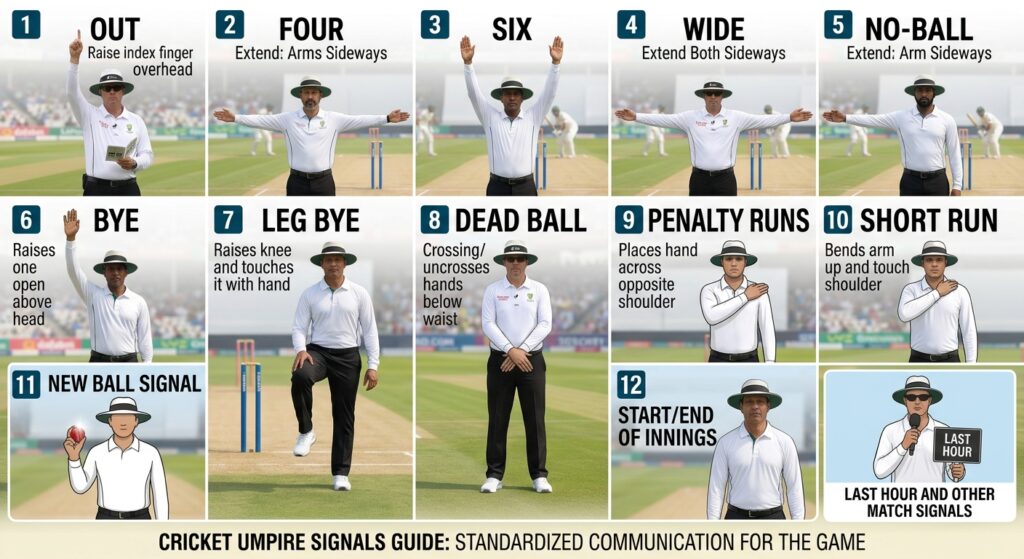
Umpires use a set of standardized hand and arm movements to communicate decisions to players, scorers, broadcasters and spectators. A simple raised finger can mean that a batter is out, while both arms stretched horizontally indicate a six. Other signals are used for wides, no-balls, boundaries, byes, leg byes, penalty runs and the end of an innings.
Knowing these signals makes cricket much easier to follow. You do not have to wait for the commentator to explain every decision because you can understand what the umpire is indicating yourself.
What Are Cricket Umpire Signals?
Cricket umpire signals are standardized gestures used by on-field officials to communicate important decisions during a match.
The signals are particularly useful because cricket matches can be played in large stadiums where spoken communication would not be practical. The scorer sitting away from the playing area needs to know what happened, and the umpire’s signal provides a quick visual confirmation.
Signals can indicate:
- A batter is out
- A boundary four
- A six
- A wide ball
- A no-ball
- Byes
- Leg byes
- Penalty runs
- Dead ball
- Short run
- The start or end of an innings
Some signals are extremely common, while others are seen only occasionally.
Why Are Umpire Signals Important?
The scoring system in cricket involves many different possibilities. A ball can produce runs from the bat, byes, leg byes, wides or no-balls. There can also be boundaries, dismissals and penalty runs.
A clear signal reduces confusion.
For example, if a batter misses a delivery and the ball goes through the wicketkeeper to the boundary, the umpire may signal four wides rather than a normal boundary four. The scorer needs to record the correct type of runs.
This is why umpire signals are not simply gestures for the crowd. They are an essential part of match administration.
Out Signal
One of the most recognizable cricket signals is the out signal.
The umpire raises the index finger of one hand straight above their head.
It is normally given when the umpire has decided that the batter is out.
This signal can follow different types of dismissals, including:
- Caught
- LBW
- Bowled
- Stumped
- Hit wicket
- Run out
- Obstructing the field
- Some other forms of dismissal under the Laws
The exact dismissal may be communicated separately to the scorer or may be obvious from the circumstances.
For spectators, the raised finger is one of the easiest signals to recognize.
Four Signal
When the ball reaches the boundary after making contact with the ground, the umpire signal a four.
The umpire extends both arms horizontally.
The arms are held out to the sides, making the signal easy to see from a distance.
A four normally means that the batting side receives four runs because the ball has reached the boundary without being hit directly over it.
This is one of the most frequently seen signals in limited-overs cricket.
Six Signal
A six has a different signal from a four.
The umpire raises both arms straight above the head.
This indicates that the ball has crossed the boundary without touching the ground after being hit by the batter.
A six is worth six runs.
The signal is particularly easy to spot because both arms are raised vertically.
Wide Signal
The wide signal is another common gesture.
The umpire extends both arms horizontally to the sides.
At first glance, this can look similar to the four signal.
The context makes the difference clear.
For a wide, the ball has been delivered outside the permitted area for the batter and has not made contact with the bat or person in a way that prevents it from being called a wide.
A wide gives the batting side an additional run and the delivery generally has to be bowled again because it does not count as one of the six legal deliveries in the over.
No-Ball Signal
For a no-ball, the umpire extends one arm horizontally to the side.
This signal is different from the wide signal because only one arm is used.
A no-ball can be called for several reasons, with an illegal delivery by the bowler being one of the most familiar examples.
In limited-overs cricket, a no-ball can also have an important strategic effect because it gives the batting team an additional run and may provide an opportunity for a free hit under the relevant playing conditions.
Bye Signal
A bye occurs when the batter does not hit the ball with the bat and the batting side completes runs.
For a bye, the umpire raises one open hand above the head.
The scorer records the runs as byes rather than batter’s runs.
For example, if the wicketkeeper misses a legally delivered ball and the batters run two, those two runs are recorded as byes.
Leg Bye Signal
The leg-bye signal is different from the bye signal.
The umpire raises one knee and touches it with one hand.
A leg bye can occur when the ball strikes the batter’s body or protective equipment rather than the bat, provided the conditions in the Laws are satisfied.
The runs are then credited as leg byes rather than to the batter.
This distinction is important because cricket scorecards separate runs scored from the bat from extras.
Dead Ball Signal
The dead-ball signal is used when the ball has become dead.
The umpire usually crosses and uncrosses both hands below the waist.
A dead ball can occur in several situations.
For example, the ball may become dead after a dismissal, when a particular event has occurred, or when the umpire considers that play has stopped according to the Laws.
The signal tells players and scorers that the delivery or playing situation has ended.
Penalty Runs Signal
Penalty runs are shown by the umpire placing one arm across the opposite shoulder.
Penalty runs are different from normal runs scored by the batting side.
They may be awarded for specific infringements under the Laws or competition regulations.
Because penalty runs can have a significant effect on the score, the scorer needs a clear indication from the umpire.
Short Run Signal
A short run occurs when the batter fails to complete a run properly and turns for another run without grounding the bat or person beyond the popping crease.
The umpire signals a short run by bending one arm upward and touching or indicating the same shoulder.
The signal informs the scorers that the relevant run should not be counted.
Short-run decisions can become important in close matches where one run may change the outcome.
New Ball Signal
When a new ball is taken in a match, the umpire can communicate this to the scorer using the appropriate signal.
This becomes particularly relevant in longer formats of cricket, where teams may be entitled to take a new ball after the required number of overs.
The condition of the cricket ball is important because it can influence swing, seam movement and bowling performance.
Last Hour and Other Match Signals
In longer formats, umpires may also use signals connected with match situations and time.
Test cricket contains several procedures that are less familiar to viewers who mainly watch T20 cricket or one-day matches.
The umpires and scorers need to communicate clearly when particular match conditions are reached.
These signals help everyone understand the current state of play.
How Scorers Use Umpire Signals
The umpire and scorer have an important working relationship.
The scorer records every ball, run, wicket and extra. Although modern professional cricket has electronic systems and video support, the umpire’s signal remains a key confirmation.
Imagine a delivery that goes past the wicketkeeper and reaches the boundary.
The scorer needs to know whether it should be recorded as:
- Four runs
- Four byes
- Four wides
- Another type of scoring event
The umpire’s signal provides the official indication.
In professional cricket, communication between officials is therefore extremely important.
Umpire Signals and Television
Television has made umpire signals even more familiar.
Broadcasters frequently show close-up footage of an umpire after a major event. Viewers can immediately understand whether a batter has been given out, a boundary has been awarded or a delivery has been called a no-ball.
Technology has also introduced systems such as the Decision Review System in many competitions. Even when a decision is reviewed, the on-field umpire’s original signal remains part of the sequence.
Third umpires can review certain decisions depending on the playing conditions.
Umpire Signals in T20 Cricket
T20 cricket moves quickly, so clear umpire signals are particularly valuable.
A T20 match can contain a large number of boundaries, wides, no-balls and wickets in a short period.
The scorer needs to keep up with every delivery.
A clear signal immediately communicates the outcome and helps prevent scoring errors.
Fans watching from the stands also benefit because they can understand what happened even when the ball disappears from view.
Common Cricket Umpire Signals at a Glance
| Decision | Umpire Signal | Meaning |
|---|---|---|
| Out | One index finger raised | Batter dismissed |
| Four | Both arms extended sideways | Boundary four |
| Six | Both arms raised above head | Boundary six |
| Wide | Both arms extended sideways | Wide delivery |
| No-ball | One arm extended sideways | No-ball |
| Bye | One hand raised above head | Runs not off bat |
| Leg bye | Knee raised/touched | Runs awarded as leg byes |
| Dead ball | Hands crossed/uncrossed below waist | Ball is dead |
| Penalty runs | Hand placed across opposite shoulder | Penalty runs |
| Short run | Hand touches same shoulder | Run not completed correctly |
The table is useful for beginners, but spectators should remember that the exact application of a signal depends on the Laws of Cricket and the playing conditions.
Tips for Learning Cricket Umpire Signals
If you are new to cricket, you do not need to memorize every signal immediately.
Start with the most common five:
- Out – one finger raised
- Four – both arms sideways
- Six – both arms above the head
- Wide – both arms sideways
- No-ball – one arm sideways
Once these become familiar, learn byes, leg byes, dead ball, penalty runs and short runs.
Watching live matches is one of the easiest ways to learn because you can connect the signal with the event that caused it.
Final Thoughts
Cricket umpire signals may look like simple hand movements, but they are an important part of the game’s communication system. They allow umpires to communicate decisions quickly to players, scorers, broadcasters and spectators.
From the raised finger of an out decision to the two arms above the head for a six, each gesture has a specific purpose. Learning these signals can make watching cricket much more enjoyable, particularly for beginners who are still becoming familiar with the Laws of the game.
The next time you watch a cricket match, pay attention to the umpire after every important delivery. Once you know the signals, you can often understand the decision before the commentator explains it.
