


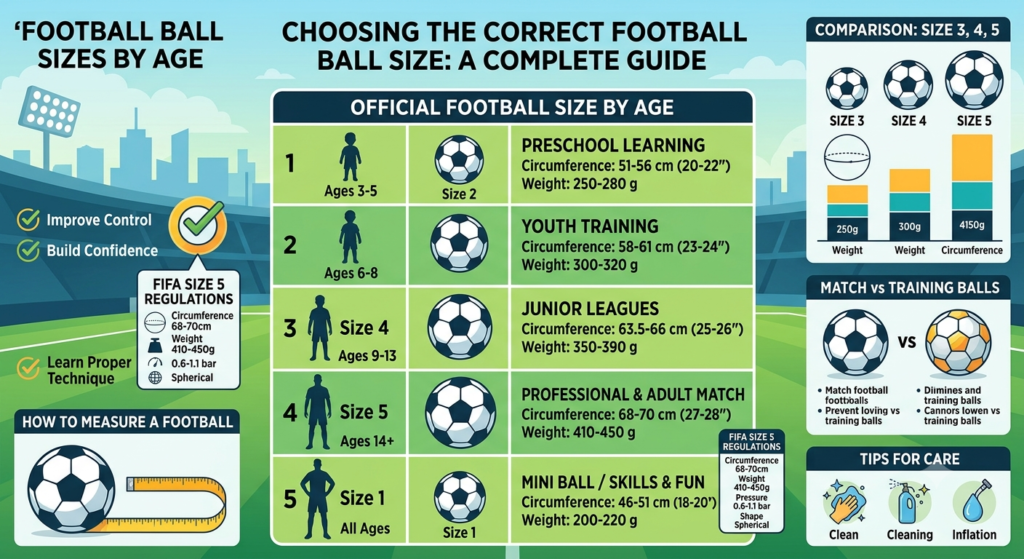
Whether you’re buying a football for a young child, coaching a youth team, or replacing your match ball, choosing the correct football size is more important than many people realize. A ball that’s too large can make it difficult for younger players to control, pass, or shoot accurately. On the other hand, a ball that’s too small won’t prepare older players for competitive matches.
Football organizations around the world, including FIFA and national football associations, recommend different ball sizes based on a player’s age. These recommendations help children develop proper technique, improve confidence, and reduce the risk of injuries.
In this guide, you’ll learn everything you need to know about football ball sizes by age, including official measurements, weight, circumference, and tips for selecting the right ball.
Why Football Ball Size Matters
Using the correct football size isn’t just about following the rules. It directly affects how players develop their skills.
A properly sized football helps players:
- Improve ball control
- Develop accurate passing
- Learn better shooting techniques
- Build confidence during matches
- Reduce strain on growing muscles and joints
Young players often struggle with oversized footballs because they require more strength to kick and control. That’s why youth football leagues use smaller balls for younger age groups.
Official Football Ball Sizes
Footballs are available in five standard sizes, although Sizes 3, 4, and 5 are the most commonly used in organized football.
| Ball Size | Circumference | Weight | Typical Age Group |
|---|---|---|---|
| Size 1 | 18–20 inches (46–51 cm) | 200–220 g | All ages (skills & fun) |
| Size 2 | 20–22 inches (51–56 cm) | 250–280 g | Ages 3–5 |
| Size 3 | 23–24 inches (58–61 cm) | 300–320 g | Ages 6–8 |
| Size 4 | 25–26 inches (63.5–66 cm) | 350–390 g | Ages 9–13 |
| Size 5 | 27–28 inches (68–70 cm) | 410–450 g | Ages 14+ and Adults |
This chart serves as the standard guide used by most football clubs and youth academies.
Football Ball Size by Age Chart
The table below provides a quick reference for selecting the correct football based on age.
| Age | Recommended Ball Size | Common Use |
|---|---|---|
| 3–5 Years | Size 2 | Early learning and fun |
| 6–8 Years | Size 3 | Youth training |
| 9–13 Years | Size 4 | Junior leagues |
| 14 Years and Older | Size 5 | Competitive football |
| Adults | Size 5 | Professional and amateur matches |
If you’re unsure which ball to buy, this chart is the easiest place to start.
Size 1 Football
A Size 1 football is often called a mini football.
Unlike other football sizes, it isn’t designed for official matches. Instead, it’s mainly used for:
- Ball mastery drills
- Footwork practice
- Indoor training
- Collectibles and souvenirs
- Promotional footballs
Because of its small size, players must make quick touches, making it excellent for improving close control.
Size 1 Specifications
| Feature | Measurement |
|---|---|
| Circumference | 18–20 inches |
| Weight | Around 200 grams |
| Best For | Skill development |
Many professional players use mini footballs during training to improve their first touch.
Size 2 Football
A Size 2 football is slightly larger than a mini ball and is ideal for preschool children.
Young players between three and five years old often find this size easier to kick than a full-sized football.
Benefits include:
- Lightweight design
- Easier ball control
- Builds confidence
- Encourages coordination
Although Size 2 footballs are rarely used in competitive matches, they’re popular in football schools and beginner coaching sessions.
Size 3 Football
The Size 3 football is considered the first “real” football for children.
It is officially recommended for players aged 6 to 8 years.
Most beginner leagues use this size because it allows children to learn passing, dribbling, and shooting without struggling with the ball’s weight.
Size 3 Specifications
| Feature | Value |
|---|---|
| Circumference | 23–24 inches |
| Weight | 300–320 grams |
| Age | 6–8 years |
At this stage, players are learning fundamental football skills, making the correct ball size especially important.
Size 4 Football
The Size 4 football bridges the gap between youth football and the adult game.
Players aged 9 to 13 years generally use this ball.
Compared to a Size 3 football, it is:
- Slightly larger
- Slightly heavier
- Better suited for stronger players
Many school competitions and youth leagues use Size 4 footballs before players transition to the official match ball.
Size 4 Specifications
| Feature | Value |
|---|---|
| Circumference | 25–26 inches |
| Weight | 350–390 grams |
| Recommended Age | 9–13 years |
Using a Size 4 football prepares players for the full-size ball they’ll use later in their football journey.
Size 5 Football
The Size 5 football is the official match ball used in professional football worldwide.
Players aged 14 years and older use this size in training and competitive matches.
Every major competition—including the FIFA World Cup, UEFA Champions League, Premier League, La Liga, and international tournaments—uses a Size 5 football.
Official Specifications
| Feature | Value |
|---|---|
| Circumference | 68–70 cm |
| Weight | 410–450 grams |
| Air Pressure | 0.6–1.1 bar |
| Age | 14+ |
Professional footballers spend years training with this size, making it the global standard for adult football.
Ball Size Comparison
| Feature | Size 3 | Size 4 | Size 5 |
|---|---|---|---|
| Age | 6–8 | 9–13 | 14+ |
| Weight | 300–320 g | 350–390 g | 410–450 g |
| Circumference | 58–61 cm | 63.5–66 cm | 68–70 cm |
| Official Matches | Youth | Junior | Adult |
As players grow older and stronger, they gradually move to larger footballs that match their physical development
FIFA Football Ball Regulations
Footballs used in official matches must meet strict standards set by FIFA and the International Football Association Board (IFAB). These rules ensure that every match ball performs consistently, regardless of the competition or manufacturer.
A regulation Size 5 football must meet the following requirements:
| Specification | Official Requirement |
|---|---|
| Circumference | 68–70 cm (27–28 inches) |
| Weight | 410–450 grams |
| Shape | Spherical |
| Material | Suitable leather or approved synthetic material |
| Air Pressure | 0.6–1.1 bar (8.7–16 psi) |
These standards are used in international tournaments, professional leagues, and most adult competitions around the world.
Match Balls vs Training Balls
Not every football is made for competitive matches. Manufacturers produce different types of balls depending on how they will be used.
| Type | Best For | Features |
|---|---|---|
| Match Ball | Official matches | Premium materials, highest accuracy |
| Training Ball | Daily practice | Durable outer cover, longer lifespan |
| Club Ball | Recreational play | Good balance between price and quality |
| Mini Ball | Skill training | Improves close control and footwork |
Match balls are built for maximum performance, while training balls are designed to withstand repeated use on different playing surfaces.
Indoor vs Outdoor Football Sizes
The size of the football generally stays the same for players of the same age, but indoor footballs are designed differently.
Outdoor Football
- Standard bounce
- Waterproof outer layer
- Designed for grass and artificial turf
- Used in 11-a-side football
Indoor Football (Futsal)
- Lower bounce
- Slightly heavier feel
- Better control on hard courts
- Designed for smaller pitches
| Feature | Outdoor Football | Futsal Ball |
|---|---|---|
| Bounce | Higher | Lower |
| Surface | Grass/Turf | Indoor Courts |
| Weight | Standard | Slightly heavier |
| Control | Normal | Easier on hard surfaces |
Although futsal often uses a Size 4 ball, it is specially designed with reduced bounce to suit the faster indoor game.
How to Measure a Football
If you’re unsure about the size of your football, measuring it is simple.
Step 1
Wrap a flexible measuring tape around the widest part of the ball.
Step 2
Record the circumference in centimeters or inches.
Step 3
Compare the measurement with the official size chart.
| Ball Size | Circumference |
|---|---|
| Size 3 | 58–61 cm |
| Size 4 | 63.5–66 cm |
| Size 5 | 68–70 cm |
This quick check can help you confirm whether a ball meets official standards.
How to Choose the Right Football
Before buying a football, consider the following factors.
1. Player’s Age
Always begin with the recommended age guide.
| Age | Ball Size |
|---|---|
| 3–5 | Size 2 |
| 6–8 | Size 3 |
| 9–13 | Size 4 |
| 14+ | Size 5 |
2. Playing Surface
Different surfaces can affect the lifespan of a football.
- Grass fields – Match balls
- Artificial turf – Durable training balls
- Concrete – Street footballs
- Indoor courts – Futsal balls
3. Frequency of Use
If the ball will be used every day, choose one with:
- Machine-stitched or hand-stitched panels
- Durable synthetic cover
- Strong bladder for better air retention
4. Budget
Expensive footballs usually offer:
- Better touch
- Improved flight
- Higher durability
However, recreational players often find mid-range training balls to be excellent value.
Common Mistakes When Buying a Football
Many parents and new players accidentally purchase the wrong football.
Here are the most common mistakes.
Buying a Size 5 Too Early
A full-size football may seem like a good long-term investment, but it can slow skill development for younger children.
Ignoring Weight
Two footballs may look identical but weigh differently.
Heavier footballs require greater kicking power and control.
Choosing Style Over Quality
Bright colors and attractive designs are appealing, but the ball’s construction is far more important.
Look for:
- Strong stitching
- Durable cover
- Good air retention
- Quality bladder
Forgetting the Playing Surface
A premium match ball can wear out quickly if used regularly on rough concrete.
Always choose a ball designed for the surface where it will be used most often.
Tips for Keeping a Football in Good Condition
A quality football can last several seasons with proper care.
Here are a few simple maintenance tips:
- Inflate it to the recommended pressure.
- Store it indoors when not in use.
- Avoid leaving it in direct sunlight for long periods.
- Clean off mud and dirt after matches.
- Check for damage before each training session.
Proper care helps maintain the ball’s shape, bounce, and overall performance.
Conclusion
Choosing the correct football ball size by age is one of the easiest ways to help players improve their skills and enjoy the game. Younger children benefit from smaller, lighter footballs that are easier to control, while older players gradually transition to larger balls as they grow stronger and more experienced. Following the recommended size chart—Size 2 for ages 3–5, Size 3 for ages 6–8, Size 4 for ages 9–13, and Size 5 for ages 14 and above ensures that training and matches are both safe and enjoyable. Whether you’re a parent buying a first football, a coach organizing youth training, or a player preparing for competition, selecting the right ball size is an important step toward better performance on the pitch.
