


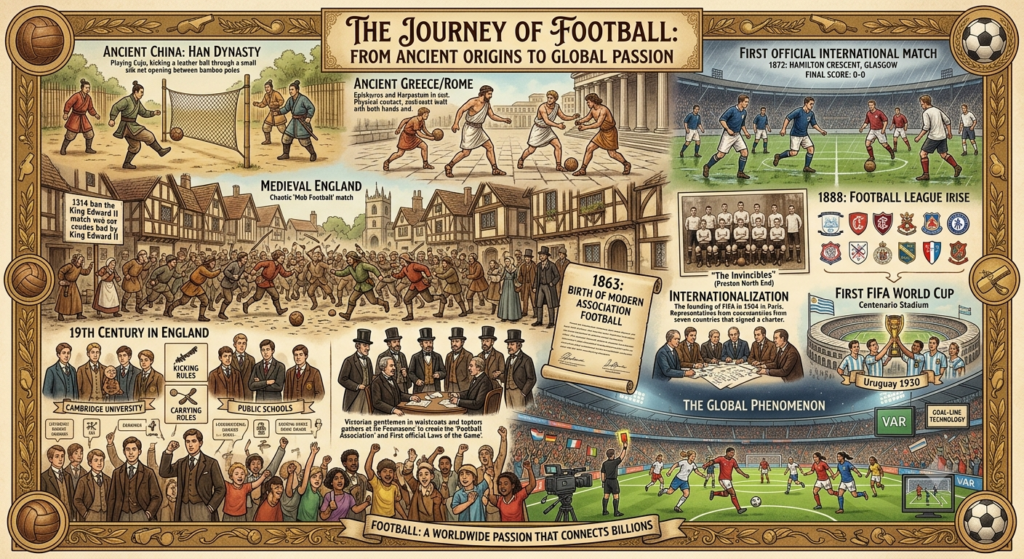
Football is more than just a game—it is a worldwide passion that connects billions of people regardless of language, culture, or nationality. Every weekend, stadiums fill with excited fans, while millions more watch matches from their homes. From neighborhood streets to the FIFA World Cup Final, football has become the world’s most popular sport.
But football wasn’t always played in massive stadiums with professional referees, advanced technology, and international tournaments. The sport has evolved over thousands of years, shaped by different civilizations, changing rules, and growing popularity.
In this guide, we’ll explore the complete history of football, how it developed into the modern game, and why it remains the most loved sport on Earth.
Quick Timeline of Football History
| Year/Period | Major Event | Importance |
|---|---|---|
| Around 200 BC | Cuju played in China | One of the earliest football-like games |
| Ancient Greece | Episkyros played | Team-based ball game |
| Ancient Rome | Harpastum introduced | Influenced later European games |
| Middle Ages | Folk football in England | Large village matches became popular |
| 1848 | Cambridge Rules created | First attempt at standardized rules |
| 1863 | Football Association founded | Birth of modern association football |
| 1872 | First official international match | England vs Scotland |
| 1904 | FIFA established | International governing body formed |
| 1930 | First FIFA World Cup | Uruguay hosted and won |
| Today | Over 200 FIFA member nations | Football becomes a global phenomenon |
Ancient Origins of Football
Many people believe football began in England, but games involving kicking a ball existed thousands of years earlier.
Historians have discovered evidence that several ancient civilizations enjoyed similar sports long before the modern rules were created.
Cuju – Ancient China
One of the earliest recorded football-like games was Cuju, played during China’s Han Dynasty over 2,000 years ago.
Players attempted to kick a leather ball through a small opening without using their hands. The game was originally used to improve soldiers’ fitness before becoming popular among ordinary citizens.
Features of Cuju
| Feature | Description |
|---|---|
| Country | China |
| Period | Around 200 BC |
| Ball | Leather filled with feathers or hair |
| Objective | Kick the ball through a net opening |
| Hands Allowed | No |
Although Cuju differed from today’s football, many historians consider it the earliest ancestor of the modern game.
Football-Like Games in Ancient Greece
The Greeks played a sport called Episkyros, which involved two teams competing to move a ball across a boundary.
Unlike modern football, players could use both their hands and feet. The game was physical and often required teamwork and strategy.
While Episkyros wasn’t football in the modern sense, it demonstrated how ball games had become an important part of ancient culture.
Harpastum in Ancient Rome
The Romans later adapted Greek games into a version known as Harpastum.
Roman soldiers played Harpastum throughout the empire, introducing ball games to different regions of Europe.
The sport emphasized:
- Strength
- Speed
- Teamwork
- Tactical movement
These early games helped spread the idea of competitive team sports across Europe.
Medieval Football in England
Football took a dramatic turn during the Middle Ages.
Instead of organized matches with referees and fixed rules, entire villages competed against each other.
These games were often called mob football or folk football.
Imagine hundreds of players chasing one ball through fields, rivers, and narrow streets.
There were almost no rules.
The objective was simply to move the ball to a designated location, sometimes miles away.
Characteristics of Medieval Football
| Feature | Description |
|---|---|
| Players | Sometimes hundreds |
| Field Size | Entire villages |
| Rules | Very few |
| Match Duration | Several hours |
| Referees | None |
Because these matches often became violent, English kings occasionally banned football.
King Edward II issued one of the earliest bans in 1314 because the games caused public disorder in London.
Despite repeated bans, people continued playing because football had already become deeply rooted in local traditions.
The Need for Standard Rules
By the early 1800s, football had become popular in English schools.
However, every school followed its own rules.
Some allowed carrying the ball with hands.
Others allowed heavy physical contact.
Some even permitted tripping opponents.
This created confusion whenever teams from different schools met.
For example:
| School | Unique Rule |
|---|---|
| Rugby School | Carrying the ball allowed |
| Eton College | Focused mainly on kicking |
| Harrow School | Different offside rules |
| Winchester College | Local variations |
Without common rules, organized competitions were almost impossible.
People soon realized football needed a single rulebook.
The Cambridge Rules (1848)
One of the first serious attempts to standardize football came in 1848.
Students from several English schools met at Cambridge University to create a shared set of rules.
The Cambridge Rules introduced ideas that are familiar today:
- Passing the ball
- Kicking instead of carrying
- Goal kicks
- Throw-ins
- Offside principles
Although not officially adopted everywhere, these rules strongly influenced modern football.
They laid the foundation for the game we recognize today.
The Birth of Modern Football (1863)
The most important year in football history is 1863.
Representatives from clubs across England gathered in London to establish common laws for the sport.
This meeting resulted in the creation of the Football Association (FA).
The FA introduced the first official Laws of the Game.
Several major decisions changed football forever:
| Rule Introduced | Impact |
|---|---|
| No carrying the ball | Separated football from rugby |
| Standard field rules | Consistent matches |
| Official fouls | Fair competition |
| Defined goals | Uniform scoring system |
| Referee authority | Better control of matches |
This moment officially separated association football from rugby football.
The word “soccer” later developed from the term Association Football, while most of the world continued calling it simply football.
Why 1863 Changed Everything
The creation of standardized rules allowed clubs to compete fairly.
It also encouraged:
- Organized leagues
- National competitions
- International matches
- Professional clubs
- Referee systems
- Player registrations
Without the FA’s work in 1863, football might never have become the structured global sport it is today.
The First Official International Football Match
Once the rules became standardized, clubs and national teams could finally compete on equal terms.
On 30 November 1872, football witnessed its first official international match between England and Scotland.
The match took place at Hamilton Crescent in Glasgow.
Although the game ended 0–0, it marked the beginning of international football.
Match Overview
| Detail | Information |
|---|---|
| Date | 30 November 1872 |
| Teams | England vs Scotland |
| Venue | Hamilton Crescent, Glasgow |
| Attendance | Around 4,000 spectators |
| Result | 0–0 |
Even though no goals were scored, the match proved that football could unite different nations under one set of rules.
The Rise of Professional Football
During the late 1800s, football became increasingly popular among workers, students, and local communities.
Clubs attracted large crowds, and talented players devoted more time to training. Many believed players deserved financial compensation for the time they spent representing clubs.
In 1885, professionalism was officially recognized in England. This decision transformed football from a recreational activity into a career.
Professional football led to:
- Better coaching
- Improved fitness
- Organized competitions
- Higher-quality matches
- Larger fan attendance
Soon, clubs began signing players from different regions, making competitions even more exciting.
Formation of the Football League
As more clubs emerged, regular competitions became necessary.
In 1888, England introduced the world’s first national football league.
Twelve clubs participated in the inaugural season.
Original Football League Facts
| Feature | Details |
|---|---|
| Founded | 1888 |
| Country | England |
| Number of Clubs | 12 |
| Competition Type | League |
| Champion | Preston North End |
Preston North End became famous for completing the season without losing a single match, earning the nickname “The Invincibles.”
The success of the Football League inspired many other countries to create their own domestic leagues.
The Birth of FIFA
As football spread across Europe and beyond, there was a growing need for an international organization to oversee the game.
In 1904, representatives from seven countries met in Paris and established the Fédération Internationale de Football Association (FIFA).
The founding members included:
- France
- Belgium
- Denmark
- Netherlands
- Spain
- Sweden
- Switzerland
FIFA’s responsibilities included:
- Organizing international competitions
- Standardizing rules worldwide
- Managing international transfers
- Promoting football globally
Today, FIFA has more than 200 member associations, making it one of the largest sports organizations in the world.
The First FIFA World Cup
One of FIFA’s greatest achievements was creating the FIFA World Cup.
The first tournament took place in 1930 in Uruguay.
Only 13 national teams participated, but the event laid the foundation for what would become the world’s biggest sporting competition.
1930 FIFA World Cup Summary
| Category | Information |
|---|---|
| Host Nation | Uruguay |
| Teams | 13 |
| Champion | Uruguay |
| Runner-up | Argentina |
| Final Score | Uruguay 4–2 Argentina |
Since then, the World Cup has grown into a tournament watched by billions of fans across the globe every four years.
Football After World War II
Following World War II, football experienced rapid growth.
Several factors contributed to its expansion:
- Television broadcasts
- Improved stadiums
- Better transportation
- International club tournaments
- Youth academies
European competitions such as continental club championships helped clubs gain worldwide recognition.
Legendary players also inspired millions of children to play the game.
Football Becomes a Global Sport
Although football began developing under organized rules in England, its popularity soon spread to every continent.
Today, countries across Europe, South America, Africa, Asia, and North America have thriving domestic leagues and passionate supporters.
Football Around the World
| Continent | Famous Competitions |
|---|---|
| Europe | Premier League, La Liga, Serie A, Bundesliga |
| South America | Copa Libertadores |
| Asia | AFC Champions League |
| Africa | CAF Champions League |
| North America | MLS, CONCACAF Champions Cup |
Football is now played professionally in hundreds of countries and enjoyed by people of all ages.
How Football Rules Have Changed Over Time
The game has continued to evolve.
Several important rule changes have made football faster, safer, and fairer.
| Rule Change | Approximate Period | Purpose |
|---|---|---|
| Yellow and Red Cards | 1970 | Improve discipline |
| Back-pass Rule | 1992 | Prevent time wasting |
| Goal-Line Technology | 2012 | Confirm goals accurately |
| Video Assistant Referee (VAR) | 2018 | Review key match decisions |
| Five Substitutions | 2020s | Reduce player fatigue |
These changes help maintain fairness while keeping football entertaining for fans.
The Growth of Women’s Football
Women’s football has existed for more than a century, but it has experienced remarkable growth in recent decades.
Professional leagues, international tournaments, and increased media coverage have helped the women’s game reach new audiences.
Today, the FIFA Women’s World Cup attracts millions of viewers worldwide, and many countries invest heavily in developing female players.
This growth reflects football’s ability to include and inspire people from all backgrounds.
Why Football Is So Popular
Football’s universal appeal comes from its simplicity and excitement.
Anyone with a ball and an open space can play.
Other reasons for its popularity include:
- Easy-to-understand rules
- Low equipment requirements
- Global competitions
- Strong club rivalries
- Passionate fan culture
- Opportunities for players at every level
Whether it’s a local park game or a World Cup final, football creates unforgettable moments.
Football by the Numbers
| Statistic | Approximate Figure |
|---|---|
| FIFA Member Associations | 200+ |
| Official Match Duration | 90 Minutes |
| Players per Team | 11 |
| FIFA World Cup Frequency | Every 4 Years |
| Countries Where Football Is Played | Nearly Every Nation |
| Estimated Global Fans | Billions |
These figures highlight football’s unmatched reach and influence.
Conclusion
The history of football is a story of continuous evolution. What began as simple ball games in ancient civilizations gradually developed into an organized sport through standardized rules in England. From the first international match to the creation of FIFA and the launch of the World Cup, each milestone helped shape the game we know today.
Modern football is played on every continent and enjoyed by billions of fans. Professional leagues, international tournaments, technological advancements, and the growth of women’s football have all contributed to its success.
Despite these changes, the essence of football remains the same: teamwork, skill, competition, and the joy of the game. Its rich history explains why football continues to unite people across cultures and generations, making it the world’s most popular sport.
Key Milestones in Football History
| Year | Event | Significance |
|---|---|---|
| Around 200 BC | Cuju played in China | Earliest known football-like game |
| 1314 | Football temporarily banned in England | Authorities tried to stop violent matches |
| 1848 | Cambridge Rules introduced | First major attempt to standardize rules |
| 1863 | Football Association founded | Birth of modern football |
| 1871 | FA Cup established | Oldest football competition |
| 1872 | First international match | England vs Scotland |
| 1885 | Professional football legalized | Players could be paid |
| 1888 | Football League created | First organized league competition |
| 1904 | FIFA founded | International governing body formed |
| 1930 | First FIFA World Cup | Beginning of the world’s biggest football tournament |
| 1970 | Yellow and red cards introduced | Improved discipline |
| 2018 | VAR used in FIFA World Cup | Technology entered top-level football |
Final Thoughts
Football’s journey from ancient recreational games to a globally celebrated sport is a remarkable story of growth, innovation, and cultural influence. Over centuries, it has evolved through changing rules, international competitions, and technological advancements while preserving the excitement that attracts players and fans alike.
Today, football is more than a sport—it is a shared language that brings together people from different countries, cultures, and backgrounds. Whether played on a local field or under the bright lights of a World Cup final, the game continues to inspire millions with its passion, teamwork, and unforgettable moments.
