


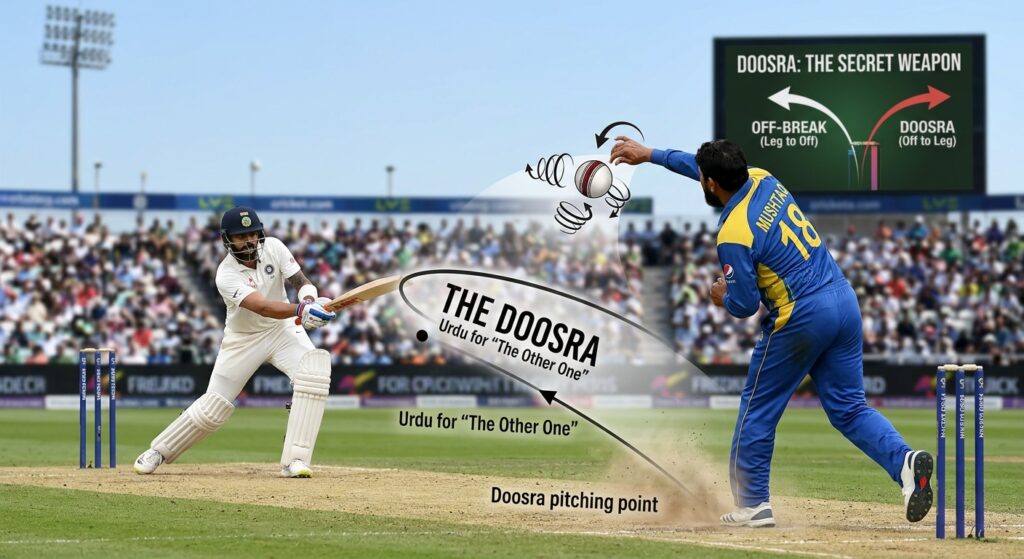
Cricket is a game full of skill, strategy, and deception. While fast bowlers use pace, swing, seam movement, and bounce to challenge batters, spin bowlers rely on turn, flight, drift, and variations. One of the most fascinating and controversial variations in spin bowling is the doosra.
A doosra is designed to surprise the batter. It looks similar to a conventional off-spin delivery but behaves differently after pitching. The batter may expect the ball to turn in one direction, only to discover that it moves the other way.
This element of surprise makes the doosra an extremely valuable weapon. When bowled well, it can confuse experienced batters, break partnerships, and change the momentum of a match.
But what exactly is a doosra in cricket? How does it differ from a normal off-spin delivery? Who invented it, and why has it generated debate in international cricket?
This complete guide explains the meaning, technique, history, famous bowlers, and importance of the doosra.
What Is a Doosra in Cricket?
A doosra is a variation bowled by an off-spin bowler that turns in the opposite direction to a traditional off-break.
The word doosra comes from Urdu and Hindi, where it means “the second one” or “the other one.” The name perfectly describes the delivery because it is an alternative to the bowler’s standard ball.
For a right-arm off-spin bowler bowling to a right-handed batter:
- A normal off-break generally turns from the off side towards the leg side.
- A doosra turns in the opposite direction, from the leg side towards the off side.
This unexpected movement is what makes the delivery difficult to play.
The bowler tries to use a similar action to the normal off-break so the batter cannot easily identify the variation before the ball is released.
Understanding the Direction of Turn
The easiest way to understand the doosra is by comparing it with a regular off-spin delivery.
Imagine a right-arm off-spinner bowling to a right-handed batter.
A traditional off-break turns into the batter after pitching. The doosra, however, moves away from the batter.
| Delivery | Bowler | Batter | Usual Direction of Turn |
|---|---|---|---|
| Off-break | Right-arm off-spinner | Right-handed batter | Off side to leg side |
| Doosra | Right-arm off-spinner | Right-handed batter | Leg side to off side |
This opposite movement creates uncertainty.
A batter who expects the ball to turn into the pads may play a defensive shot accordingly. If the ball instead moves away, the outside edge can become exposed.
That is the main purpose of the doosra: to make the batter expect one thing and receive another.
Why Is It Called a Doosra?
The word doosra has its roots in South Asian languages, particularly Urdu and Hindi.
It translates roughly as:
- The second one
- The other one
- Another variation
The term became popular because the delivery served as an alternative weapon for off-spin bowlers.
Rather than relying only on the traditional off-break, a bowler could introduce “the other one” and surprise the batter.
The name has now become part of international cricket vocabulary. Commentators around the world use the word doosra when discussing spin bowling variations.
Who Invented the Doosra?
The development of the doosra is commonly associated with Pakistani cricket.
Saqlain Mushtaq is widely credited with popularizing the doosra at the international level. His ability to bowl conventional off-spin and then suddenly produce a delivery moving in the opposite direction made him a difficult bowler to face.
Saqlain’s success inspired other off-spin bowlers to develop similar variations.
Over time, the doosra became an important weapon in modern cricket, particularly in limited-overs formats where bowlers need different ways to surprise aggressive batters.
The delivery also contributed to the evolution of “mystery spin,” where bowlers use multiple variations while attempting to hide clues from the batter.
How Is a Doosra Bowled?
The doosra is difficult to master because the bowler must create opposite spin while trying to maintain a similar bowling action.
The basic challenge is simple to understand but difficult to perform.
A conventional off-spinner normally uses finger spin to produce an off-break. For the doosra, the bowler manipulates the wrist and fingers differently at release, creating rotation that makes the ball move in the opposite direction.
The bowler must focus on several things:
- Maintaining a consistent run-up.
- Keeping the arm action similar.
- Controlling the wrist position.
- Applying the correct finger pressure.
- Hiding the variation from the batter.
The final point is particularly important.
If the bowler changes their action noticeably, an experienced batter may detect the doosra before release.
A successful doosra should look similar to a normal off-break until the last possible moment.
Why Is the Doosra So Difficult for Batters?
The doosra is effective because cricket batters often make decisions based on expectations.
When facing an off-spinner, a right-handed batter may naturally expect the ball to turn towards them. Their footwork, bat angle, and shot selection may be influenced by that expectation.
The doosra challenges this assumption.
Instead of turning in, the ball moves away.
This can create several dismissal opportunities:
- Outside edge to the wicketkeeper.
- Catch at slip.
- Bowled.
- Mistimed attacking shot.
- Stumping after incorrect footwork.
The effectiveness of the doosra increases when it is used sparingly.
If a bowler delivers the variation too frequently, the batter may begin to expect it. But when used as a surprise weapon, it can be extremely dangerous.
Doosra vs Off-Break: What Is the Difference?
Although both deliveries are bowled by an off-spinner, they behave differently.
| Feature | Off-Break | Doosra |
|---|---|---|
| Type | Standard delivery | Variation |
| Direction of turn | Traditional off-spin direction | Opposite direction |
| Expected by batter | Usually yes | Often difficult to predict |
| Main purpose | Control and pressure | Deception |
| Difficulty to bowl | Moderate to difficult | Extremely difficult |
The traditional off-break remains the foundation of off-spin bowling. A doosra is most effective when the batter is already focused on the standard delivery.
This combination creates a tactical advantage.
Famous Bowlers Associated With the Doosra
Several international bowlers became known for using the doosra.
Saqlain Mushtaq
Saqlain Mushtaq played a major role in bringing the doosra into modern international cricket. His success demonstrated how valuable an opposite-turning delivery could be for an off-spinner.
His ability to mix conventional off-breaks with deceptive variations made him a major wicket-taking threat.
Muttiah Muralitharan
Muttiah Muralitharan was one of cricket’s greatest spin bowlers. His unusual action, extraordinary wrist movement, and wide range of variations made him exceptionally difficult for batters to read.
Harbhajan Singh
Harbhajan Singh was another prominent spinner associated with variations in off-spin bowling. His success against some of the world’s best batting line-ups demonstrated the importance of variation and tactical bowling.
Ajantha Mendis
Ajantha Mendis became famous for his mystery spin and ability to bowl multiple variations. His success showed how unpredictable spin bowling could disrupt even highly skilled batters.
These bowlers helped make spin variations an increasingly important part of modern cricket.
The Doosra and Bowling Action Controversy
The doosra has also been the subject of significant debate.
One of the major challenges involves bowling regulations and the amount a bowler can straighten their arm during delivery.
Cricket has rules governing illegal bowling actions. Bowlers are required to remain within permitted limits regarding elbow extension.
Because bowling a doosra can require unusual wrist, forearm, and arm movements, questions have sometimes been raised about whether certain bowlers can deliver the ball legally.
As a result, some bowlers have undergone testing and biomechanical analysis.
This controversy does not mean that every doosra is illegal. However, it highlights how technically demanding the delivery can be.
The ability to produce opposite spin while maintaining a legal action is one reason the doosra is difficult to master.
How Do Batters Read a Doosra?
Experienced batters try to identify clues before the ball reaches them.
They may observe:
- The bowler’s wrist.
- Finger position.
- Arm speed.
- Seam rotation.
- Release point.
- Changes in flight.
However, a skilled bowler tries to hide these signals.
The best way for a batter to respond is often to avoid guessing too early.
Instead, experienced players focus on:
Watching the Ball Closely
Following the ball from the bowler’s hand can provide valuable information.
Playing Late
Late decision-making allows more time to observe the direction of movement.
Maintaining Balanced Footwork
Overcommitting forward or backward can make a batter vulnerable.
Respecting the Variation
A batter who assumes every ball will turn in the same direction can easily be deceived.
The mental battle between spinner and batter is one of the most fascinating parts of cricket.
Doosra vs Googly
The doosra and googly are often compared because both are deceptive deliveries that turn opposite to a bowler’s standard ball.
However, they are associated with different types of spin bowling.
| Feature | Doosra | Googly |
|---|---|---|
| Usually bowled by | Off-spinner | Leg-spinner |
| Purpose | Turns opposite to off-break | Turns opposite to leg break |
| Main strength | Surprise and disguise | Wrist-spin deception |
| Difficulty | Very high | Very high |
In simple terms:
- The doosra is the surprise variation of an off-spinner.
- The googly is the surprise variation of a leg-spinner.
Both deliveries rely heavily on deception.
Why Is the Doosra Useful in Limited-Overs Cricket?
Modern limited-overs cricket is dominated by aggressive batting.
Batters often analyze bowlers and prepare specific scoring shots. If a spinner bowls the same type of delivery repeatedly, the batter can become comfortable.
The doosra adds uncertainty.
Imagine a batter facing an off-spinner during a T20 match.
The bowler has delivered four consecutive off-breaks. The batter has successfully adjusted to the movement.
On the fifth ball, the bowler delivers a doosra.
Instead of turning into the batter, the ball moves away.
The batter may misread the line and attempt a shot based on the expected turn.
This unpredictability is valuable during:
- Powerplays.
- Middle overs.
- Partnership-breaking situations.
- Final overs.
A spinner with more variations can be harder to attack.
How Can Bowlers Practice the Doosra?
The doosra should not be treated as an easy variation for beginners.
Young bowlers should first master the basics of off-spin:
- Consistent line.
- Consistent length.
- Conventional off-break.
- Flight.
- Drift.
- Control.
Only after developing a strong foundation should a bowler begin exploring advanced variations.
Practice should focus on accuracy as well as spin.
For example, a bowler can measure progress over several sessions:
| Practice Session | Deliveries Attempted | Accurate Doosras | Accuracy |
|---|---|---|---|
| Session 1 | 20 | 6 | 30% |
| Session 2 | 20 | 10 | 50% |
| Session 3 | 20 | 14 | 70% |
The basic calculation is:
Accuracy Percentage = Accurate Deliveries ÷ Total Deliveries × 100
For example:
14 ÷ 20 × 100 = 70%
However, accuracy alone is not enough. The bowler must also maintain a legal and repeatable bowling action. Coaching and proper technical guidance are important when developing complex spin variations.
Is the Doosra Still Important in Modern Cricket?
Yes, although cricket continues to evolve.
Modern players use advanced video analysis, data, and match preparation. Batters study bowling actions closely and try to identify variations.
This makes deception even more valuable.
The doosra is part of a broader evolution in spin bowling. Modern spinners often combine several variations, including changes in pace, flight, arm angle, and direction of spin.
A bowler does not necessarily need to bowl a doosra frequently. Sometimes simply having the variation creates doubt in the batter’s mind.
If the batter knows that every delivery could behave differently, they may become less confident about attacking.
That hesitation can be just as valuable as the delivery itself.
The Psychology Behind the Doosra
Spin bowling is not only a physical skill. It is also a psychological contest.
A bowler tries to establish patterns.
For example:
Ball 1: Off-break
Ball 2: Off-break
Ball 3: Off-break
Ball 4: Slightly slower off-break
Ball 5: Doosra
The first few deliveries create an expectation.
The final delivery breaks that expectation.
This strategy can force the batter into making decisions based on previous balls rather than the actual delivery.
The best spin bowlers understand that taking wickets is often about creating uncertainty.
The doosra is a perfect example of this principle.
Final Thoughts
So, what is a doosra in cricket?
A doosra is a deceptive variation bowled primarily by an off-spinner that turns in the opposite direction to a traditional off-break. The name means “the other one,” which perfectly describes its role as an unexpected alternative to the bowler’s standard delivery.
The doosra is difficult to bowl because it requires excellent control, unusual finger and wrist movement, accuracy, and effective disguise. It is difficult to play because the batter may expect the ball to turn one way, only to see it move in the opposite direction.
Popularized by great spin bowlers such as Saqlain Mushtaq, the doosra changed the way cricket fans viewed off-spin bowling. It demonstrated that off-spinners could possess mystery, variation, and unpredictability alongside traditional turn and flight.
In modern cricket, where batters are constantly searching for scoring opportunities, a well-disguised doosra remains a powerful weapon. It represents one of the most intelligent aspects of the game: making an opponent believe they know what is coming and then delivering something completely different.
That combination of skill, deception, and surprise is exactly what makes the doosra one of cricket’s most fascinating deliveries.
