


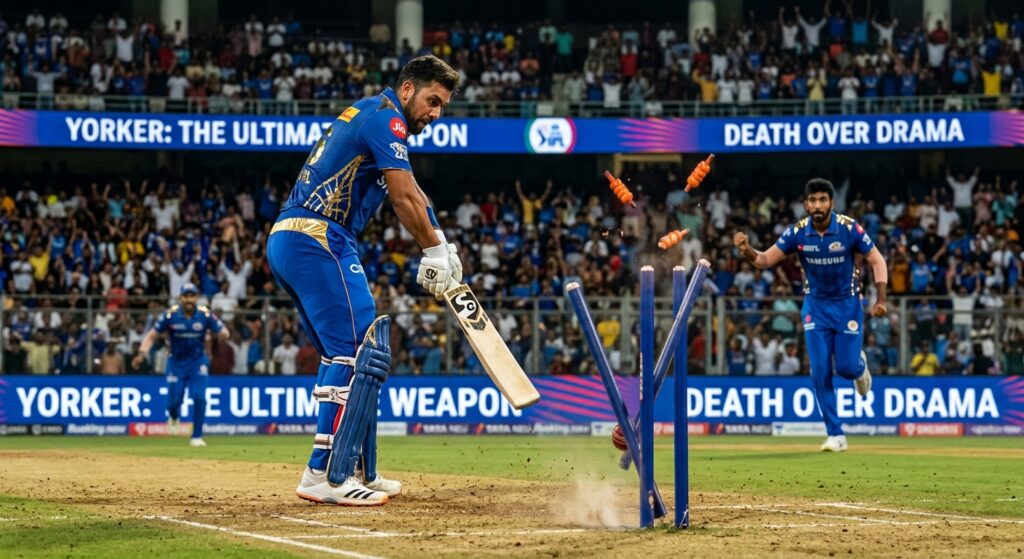
Cricket is a game filled with different bowling techniques, each designed to challenge the batter in a unique way. Some deliveries move through the air, some bounce sharply off the pitch, and others deceive the batter with spin or changes of pace. Among all these bowling weapons, the yorker has earned a special reputation.
A well-executed yorker can be almost impossible to play. It arrives at the batter’s feet at high speed, leaves very little time for reaction, and can destroy the stumps in an instant. Whether it is the final over of a T20 match, the closing stages of an ODI, or a crucial moment in Test cricket, a perfect yorker can completely change the direction of a game.
But what exactly is a yorker in cricket, why is it so difficult to bowl, and how do professional bowlers use it to take wickets? This guide explains everything beginners and cricket fans need to know.
What Is a Yorker in Cricket?
A yorker is a cricket delivery that pitches very close to the batter’s feet, usually around the popping crease. The ball is aimed at the base of the stumps or directly at the batter’s toes.
Because the ball lands so close to the batter, there is very little room to swing the bat properly. The batter must react quickly and bring the bat down at exactly the right moment. Even a small mistake can result in the ball hitting the stumps or trapping the batter leg before wicket.
In simple terms:
A yorker is a full-length delivery aimed at the batter’s toes or the base of the stumps.
Unlike a normal full-length ball, a yorker is pitched extremely close to the batter. This precise length is what makes it one of the hardest deliveries to master.
Why Is It Called a Yorker?
The exact origin of the term “yorker” is not completely certain. One popular explanation connects the delivery with Yorkshire, a historic cricketing region in England. Over time, the name became associated with a fast, toe-crushing delivery that was difficult for batters to play.
Regardless of where the name came from, the yorker is now a universal cricket term. Players, commentators, coaches, and fans all understand that a yorker refers to a delivery aimed very close to the batter’s feet.
Where Does a Yorker Pitch?
The most important feature of a yorker is its length.
A good yorker lands much closer to the batter than a standard full-length delivery. Ideally, it pitches near the popping crease and then travels towards the base of the stumps.
Here is a simple comparison of bowling lengths:
| Type of Delivery | Typical Pitching Area | Main Purpose |
|---|---|---|
| Short ball | Far from the batter | Creates bounce |
| Good length | Middle area of the pitch | Creates uncertainty |
| Full-length ball | Closer to the batter | Encourages a drive |
| Yorker | Very close to the batter’s feet | Targets stumps and toes |
The difference between a perfect yorker and an ordinary full toss can be very small. If the bowler releases the ball slightly too early, it may become a full toss. If released slightly too late, it may turn into a half-volley, giving the batter an easy scoring opportunity.
That is why yorker bowling requires exceptional control.
Why Is a Yorker So Difficult to Play?
The biggest challenge for a batter is the lack of time.
Most cricket shots require the batter to judge the length of the ball and move accordingly. Against a yorker, however, the ball arrives almost directly at the feet. The batter has very little opportunity to move forward or backward.
A fast yorker creates several problems:
- The bat must come down extremely quickly.
- The ball may hit the toes.
- The base of the stumps is under direct threat.
- Powerful attacking shots become difficult.
- A small error can lead to a wicket.
Imagine a fast bowler delivering the ball at 140 km/h. The batter has only a fraction of a second to identify the length and react. If the ball is aimed perfectly at the blockhole—the area around the base of the stumps—the batter may struggle even if they know a yorker is coming.
This combination of speed and accuracy makes the yorker such a dangerous delivery.
What Is the Blockhole in Cricket?
The word blockhole is commonly associated with yorker bowling.
The blockhole is the small area near the batter’s feet, particularly around the popping crease and base of the stumps. A bowler attempting a yorker usually aims for this area.
The term comes from the idea that a batter’s bat creates a mark or “hole” in this area while repeatedly blocking deliveries.
When commentators say a bowler has “hit the blockhole,” they usually mean the bowler has delivered an excellent yorker.
Types of Yorkers in Cricket
Not every yorker is exactly the same. Skilled bowlers can use several variations depending on the situation.
1. Straight Yorker
This is the classic yorker.
The ball is aimed directly at the base of the middle stump or off stump. It is particularly dangerous because the batter must protect the stumps while bringing the bat down quickly.
A straight yorker is often used when a bowler wants to take a bowled dismissal.
2. Inswinging Yorker
An inswinging yorker moves into the batter after pitching or during its flight.
For a right-handed batter, a ball that swings towards the pads and stumps can be extremely dangerous. The movement makes it harder to predict the exact line of the delivery.
An inswinging yorker can result in:
- Bowled
- LBW
- Inside edge onto the stumps
3. Outswinging Yorker
An outswinging yorker moves away from the batter.
This variation is often aimed around the off stump. It can force the batter to reach for the ball and create an outside edge.
Although less common as a pure wicket-taking yorker at the death, it can be highly effective when used as a surprise variation.
4. Wide Yorker
A wide yorker is deliberately aimed outside the batter’s reach, usually near the wide guideline.
This delivery has become extremely popular in T20 cricket.
When a batter moves towards the leg side to hit a big shot, the bowler can send a yorker wide outside off stump. The batter then has difficulty reaching the ball with enough power.
However, the bowler must be careful. If the ball is too wide, the umpire may call it a wide.
5. Slower Yorker
A slower yorker combines two forms of deception: reduced pace and a very full length.
The batter may expect a fast delivery and begin the shot too early. When the slower yorker arrives, the timing is disrupted.
This variation is particularly useful against aggressive batters.
Why Are Yorkers Important at the End of an Innings?
Yorkers are especially valuable during the final overs of limited-overs cricket.
The last few overs are often called the death overs. During this period, batters usually attempt powerful shots to score as many runs as possible.
A normal length delivery can be easier to hit for six. A short ball can be pulled or hooked. Even a slightly overpitched ball may be driven.
A yorker, however, removes much of the batter’s hitting space.
Example of Death-Over Strategy
Imagine a team needs:
- 12 runs from 6 balls
- One specialist fast bowler is bowling
- Two powerful batters are at the crease
The bowler’s strategy might look like this:
| Ball | Possible Delivery |
|---|---|
| 1 | Yorker |
| 2 | Wide yorker |
| 3 | Slower ball |
| 4 | Yorker |
| 5 | Short slower delivery |
| 6 | Yorker |
Using yorkers repeatedly can make scoring boundaries more difficult. However, predictable bowling can also help a batter prepare. Therefore, the best bowlers mix yorkers with other variations.
Famous Bowlers Known for Yorkers
Several great bowlers have become famous for their ability to deliver accurate yorkers under pressure.
Wasim Akram
Wasim Akram was renowned for swing bowling and his ability to produce deadly yorkers. His left-arm angle and late movement made his full-length deliveries particularly difficult to play.
Waqar Younis
Waqar Younis was another master of the yorker. His reverse swing combined with fast, full deliveries caused problems for batters around the world.
Lasith Malinga
Lasith Malinga developed a unique bowling action and became famous for his toe-crushing yorkers. His ability to bowl accurate full deliveries at high pace made him a major threat in limited-overs cricket.
Jasprit Bumrah
Jasprit Bumrah is known for his unusual action, pace variations, and outstanding accuracy. His yorkers have been particularly effective in pressure situations.
These bowlers demonstrate that a yorker is not simply about bowling fast. Accuracy, confidence, variation, and practice are equally important.
How Do Bowlers Bowl a Yorker?
Bowling a yorker requires excellent control over length.
A bowler generally focuses on three main things:
1. Target
The bowler selects a small target near the popping crease or base of the stumps.
Some bowlers use markers during practice sessions to improve accuracy.
2. Release Point
The release point is crucial.
Releasing the ball slightly too early can produce a full toss. Releasing it too late may result in a half-volley.
Professional bowlers spend countless hours repeating their action to develop consistency.
3. Follow-Through
A balanced bowling action helps maintain accuracy. If a bowler loses balance during delivery, controlling the length becomes more difficult.
Yorker bowling is therefore a combination of technique and repetition.
How to Practice Yorkers
Young bowlers can improve their yorker accuracy through simple drills.
Target Practice
Place a small marker near the batter’s popping crease and attempt to land the ball on or close to it.
For example:
- Bowl 24 deliveries.
- Count how many land in the yorker zone.
- Record the result.
- Try to improve in the next session.
A simple calculation could look like this:
Yorker Accuracy = Successful Yorkers ÷ Total Deliveries × 100
If a bowler delivers 24 balls and lands 12 accurate yorkers:
12 ÷ 24 × 100 = 50% accuracy
The goal is to gradually increase the percentage.
| Practice Session | Yorkers Attempted | Accurate Yorkers | Accuracy |
|---|---|---|---|
| Session 1 | 24 | 12 | 50% |
| Session 2 | 24 | 15 | 62.5% |
| Session 3 | 24 | 18 | 75% |
Consistent practice can significantly improve control.
Can Batters Hit Yorkers for Boundaries?
Yes. Although yorkers are difficult to play, skilled batters can still score from them.
Modern cricket has changed the way players approach yorkers. Batters now practice shots such as:
- Digging the ball out
- Squeezing it behind square
- Moving across the crease
- Opening the face of the bat
- Turning a yorker into a low full toss
Some innovative batters can even hit yorkers for boundaries by moving early and changing their position.
However, moving too early is risky. A smart bowler may notice the movement and change the delivery.
This creates an interesting battle between bowler and batter.
Yorker vs Full Toss
A yorker and a full toss are sometimes confused, but they are different.
A yorker bounces on the pitch before reaching the batter. A full toss reaches the batter without bouncing.
| Feature | Yorker | Full Toss |
|---|---|---|
| Bounces on pitch | Yes | No |
| Length | Very full | No pitching length |
| Difficulty to hit | Usually high | Depends on height |
| Main target | Toes and stumps | Varies |
| Risk for bowler | Can become a half-volley | May be hit easily |
A bowler attempting a yorker must avoid accidentally bowling a comfortable full toss.
Why Is the Yorker Considered a Skillful Delivery?
The yorker demands precision that many other deliveries do not.
A bowler can sometimes get away with a slightly inaccurate short ball or good-length delivery. But with a yorker, even a small mistake can completely change the result.
Too short, and it becomes a hittable half-volley.
Too full, and it becomes a full toss.
Too wide, and it may be called a wide.
Too straight, and it may become easier for the batter to flick.
For this reason, delivering a yorker under pressure is considered one of the most impressive skills in cricket.
Final Thoughts
So, what is a yorker in cricket? It is a very full delivery pitched close to the batter’s feet, usually targeting the base of the stumps. Simple in definition but extremely difficult to execute, the yorker remains one of the most effective weapons available to a bowler.
From the classic swinging yorkers of Wasim Akram and Waqar Younis to the modern death-over skills of Jasprit Bumrah, cricket history has shown how one perfectly placed ball can change a match.
A yorker can break the stumps, trap a batter LBW, prevent a boundary, or create pressure during the most important moment of an innings. That is why bowlers spend years trying to master it.
For cricket beginners, understanding the yorker is essential because it highlights one of the most fascinating aspects of the sport: cricket is not just about speed or power. Sometimes, success comes down to placing a ball within a few inches of the perfect spot.
And when a bowler gets it exactly right, there are few deliveries in cricket more satisfying—or more dangerous—than a perfect yorker.
