


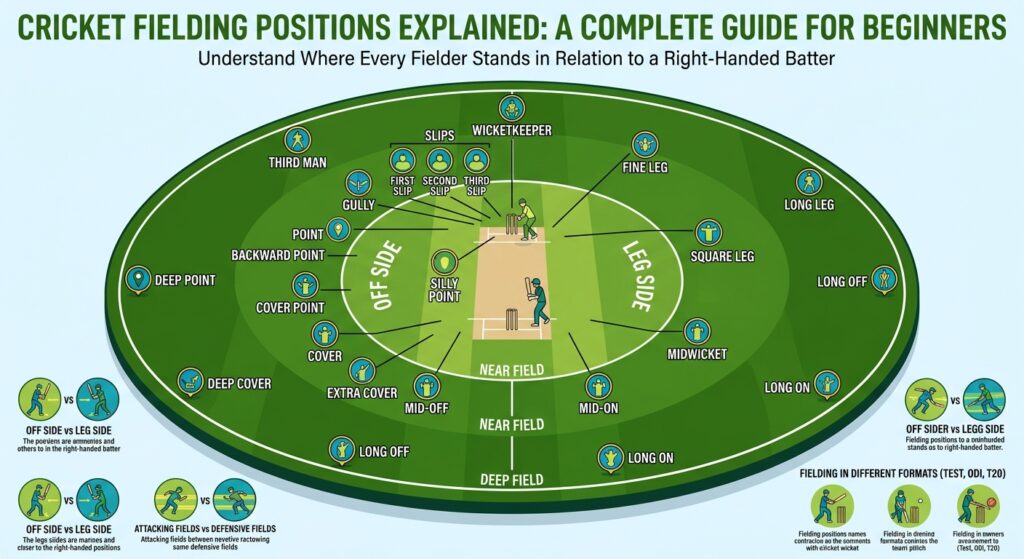
Cricket can look confusing when you first watch a match. The bowler runs in, the batter takes guard, and suddenly you hear the commentator talking about silly point, gully, cover, midwicket, fine leg, or third man. For someone who is new to cricket, these names can sound like a completely different language.
The good news is that cricket fielding positions are much easier to understand once you know where each fielder stands and what kind of shot or situation that position is designed for.
Fielders are not placed randomly around the cricket field. The captain chooses their positions according to the bowler, batter, pitch conditions, match situation, and the type of shots the batter is likely to play. A strong fielding setup can create pressure, save runs, and even produce wickets.
This guide is about the main cricket fielding positions explained in simple terms, including where they are located, what they are used for, and why captains move players around during a match.
What Are Cricket Fielding Positions?
A cricket fielding position is a specific area on the field where a fielder is positioned while the ball is being bowled.
Unlike some sports, cricket does not have a fixed formation that must be followed. Apart from certain restrictions in limited-overs cricket, the captain has considerable freedom to decide where fielders should stand.
The positions are generally described in relation to the batter. For example, positions on the off side are located on the side of the batter’s body where the bat is usually presented for an off-side shot, while leg-side positions are on the opposite side.
Some positions are very close to the batter, while others are placed near the boundary.
Off Side and Leg Side
Before learning individual positions, it helps to understand the two main sides of the cricket field.
| Side | Basic Meaning |
|---|---|
| Off side | The side of the field corresponding to the batter’s off side |
| Leg side | The side behind the batter’s legs |
| Near field | Positions close to the batter |
| Deep field | Positions closer to the boundary |
For a right-handed batter, the off side is generally to the batter’s right, while the leg side is to the batter’s left. For a left-handed batter, the arrangement is reversed.
This is important because fielding positions are often described from the batter’s perspective rather than simply using the viewer’s left and right.
1. Wicketkeeper
The wicketkeeper is one of the most recognizable fielding positions in cricket.
The keeper stands directly behind the stumps at the batter’s end. Their main job is to stop deliveries that the batter misses and to collect balls coming through at different speeds and angles.
The wicketkeeper also plays an important role in dismissals. They can complete catches behind the wicket and remove the bails when a batter is attempting to run.
A wicketkeeper needs excellent concentration, quick hands, good footwork, and strong anticipation.
Because the keeper is involved in almost every delivery, it is one of the busiest positions on the field.
2. Slip
Slip fielders stand beside the wicketkeeper, slightly behind the batter’s wicket.
There can be several slips, usually called first slip, second slip, third slip, and sometimes fourth slip. The exact number depends on the match situation.
Slips are especially important when fast bowlers or swing bowlers are attacking.
A ball that moves away from the batter can take the edge of the bat and fly toward the slips. Therefore, slip fielders need extremely quick reactions.
Why Are Slips Important?
A batter may play a defensive shot but only get a thin edge. That edge can travel quickly, making the slip fielder’s position extremely valuable.
Slip catching is often considered one of the most demanding forms of fielding because there is very little time to react.
3. Gully
Gully is positioned wider than the slips, between the slip cordon and point.
This position is particularly useful against shots that are edged or played square on the off side.
Fast bowlers can create opportunities at gully when the ball moves away from the batter. A thick edge may travel between the traditional slip area and point, making gully an important catching position.
A gully fielder needs good anticipation because the ball can arrive at considerable speed.
4. Point
Point is located on the off side, roughly square to the batter.
It is one of the most commonly used fielding positions in cricket.
A point fielder can stop square cuts and other shots played through the off side. The player may also be required to make diving stops and prevent quick singles.
Because many batters like to score through point, captains often place a strong and athletic fielder in this position.
5. Backward Point
Backward point is positioned slightly behind square on the off side.
The position is useful for stopping shots played behind point, particularly late cuts and angled shots.
A quick fielder at backward point can save runs and sometimes create run-out opportunities.
The difference between point and backward point is mainly their angle in relation to the batter.
6. Cover Point
Cover point is positioned between point and cover.
It is used to stop shots played through the area between the two positions.
This can be a busy scoring region for technically strong batters. A well-timed drive can travel quickly through the covers, so a captain may use a skilled fielder there.
7. Cover
Cover is positioned farther toward the bowler’s side of the off-side field.
It is one of the classic cricket fielding positions because the cover region is a popular scoring area.
Batters often play cover drives through this part of the field. A fielder at cover can stop boundaries, save singles, and sometimes catch a batter attempting an aerial drive.
A player at cover usually needs good speed, throwing accuracy, and awareness.
8. Extra Cover
Extra cover is placed between cover and mid-off.
The position is particularly useful for stopping drives hit slightly straighter than traditional cover drives.
Captains often adjust the exact location of extra cover according to the batter’s technique and the bowler’s line.
For example, if a bowler is consistently bowling outside off stump, the captain may place a fielder in a position designed to stop the batter from driving through the off side.
9. Mid-Off
Mid-off is positioned on the off side, relatively close to the bowler.
The fielder is usually placed somewhere between the bowler and cover.
Mid-off has several responsibilities. The fielder can stop straight drives, prevent singles, and provide support for run-out attempts.
A captain may move mid-off closer to the pitch when attacking or push the fielder deeper when trying to prevent boundaries.
10. Mid-On
Mid-on is the leg-side equivalent of mid-off.
It is positioned near the bowler on the leg side.
The fielder’s main duties include stopping straight drives, preventing singles, and supporting the bowler.
Mid-on can also become a catching position when a batter hits a lofted shot toward the bowler’s side.
11. Midwicket
Midwicket is located on the leg side, between square leg and mid-on.
This is another important scoring area.
Batters often play flicks and controlled shots through midwicket, especially when the ball is directed toward their pads.
A strong fielder at midwicket can save runs and put pressure on the batter.
12. Square Leg
Square leg is positioned on the leg side, approximately square to the batter.
The position is useful for stopping pull shots, glances, and other leg-side strokes.
Square leg can also become a catching position when a batter mistimes a shot toward the leg side.
The exact distance from the batter changes depending on the captain’s strategy.
13. Fine Leg
Fine leg is located behind square on the leg side, closer to the boundary.
It is commonly used to stop balls that travel behind the batter on the leg side.
A batter may use the pace of the ball to guide a delivery toward fine leg. If the fielder is positioned too far forward, such shots may reach the boundary.
Fine leg is therefore particularly important against bowlers who attack the batter’s body or leg stump.
14. Third Man
Third man is located behind the wicket on the off side, usually near the boundary.
This position is commonly used to stop edges and shots played late behind the wicket.
In limited-overs cricket, third man can be an important boundary-saving position.
A captain might move third man closer when expecting an edge or deeper when protecting against boundaries.
15. Long Leg
Long leg is a deep leg-side position, generally around the boundary behind square.
It is useful for stopping powerful pulls, hooks, and other leg-side shots.
Against a fast bowler who bowls short deliveries, the captain may place a fielder at long leg because the batter may attempt to hit the ball over the square-leg region.
16. Long On
Long on is positioned near the boundary on the leg side, roughly in line with the pitch.
It is a common position in limited-overs cricket because batters frequently attempt to hit the ball over mid-on.
Long on becomes especially important when a batter is trying to score sixes.
A good long-on fielder needs to judge high catches, control the boundary, and throw accurately back toward the wicket.
17. Long Off
Long off is the off-side equivalent of long on.
The fielder is placed near the boundary in line with the pitch.
It is particularly useful against lofted drives and big shots played over the bowler’s head or toward the off side.
In the final overs of a limited-overs innings, long off is often an important boundary position.
18. Deep Cover
Deep cover is positioned near the boundary behind the cover region.
Its main purpose is to prevent boundaries from powerful cover drives and aerial shots.
This position is particularly valuable when the batter is known for hitting through the off side.
19. Deep Point
Deep point is located near the boundary behind the point region.
The fielder is responsible for stopping square cuts and other powerful shots played through the off side.
The position becomes especially useful when the batter has a strong cut shot.
Cricket Fielding Positions at a Glance
| Position | General Area | Main Responsibility |
|---|---|---|
| Wicketkeeper | Behind stumps | Catches, stumpings, stopping balls |
| Slip | Behind wicket, off side | Edge catches |
| Gully | Between slip and point | Edge catches |
| Point | Square off side | Cuts and singles |
| Cover | Off side | Drives and boundaries |
| Extra cover | Between cover and mid-off | Drives |
| Mid-off | Near bowler, off side | Straight drives |
| Mid-on | Near bowler, leg side | Straight drives |
| Midwicket | Leg side | Flicks and leg-side shots |
| Square leg | Square leg side | Pulls and glances |
| Fine leg | Behind square leg side | Leg-side shots |
| Third man | Behind square, off side | Edges and late shots |
| Long on | Deep leg side | Lofted shots |
| Long off | Deep off side | Lofted drives |
| Deep cover | Deep off side | Cover boundaries |
| Deep point | Deep square off side | Cut shots |
Why Do Fielders Change Positions?
One of the most interesting parts of cricket is that the field is constantly changing.
A captain may change a fielder’s position because of:
- The type of bowler bowling
- The batter’s preferred shots
- The match situation
- The pitch conditions
- The number of runs required
- The number of wickets remaining
- The format of cricket
- Whether the captain is attacking or defending
For example, suppose a batter repeatedly hits the ball through cover. The captain may move an additional fielder into the cover region.
Similarly, if a batter is struggling against short-pitched bowling, the captain may place fielders around the leg side to catch a mistimed pull or hook.
Attacking vs Defensive Field Settings
Field placements can generally be divided into attacking and defensive strategies.
An attacking field focuses on taking wickets. Several fielders may be positioned close to the batter, especially in catching areas such as slips and gully.
A defensive field focuses more on preventing runs. Fielders are pushed toward the boundary to stop fours and sixes.
The captain has to balance both objectives.
If too many players are close to the wicket, the batter may find easy gaps and score boundaries. If too many players are on the boundary, the bowler may struggle to create wicket-taking pressure.
Fielding Positions in Different Formats
Fielding strategies can differ significantly between Test matches, One Day Internationals, and T20 cricket.
Test Cricket
Test cricket usually allows captains more time to build attacking fields. Multiple slips, gully, short leg, and other close-catching positions may be used.
One-Day Cricket
One-day cricket requires a balance between taking wickets and controlling the scoring rate.
Captains often adjust fields depending on the powerplay, middle overs, and final overs.
T20 Cricket
T20 cricket is extremely fast. Boundary protection is often a major priority because batters attack almost every delivery.
Positions such as long on, long off, deep midwicket, deep square leg, and deep cover are frequently important.
Why Fielding Position Matters
Fielding positions are not simply names on a cricket diagram. They are part of the captain’s tactical plan.
Imagine a bowler repeatedly delivering the ball outside off stump. The batter tries to drive but occasionally edges the ball. The captain may place slips and a gully because those positions increase the chance of catching the edge.
Now imagine a batter who loves hitting sixes over midwicket. The captain may place a deep midwicket or long-on fielder near the boundary.
In both cases, the field is designed around the likely outcome of the next delivery.
How Beginners Can Learn Fielding Positions
The easiest way to learn cricket fielding positions is not to memorize every name at once.
Start with the major areas:
- Wicketkeeper
- Slip
- Point
- Cover
- Mid-off
- Mid-on
- Midwicket
- Square leg
- Fine leg
- Third man
- Long on
- Long off
Once these become familiar, positions such as gully, backward point, extra cover, deep cover, and deep point become much easier to understand.
Watching matches while looking at the fielding graphic can also help. After a few games, you will begin to recognize the positions naturally.
Final Thoughts
Cricket fielding positions may seem complicated when you first encounter terms such as gully, silly point, deep midwicket, or extra cover. However, each position has a logical purpose.
The wicketkeeper stays behind the stumps, slips look for edges, point protects the square off side, cover protects drives, mid-on and mid-off guard the areas near the bowler, while deep fielders protect the boundary.
The exact position of a fielder can change from one delivery to the next. That is what makes cricket strategy so fascinating. Captains are constantly trying to predict what the batter will do while bowlers attempt to create the conditions needed for a wicket.
Once you understand the basic fielding positions, watching cricket becomes much easier. You can follow the captain’s tactics, understand why a fielder has moved, and even begin predicting where the next shot might go.
Most importantly, remember that there is no single field that works for every situation. The best field depends on the bowler, batter, pitch, format, and match circumstances. Learning these positions gives beginners a useful foundation for understanding the tactical side of cricket.
