


The penalty spot is one of the most important markings on a football pitch. It is the place where a penalty kick is taken after the defending team commits a foul inside its own penalty area. Although the penalty kick looks simple, the distance between the penalty spot and the goal has a major influence on the pressure, technique, and outcome of the shot.
So, how far is a penalty spot in football?
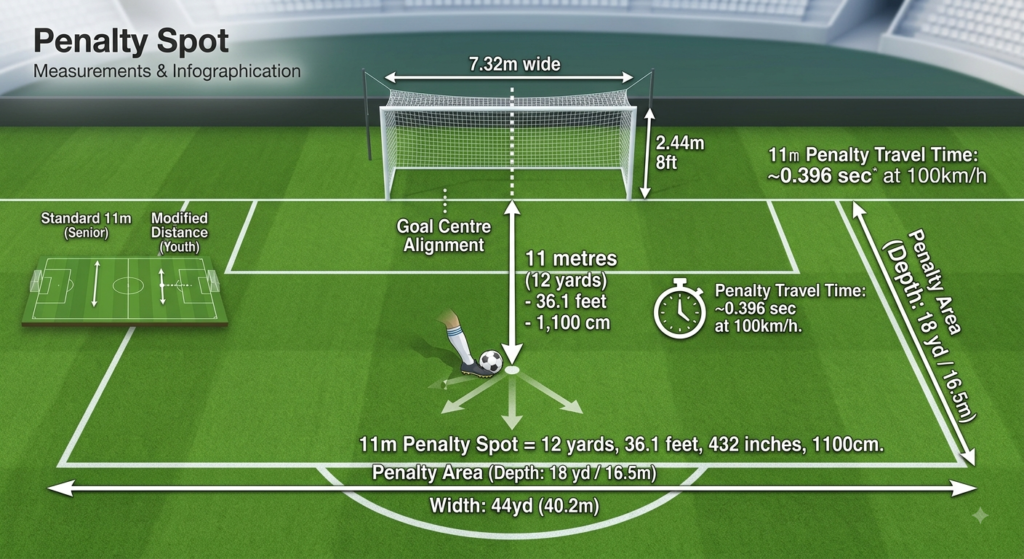
According to the Laws of the Game, the penalty spot is 11 metres (12 yards) from the midpoint between the goalposts. This distance is measured along the same line as the centre of the goal. The penalty mark itself is positioned inside the penalty area, directly in front of the goal.
That 11-metre distance has become a familiar sight in football. From local youth matches to the biggest international competitions, players face the same basic challenge: stand on the penalty mark, wait for the referee’s signal, and attempt to beat the goalkeeper from 12 yards.
How Far Is the Penalty Spot From the Goal?
The official distance is:
| Measurement | Distance |
|---|---|
| Penalty spot to goal line | 11 metres |
| Penalty spot to goal line | 12 yards |
| Approximate distance in feet | 36.1 feet |
| Distance in centimetres | 1,100 cm |
| Distance in inches | 432 inches |
The important point is that the 11-metre measurement is taken from the penalty mark to the goal line, not simply to the front edge of the goal net.
The penalty spot sits directly in front of the centre of the goal. This gives the kicker an equal starting position whether they decide to shoot toward the goalkeeper’s left, right, or the middle.
Why Is the Penalty Spot 12 Yards Away?
The 12-yard penalty distance has a long history in football. It was introduced as part of the development of the penalty kick during the late nineteenth century.
Before penalty kicks existed, defending players could sometimes commit serious fouls near their own goal without facing a direct consequence comparable to today’s penalty. The introduction of the penalty kick gave attacking teams an opportunity to score after certain offences inside the penalty area.
The distance of 12 yards created a balance between the attacking player and goalkeeper. The kicker gets a very good scoring opportunity, but the goalkeeper is still allowed to defend the goal.
Over time, the 12-yard penalty became one of the most recognizable features of football.
Penalty Spot vs Penalty Area
One common source of confusion is the difference between the penalty spot and the penalty area.
They are not the same thing.
The penalty area is the large rectangular section surrounding the goal. It is commonly called the “18-yard box” because its depth is 18 yards under the traditional measurement system.
The penalty spot is a small circular mark inside that area.
A simplified layout looks like this:
| Pitch Feature | Traditional Measurement |
|---|---|
| Penalty spot from goal line | 12 yards |
| Penalty area depth | 18 yards |
| Penalty area width | 44 yards |
| Goal width | 8 yards |
| Goal height | 8 feet |
The penalty spot is therefore 6 yards closer to the goal line than the far edge of the penalty area, when using the traditional 18-yard measurement.
What Is the Distance in Feet?
Many football fans are familiar with the phrase “a penalty from 12 yards.” If you prefer feet, the distance is approximately 36 feet and 1 inch.
The calculation is straightforward:
1 yard = 3 feet
Therefore:
12 yards × 3 = 36 feet
Because the official metric measurement is 11 metres, the exact conversion is slightly more than 36 feet:
11 metres × 3.28084 = approximately 36.09 feet
So, when someone says a footballer is taking a penalty from around 36 feet, they are talking about the same basic distance.
How Big Is the Goal Compared With the Penalty Distance?
A regulation football goal is 7.32 metres wide and 2.44 metres high.
That means the kicker is standing 11 metres away from a goal that is more than 7 metres wide.
At first glance, this may make penalties appear easy. However, the goalkeeper occupies part of the visual space, and the kicker must strike the ball accurately while dealing with enormous psychological pressure.
A penalty is not simply about kicking the ball hard.
The player must consider:
- Placement
- Power
- Height
- Run-up
- Body position
- Goalkeeper movement
- Timing
- Confidence
Even professional players can miss penalties.
How Fast Does a Penalty Travel?
A powerful penalty can travel toward the goal extremely quickly. Depending on the player’s technique and strike, the ball may reach speeds well above 100 kilometres per hour.
The short distance gives the goalkeeper very little time to react.
For example, suppose a penalty is struck at 100 km/h.
First, convert the speed:
100 km/h ÷ 3.6 = 27.78 m/s
The distance is 11 metres.
So:
Time = Distance ÷ Speed
11 ÷ 27.78 = 0.396 seconds
That is less than half a second.
A faster penalty would take even less time to reach the goal. This explains why goalkeepers often have to anticipate the direction of the shot rather than simply wait to see where the ball is going.
Can the Penalty Spot Be Moved?
In a properly marked regulation pitch, the penalty mark has a fixed location. It cannot simply be moved closer to or farther from the goal because a player wants an easier or harder penalty.
The referee and match officials are responsible for ensuring that the field markings are correct.
The penalty mark is positioned 11 metres from the goal line, centered with the goal.
If the field has incorrect or damaged markings, officials may need to address the problem before or during the match depending on the circumstances.
How Far Is a Penalty Spot in Youth Football?
This is where things can become different.
Youth football does not always use exactly the same pitch dimensions as senior football. Younger players often play on smaller fields, with smaller goals and modified rules designed for their age group.
As a result, the penalty-mark distance can vary according to the competition’s regulations.
Parents, coaches, and players should therefore check the rules of their particular youth league rather than assuming that every age group uses an 11-metre penalty distance.
Senior-level football follows the standard Laws of the Game, while youth competitions may introduce modifications.
Why Do Penalty Takers Usually Aim Toward the Corners?
The corners are popular targets because the goalkeeper cannot cover the entire goal from the centre.
A penalty taker can attempt to place the ball close to either post or into the upper corners. These areas are difficult for a goalkeeper to reach, particularly when the shot has enough pace.
However, aiming for the corner also increases the risk of missing the target.
There is a trade-off:
More accuracy = potentially less risk
More extreme placement = potentially greater reward but greater risk
This is why some players choose a controlled shot rather than simply trying to blast the ball as hard as possible.
What Happens if the Ball Hits the Post?
The penalty kick is still considered a shot at goal if the ball hits the post or crossbar.
If the ball rebounds back into play, the situation depends on the laws governing penalty kicks and whether another player has touched the ball.
The penalty taker cannot simply kick the ball a second time immediately after the initial kick if the ball has not been touched by another player.
For example, if the ball hits the post and comes directly back to the same player, they cannot legally take a second touch before another player touches it.
This is different from situations in which the goalkeeper makes a save and the ball rebounds into the playing area.
Penalty Spot During a Shootout
The penalty spot is also used during penalty shootouts to determine the winner of certain matches.
The distance remains the same: 11 metres from the goal line.
A shootout can create some of the most dramatic moments in football. Players who normally appear calm during matches may face enormous pressure when standing alone at the penalty mark.
The goalkeeper also faces a difficult decision. They can remain in the centre, attempt to read the kicker, or dive toward one side.
There is no guaranteed method for saving a penalty.
Why Penalties Are So Difficult
From a technical perspective, the penalty spot is only 11 metres away from the goal. But psychologically, it can feel much farther.
The player knows that thousands of spectators may be watching. Teammates expect them to score. Opposing supporters may try to distract them. The goalkeeper is attempting to predict their decision.
This combination of physical skill and mental pressure makes penalties unique.
A footballer can score dozens of penalties during training but still struggle in an important competitive match.
Simple Penalty Distance Calculation
Here is a quick calculation to remember the official distance:
1 metre = 100 centimetres
Therefore:
11 metres × 100 = 1,100 centimetres
In yards:
11 metres ≈ 12.03 yards
Football’s traditional description rounds this to 12 yards.
In feet:
11 metres × 3.28084 ≈ 36.09 feet
So the penalty spot is approximately:
11 metres = 12 yards = 36 feet
These are different ways of describing essentially the same location.
Penalty Spot Compared With Other Football Measurements
Understanding the penalty spot becomes easier when you compare it with other parts of the pitch.
| Football Measurement | Approximate Distance |
|---|---|
| Penalty spot from goal | 11 m / 12 yd |
| Penalty area depth | 16.5 m / 18 yd |
| Goal width | 7.32 m / 8 yd |
| Goal height | 2.44 m / 8 ft |
| Centre circle radius | 9.15 m / 10 yd |
The numbers show why the penalty area extends significantly farther from the goal than the penalty mark itself.
Final Answer: How Far Is a Penalty Spot?
The answer is simple: the penalty spot in standard football is 11 metres, or 12 yards, from the goal line.
It is placed directly in front of the centre of the goal. In feet, that works out to approximately 36.1 feet.
Although the distance may seem short, scoring from the penalty spot requires much more than power. The player has to control their technique, choose a target, deal with the goalkeeper, and handle the pressure of the moment.
The 12-yard penalty has become one of football’s defining situations. From a quiet league match to a World Cup final, the same small mark can suddenly become the centre of attention.
That is what makes the penalty spot so interesting. It is only 11 metres from the goal, but when the entire match depends on one kick, those 11 metres can feel like a very long way.
