


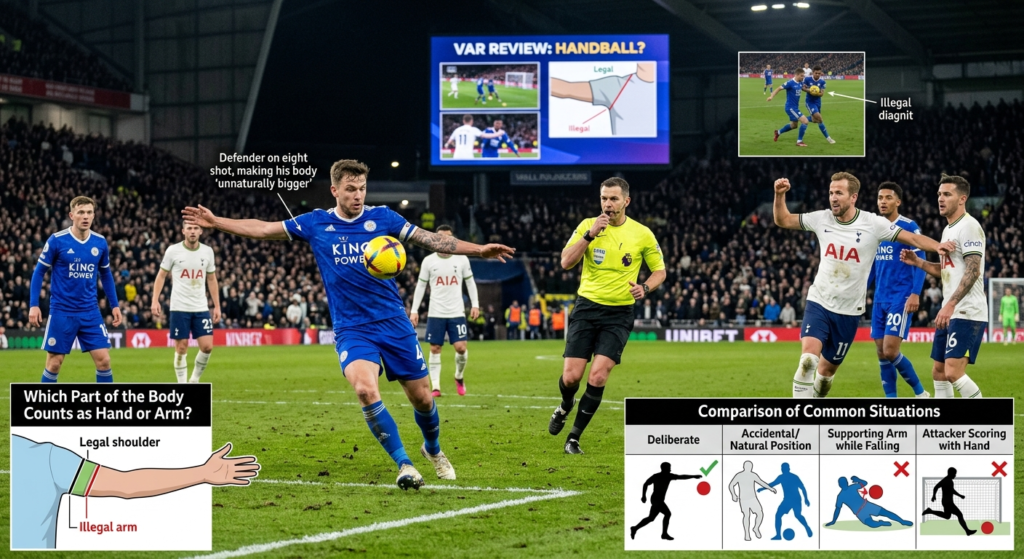
The handball rule is one of the most debated rules in football. A match can be changed in seconds when the referee decides that the ball has struck a player’s hand or arm. Fans often disagree, players protest, and VAR reviews can make the situation even more confusing.
But what exactly is the football handball rule?
The basic idea sounds simple: an outfield player cannot deliberately use their hand or arm to control the ball. However, modern football has more detailed rules because not every contact between the ball and a player’s hand or arm is considered an offence.
The referee must consider factors such as the player’s movement, the position of the arm, whether the player made their body unnaturally bigger, and how the ball reached the hand or arm.
This guide explains the football handball rule in simple terms, including penalties, exceptions, accidental handballs, and common examples.
Football Handball Rule Explained?
A handball offence occurs when a player illegally touches the ball with their hand or arm.
However, the word illegally is important.
If the ball touches a player’s hand or arm, the referee does not automatically have to stop the match. Some handball incidents are accidental and are therefore allowed to continue.
A handball is generally considered an offence when a player:
- Deliberately touches the ball with their hand or arm.
- Moves their hand or arm toward the ball.
- Makes their body unnaturally bigger with the hand or arm.
- Scores directly with the hand or arm.
- Immediately creates a goal-scoring situation after the ball touches their hand or arm in certain attacking situations.
The exact decision depends on the circumstances of the incident.
Which Part of the Body Counts as the Hand or Arm?
One common question is: Where does the arm end and the shoulder begin?
In football, the arm is generally considered to begin below the bottom of the armpit. Contact with the shoulder itself is not normally treated as handball.
This is why a player may legally control the ball with the upper part of the shoulder while controlling it with the hand or lower arm would be a possible offence.
Understanding this distinction is important when watching close VAR decisions.
Deliberate Handball
The clearest type of handball is deliberate handball.
This happens when a player intentionally moves their hand or arm toward the ball.
For example, imagine an opponent is running toward goal. A defender reaches out and blocks the ball with their hand to stop the attack.
That is clearly a handball offence.
Another obvious example is when an outfield player catches or pushes the ball with their hand.
Deliberate handball is usually easier for referees to identify because the player’s movement clearly shows an intention to make contact.
What Does “Making the Body Unnaturally Bigger” Mean?
Modern handball decisions often focus on whether a player has made their body unnaturally bigger.
A player’s arms are expected to move naturally while running, jumping, turning, or trying to maintain balance. But if a player places their arms in a position that increases the area their body covers, the referee may decide that the player has created an unfair barrier.
For example, a defender standing with their arms stretched wide may block a cross with an arm. Even if the player did not deliberately move the arm toward the ball, the position of the arm could still lead to a handball decision.
Here is a simple comparison:
| Situation | Possible Decision |
|---|---|
| Player deliberately moves hand toward the ball | Handball |
| Arm stretched away from the body and blocks the ball | Often handball |
| Arm in a natural position for balance | May not be handball |
| Ball strikes a supporting arm while a player falls | Often not handball |
| Ball hits the shoulder | Usually not handball |
| Player scores directly with the hand or arm | Handball offence |
The referee must judge each situation individually.
Is Every Accidental Handball a Foul?
No. This is one of the biggest misunderstandings in football.
Accidental contact does not automatically mean a foul.
For example, a player may be standing with their arms close to their body when a powerful shot hits the arm from a very short distance. If the player had no realistic opportunity to avoid the ball and the arm was in a natural position, the referee may allow play to continue.
Football is a fast sport. Players cannot always react quickly enough to move their arms away from the ball.
The referee must therefore consider the full situation instead of simply asking, “Did the ball touch the hand?”
Handball Inside the Penalty Area
A handball inside the penalty area can have major consequences.
If a defender commits a handball offence inside their own penalty area, the opposing team is awarded a penalty kick.
For example:
- An attacker crosses the ball.
- The defender stretches their arm away from their body.
- The ball hits the defender’s arm.
- The referee decides the arm made the body unnaturally bigger.
- A penalty may be awarded.
However, not every ball-to-hand incident inside the penalty area results in a penalty.
The same handball principles still apply.
The referee must first decide whether an actual handball offence has occurred.
Can an Attacking Player Score With Their Hand?
No. A player cannot legally score a goal directly with their hand or arm, even if the contact is accidental.
For example, if the ball accidentally touches an attacker’s arm and then goes directly into the goal, the goal will not count.
This rule exists to prevent goals from being scored through illegal use of the hand or arm.
The famous “Hand of God” incident involving Diego Maradona remains one of the most famous examples of handball controversy in football history. The goal stood because the referee did not see the offence, but under modern officiating and video review, such an incident would be examined much more closely.
Handball and VAR
VAR has made handball decisions more visible and more controversial.
Before VAR, many handball incidents happened too quickly for referees to see clearly. Video review allows officials to examine incidents from different angles and sometimes in slow motion.
VAR may check:
- Whether the ball touched the hand or arm.
- The exact point of contact.
- The position of the player’s arm.
- Whether the player made their body bigger.
- Whether the attacking phase directly led to a goal.
Although VAR provides more information, it does not remove all debate. Referees must still interpret the law and judge whether the arm position was justified by the player’s movement.
What Happens After a Handball Offence?
The restart depends on where the offence occurs.
| Location of Handball | Restart |
|---|---|
| Outside the offender’s penalty area | Direct free kick |
| Defender commits offence inside own penalty area | Penalty kick |
| Attacking team commits offence | Free kick to defending team |
The referee may also show a yellow or red card depending on the seriousness of the offence.
A deliberate handball can result in disciplinary action, especially if it:
- Stops a promising attack.
- Prevents a clear goal-scoring opportunity.
- Deliberately prevents a goal.
Can a Player Get a Red Card for Handball?
Yes, in certain situations.
A player may receive a red card for deliberately handling the ball to prevent a goal or a clear goal-scoring opportunity.
Imagine the goalkeeper has been beaten and the ball is travelling toward an empty goal. A defender standing on the goal line deliberately uses their hand to stop the ball from entering.
The referee can award a penalty and send the defender off.
This is considered a serious offence because the player has illegally prevented a likely goal.
Is a Goalkeeper Allowed to Handle the Ball Anywhere?
No.
Goalkeepers have special handling privileges, but only inside their own penalty area.
Inside the penalty area, a goalkeeper may generally use their hands to control the ball, catch it, or make saves.
Outside the penalty area, the goalkeeper is treated like any other player. If they deliberately handle the ball outside the box, it is a handball offence.
This can sometimes result in a yellow or red card depending on the situation.
Goalkeepers must also follow special restrictions when the ball is deliberately kicked to them by a teammate. They cannot simply pick up every ball played back to them with the foot.
Common Handball Examples Explained
Example 1: Ball Hits an Arm Close to the Body
A defender has their arms naturally close to their sides. An opponent shoots from close range, and the ball strikes the defender’s arm.
Possible decision: No handball.
The referee may decide that the defender did not deliberately play the ball and did not make their body unnaturally bigger.
Example 2: Defender Blocks a Cross With an Extended Arm
A defender has one arm stretched far away from their body. A cross hits that arm.
Possible decision: Handball and penalty if the incident happens inside the penalty area.
The arm may have increased the defender’s body size and created an unfair barrier.
Example 3: Player Deliberately Slaps the Ball
A player intentionally moves their hand toward the ball and changes its direction.
Decision: Handball.
This is one of the clearest examples of deliberate handling.
Example 4: Ball Hits a Supporting Arm
A player falls to the ground and uses one arm to support their body. The ball then strikes that arm.
Possible decision: Often no handball.
A supporting arm can be considered part of a natural body position during a fall, depending on the exact circumstances.
Example 5: Accidental Contact Before a Goal
The ball touches an attacker’s arm and immediately goes into the goal.
Decision: The goal is disallowed.
A player cannot score directly with the hand or arm, even if the contact was accidental.
Why Is the Handball Rule So Controversial?
The handball rule is controversial because football is not played in slow motion.
A player may have less than a second to react to a powerful shot. At the same time, defenders cannot be allowed to place their arms in positions that unfairly block the ball.
Finding the correct balance is difficult.
Different incidents can look similar but have important differences in:
- Distance between the players.
- Speed of the ball.
- Position of the arm.
- Direction of movement.
- Whether the player is jumping or falling.
- Whether the arm position is natural.
This is why fans sometimes disagree with decisions even after watching several replays.
How Players Avoid Handball
Defenders are trained to be careful with their arm positions, especially inside the penalty area.
Some common techniques include:
Keeping Arms Close to the Body
This reduces the chance of the arm blocking the ball.
Turning the Body
Players may turn sideways to block shots using their body instead of their arms.
Avoiding Unnecessary Arm Movement
Defenders try not to stretch their arms when challenging for crosses or blocking shots.
Maintaining Balance Carefully
Players naturally need their arms for balance, especially when jumping or changing direction. The challenge is to balance naturally without creating an unnecessary barrier.
The Difference Between Handball and Ball-to-Hand
The phrase “ball-to-hand” is often used when the ball hits a player’s hand or arm without the player deliberately trying to play it.
This does not always mean that play continues. Modern football also considers whether the player’s arm position was justifiable.
However, the basic difference is useful:
| Situation | Meaning |
|---|---|
| Hand-to-ball | Player moves hand toward the ball |
| Ball-to-hand | Ball unexpectedly strikes the hand or arm |
A clear hand-to-ball movement is more likely to be punished.
Final Thoughts
The football handball rule is simple at its core but complicated in real match situations. The main question is not always whether the ball touched a player’s arm. Referees must decide whether the player illegally used the hand or arm, deliberately moved toward the ball, or made their body unnaturally bigger.
A handball can result in a free kick, penalty, yellow card, or red card depending on where and how the offence occurs.
For fans, the easiest way to understand the rule is to look at the player’s actions and body position. Ask: Did the player deliberately play the ball? Was the arm in a natural position? Did the arm create an unfair barrier?
These questions help explain why some incidents are given as handball while others are allowed to continue.
The rule may continue to create debate, but its purpose remains clear: football is played mainly with the feet, legs, head, and body, not with the hands and arms. Understanding the handball rule makes watching and enjoying the game much easier, especially during those tense VAR moments that can decide an entire match.
