


American football is one of the most exciting and widely followed sports in the United States. Every year, millions of fans watch games at high school stadiums, college campuses, and professional arenas, while millions more tune in from around the world. The sport combines strategy, athleticism, teamwork, and physical strength in a way few other games can match.
For newcomers, American football may seem complicated because of its unique rules and terminology. Yet once you understand the basics, it becomes an exciting game full of tactical decisions, dramatic moments, and memorable plays.
This guide explains everything you need to know about American football, including its history, rules, positions, scoring system, equipment, and why it remains one of the world’s most popular sports.
What Is American Football?
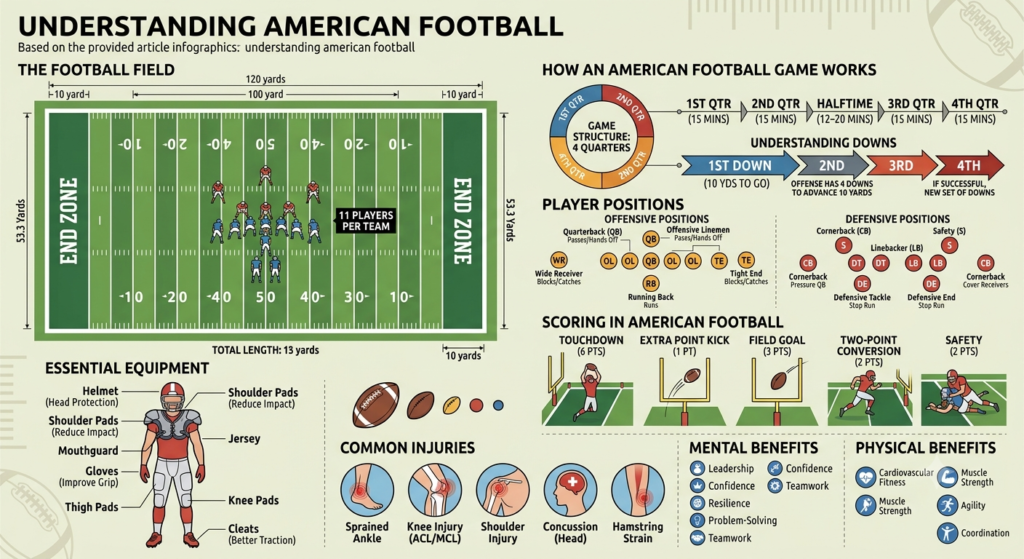
American football is a team sport played between two teams of 11 players on a rectangular field. The objective is to score more points than the opponent by advancing the football into the opposing team’s end zone or kicking it through the goalposts.
The game is played in four quarters and combines running, passing, tackling, and kicking. Success depends on careful planning, quick decision-making, and coordinated teamwork.
Quick Facts About American Football
| Feature | Details |
|---|---|
| Players on the Field | 11 per team |
| Total Team Roster | 45–53 players (professional level) |
| Game Length | 60 minutes (4 quarters) |
| Quarter Duration | 15 minutes |
| Field Length | 120 yards including end zones |
| Field Width | 53.3 yards |
| Main Objective | Score more points than the opponent |
A Brief History of American Football
American football evolved during the late 19th century from rugby and association football (soccer). Universities in the United States gradually modified the rules to create a unique game that emphasized both physical play and tactical planning.
One of the most influential figures in the sport’s development was Walter Camp, often called the “Father of American Football.” He introduced innovations such as the line of scrimmage, the system of downs, and standardized team sizes.
Over time, the sport expanded from colleges to professional leagues. Today, the National Football League (NFL) is the highest level of competition, attracting millions of viewers worldwide.
How an American Football Game Works
Each game consists of four quarters lasting 15 minutes each.
Game Structure
| Period | Time |
|---|---|
| First Quarter | 15 Minutes |
| Second Quarter | 15 Minutes |
| Halftime | About 12–20 Minutes |
| Third Quarter | 15 Minutes |
| Fourth Quarter | 15 Minutes |
If the score is tied, overtime may be played depending on the competition’s rules.
The Football Field
The playing field measures 120 yards long, including two 10-yard end zones.
Field Dimensions
| Area | Measurement |
|---|---|
| Playing Field | 100 yards |
| End Zone | 10 yards each |
| Total Length | 120 yards |
| Width | 53.3 yards |
Yard lines marked every five yards help players, coaches, and officials determine field position.
Player Positions
Each team uses specialized offensive, defensive, and special teams players.
Offensive Positions
| Position | Main Responsibility |
|---|---|
| Quarterback | Passes or hands off the football |
| Running Back | Runs with the football |
| Wide Receiver | Catches passes |
| Tight End | Blocks and catches passes |
| Offensive Linemen | Protect the quarterback |
The quarterback is considered the team’s leader because every offensive play begins with the ball in their hands.
Defensive Positions
| Position | Responsibility |
|---|---|
| Defensive End | Pressure the quarterback |
| Defensive Tackle | Stop running plays |
| Linebacker | Defend runs and passes |
| Cornerback | Cover receivers |
| Safety | Last line of defense |
The defense attempts to stop the opposing offense from scoring.
Understanding Downs
One of football’s unique features is the down system.
The offense has four downs to advance at least 10 yards.
If successful, they earn another set of four downs.
If they fail, possession changes to the opposing team.
Example
| Down | Situation |
|---|---|
| 1st Down | 10 yards to go |
| 2nd Down | Depends on previous play |
| 3rd Down | Remaining distance |
| 4th Down | Final attempt before turnover |
Teams often choose to punt or attempt a field goal on fourth down instead of risking a turnover.
Scoring in American Football
There are several ways to score.
| Scoring Method | Points |
|---|---|
| Touchdown | 6 |
| Extra Point Kick | 1 |
| Two-Point Conversion | 2 |
| Field Goal | 3 |
| Safety | 2 |
A touchdown is the most valuable and exciting way to score.
Essential Equipment
Player safety relies on specialized protective gear.
| Equipment | Purpose |
|---|---|
| Helmet | Head protection |
| Shoulder Pads | Reduce impact |
| Mouthguard | Protect teeth |
| Gloves | Improve grip |
| Cleats | Better traction |
| Thigh Pads | Protect legs |
| Knee Pads | Cushion impacts |
| Jersey | Team identification |
Modern equipment is designed to reduce injuries while allowing athletes to perform at a high level.
Skills Needed to Play
American football requires a wide range of physical and mental abilities.
Important skills include:
- Speed
- Strength
- Agility
- Balance
- Coordination
- Decision-making
- Communication
- Discipline
Different positions emphasize different skills. For example, quarterbacks need vision and accuracy, while linemen rely on strength and technique.
Why Teamwork Is So Important
No player can succeed alone in football. Every play depends on all 11 players performing their assignments.
An offensive lineman protects the quarterback.
Receivers create space.
Running backs follow blockers.
Defenders communicate to stop the offense.
Even a perfectly designed play can fail if one player misses an assignment, making teamwork one of the sport’s defining characteristics.
Popular Competitions
American football is played at several levels.
| Level | Description |
|---|---|
| Youth Football | Beginner programs |
| High School Football | Student competition |
| College Football | University teams |
| Professional Football | NFL and other leagues |
College football is especially popular in the United States, with many stadiums holding more than 80,000 fans.
Health Benefits of Playing Football
Participation in football offers several physical benefits:
- Improved cardiovascular fitness
- Increased muscle strength
- Better coordination
- Greater endurance
- Faster reflexes
- Enhanced agility
Regular training also encourages healthy habits and active lifestyles.
Mental Benefits
Football develops valuable life skills that extend beyond the field.
Players often improve in:
- Leadership
- Confidence
- Time management
- Problem-solving
- Communication
- Resilience
Learning to perform under pressure prepares athletes for challenges in school, work, and everyday life.
Common Injuries
Although football is exciting, it is also a contact sport.
Common injuries include:
| Injury | Description |
|---|---|
| Sprained Ankle | Ligament damage |
| Knee Injury | ACL or MCL tears |
| Shoulder Injury | Dislocations and strains |
| Concussion | Head injury |
| Finger Injury | Fractures or sprains |
| Hamstring Strain | Muscle injury |
Proper coaching, conditioning, and modern safety equipment help reduce these risks.
Tips for Beginners
If you’re new to American football, these tips can help you get started:
- Learn the basic rules before playing.
- Practice catching and throwing regularly.
- Improve your fitness with strength and conditioning.
- Focus on proper tackling technique.
- Watch experienced players to understand positioning.
- Listen carefully to coaches.
- Always wear the correct safety equipment.
Progress comes through consistent practice and patience.
Why American Football Is So Popular
Several factors contribute to the sport’s popularity:
- Fast-paced action
- Strategic gameplay
- Strong team rivalries
- Community support
- Exciting championship events
- Memorable traditions
Fans appreciate that every play can change the outcome of a game, keeping the excitement high from kickoff to the final whistle.
The Future of American Football
Technology continues to shape the future of the sport. Teams now use video analysis, wearable performance trackers, and advanced statistics to improve coaching decisions and player development. Equipment manufacturers are also introducing safer helmets and protective gear to help reduce injuries.
As the game expands internationally, more countries are developing leagues and youth programs, introducing new audiences to American football.
Conclusion
American football is far more than a physical contest. It is a game built on preparation, teamwork, discipline, and strategy. Whether played in a local park, a high school stadium, a college arena, or a professional venue, the sport challenges athletes to think quickly, work together, and perform under pressure.
For players, it offers opportunities to build character, improve fitness, and develop leadership skills. For fans, it delivers unforgettable moments, fierce rivalries, and thrilling competition. As the sport continues to evolve, American football remains one of the most influential and widely celebrated games in the world.
